 Back
BackNewton's Laws of Motion and Forces: Foundations of Classical Mechanics
Study Guide - Smart Notes
 Tailored notes based on your materials, expanded with key definitions, examples, and context.
Historical Foundations of Motion
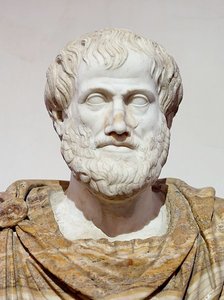
Aristotle's View of Motion
Early ideas about motion were shaped by Aristotle, who distinguished between two types of motion: natural motion and forced motion. Natural motion was thought to occur when objects moved to join similar materials (earth, fire, air, water), while forced motion required a continuous push or pull and would cease when the force stopped.
Natural Motion: Objects move to their 'natural place' based on their composition.
Forced Motion: Requires continuous application of force; objects 'want' to be at rest.
Galileo Galilei and the Concept of Inertia
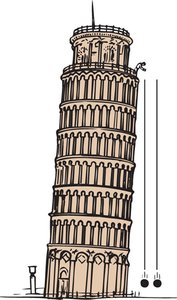
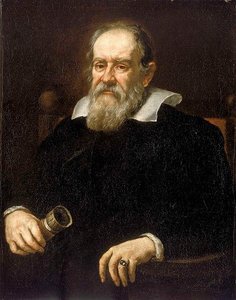
Galileo Galilei challenged Aristotle's ideas through experiments, notably with inclined planes. He introduced the concept of inertia, the tendency of an object to maintain its state of motion unless acted upon by an external force. Galileo also demonstrated that, in the absence of air resistance, all objects fall with the same constant acceleration due to gravity, regardless of mass.
Inertia: The resistance of an object to changes in its state of motion.
Constant Acceleration: All objects experience the same gravitational acceleration when dropped.
Isaac Newton and the Laws of Motion
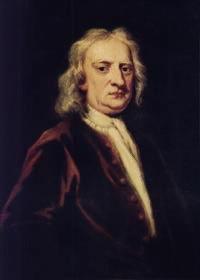
Isaac Newton synthesized earlier work into three fundamental laws that describe the relationship between forces and motion. Newton emphasized that understanding motion requires analyzing all forces acting on an object.
Forces and Their Types
Definition of Force
A force is a push or pull that can cause an object to accelerate, slow down, remain in place, or change direction. Forces are vector quantities, meaning they have both magnitude and direction.
Common Forces: Gravitational, frictional, magnetic, and elastic forces.
Newton's Three Laws of Motion
Newton's First Law (Law of Inertia)
Statement: An object at rest remains at rest, and an object in motion continues in a straight line at constant speed unless acted upon by an unbalanced force.
Inertia: The property of matter to resist changes in motion.
Balanced Forces: When all forces acting on an object sum to zero, the object's motion does not change.
Example: A hockey puck sliding on ice will keep moving in a straight line unless friction or another force acts on it.
Newton's Second Law (Law of Acceleration)
Statement: The acceleration of an object is directly proportional to the net force acting on it and inversely proportional to its mass. The direction of acceleration is the same as the direction of the net force.
Mathematical Form:
Unbalanced Forces: Cause changes in an object's motion (acceleration).
Example: Pushing a shopping cart: the harder you push (greater force), the faster it accelerates; a heavier cart (greater mass) accelerates less for the same force.
Newton's Third Law (Action-Reaction Law)
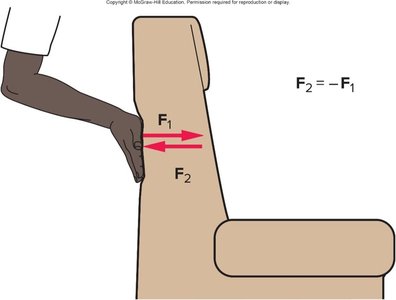
Statement: For every action, there is an equal and opposite reaction. If body A exerts a force on body B, body B exerts an equal and opposite force on body A.
Action-Reaction Pairs: Forces always occur in pairs, acting on different objects.
Example: When you push against a wall, the wall pushes back with equal force.
Normal Force
Definition and Direction
The normal force is the support force exerted by a surface perpendicular to the object resting on it. It balances the object's weight when on a horizontal surface.
Always perpendicular to the contact surface.
Example: A book resting on a table experiences an upward normal force equal in magnitude to its weight.
Friction
Nature and Types of Friction
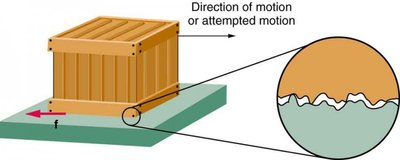
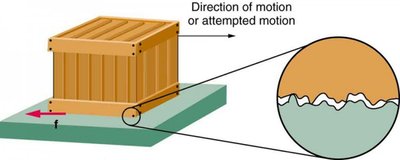
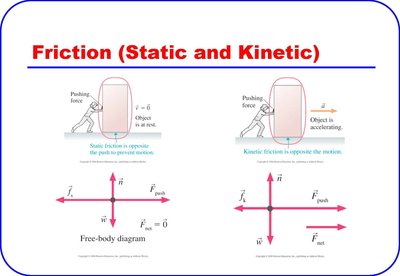
Friction is a force that opposes the relative motion or attempted motion between two surfaces in contact. It depends on the nature of the surfaces and the force pressing them together.
Static Friction: Prevents motion between stationary objects. Must be overcome to start moving an object.
Kinetic Friction: Acts between moving surfaces. Must be overcome to keep an object moving.
Formulas for Friction
Static Friction:
Kinetic Friction:
Where and are the coefficients of static and kinetic friction, and is the normal force.
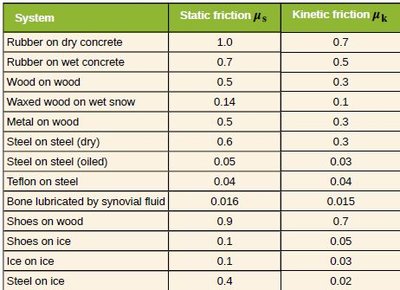
The coefficient of static friction is always greater than the coefficient of kinetic friction for the same surfaces.
Coefficients of Friction: Comparison Table
The following table compares typical values for the coefficients of static and kinetic friction for various material pairs:
System | Static friction | Kinetic friction |
|---|---|---|
Rubber on dry concrete | 1.0 | 0.7 |
Rubber on wet concrete | 0.7 | 0.5 |
Wood on wood | 0.5 | 0.3 |
Waxed wood on wet snow | 0.14 | 0.1 |
Metal on wood | 0.5 | 0.3 |
Steel on steel (dry) | 0.6 | 0.3 |
Steel on steel (oiled) | 0.05 | 0.03 |
Teflon on steel | 0.04 | 0.04 |
Bone lubricated by synovial fluid | 0.016 | 0.015 |
Shoes on wood | 0.9 | 0.7 |
Shoes on ice | 0.1 | 0.05 |
Ice on ice | 0.1 | 0.03 |
Steel on ice | 0.4 | 0.02 |
Mass and Weight
Definitions and Differences
Mass: A measure of the amount of matter in an object. It is constant regardless of location and measured in kilograms (kg).
Weight: The force of gravity acting on an object's mass. It varies with gravitational acceleration and is measured in newtons (N).

Weight Formula
The weight of an object is calculated as:
Where is weight, is mass, and is the acceleration due to gravity (approximately on Earth).
Applications and Problem Solving with Newton's Laws
Balanced and Unbalanced Forces
When forces on an object are balanced (equal in magnitude and opposite in direction), the object does not accelerate. If forces are unbalanced, the object accelerates in the direction of the net force.

Force Diagrams and Vector Addition
Forces are vectors and must be added using vector addition. The net force determines the acceleration according to Newton's Second Law.
Sample Problem: Calculating Mass from Forces and Acceleration
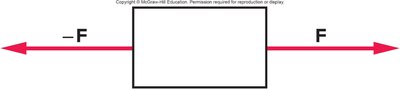
If two forces act in opposite directions on a box and the net force and acceleration are known, the mass can be found using .
Example: If , , and , then and .
Sample Problem: Net Force and Acceleration
Given multiple forces acting on a block, sum the forces vectorially to find the net force, then use to find acceleration.
Equilibrium and Tension
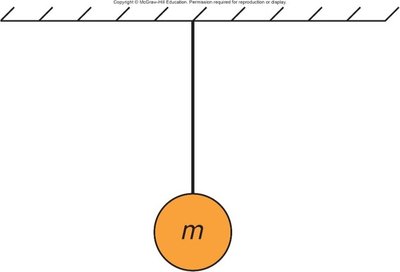
When an object is at rest and suspended by a string, the upward tension balances the downward gravitational force, resulting in zero net force and no acceleration.
Summary Table: Newton's Laws of Motion
Law | Statement | Key Concept |
|---|---|---|
First Law | An object remains at rest or in uniform motion unless acted on by an unbalanced force. | Inertia |
Second Law | The net force on an object equals mass times acceleration. | |
Third Law | For every action, there is an equal and opposite reaction. | Action-Reaction Pairs |
