 Back
BackNewton’s Laws of Motion, Mass, Weight, and Free-Body Diagrams
Study Guide - Smart Notes
 Tailored notes based on your materials, expanded with key definitions, examples, and context.
Newton’s Laws of Motion
Overview of Newton’s Laws
Newton’s Laws of Motion are fundamental principles that describe the relationship between the motion of an object and the forces acting upon it. These laws form the basis for classical mechanics and are essential for understanding the behavior of objects in various physical situations.
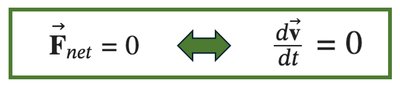
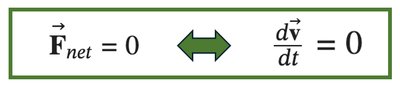
Newton’s First Law (Law of Inertia): An object at rest remains at rest, and an object in motion continues in motion with constant velocity unless acted upon by a net external force.
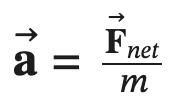
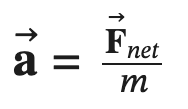
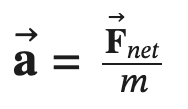
Newton’s Second Law: The acceleration of an object is directly proportional to the net force acting on it and inversely proportional to its mass.
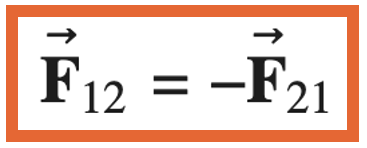
Newton’s Third Law: For every action, there is an equal and opposite reaction.
Mathematical Formulation
First Law (Equilibrium Condition):
Second Law (Force and Acceleration):
Third Law (Action-Reaction):
Mass and Weight
Definitions and Distinctions
Mass is a measure of the amount of matter in an object and characterizes its resistance to acceleration (inertia). The SI unit of mass is the kilogram (kg).
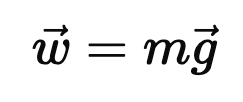
Weight is the gravitational force exerted on an object by a planet, moon, or star. The SI unit of weight is the newton (N).
Formula for Weight:
Weight varies with location due to changes in the local gravitational acceleration .
Examples and Applications
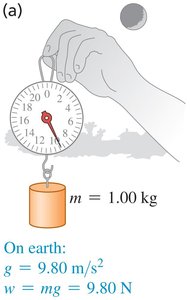
On Earth, .
The weight of a 1.00 kg mass on Earth is .
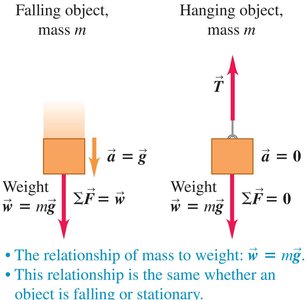
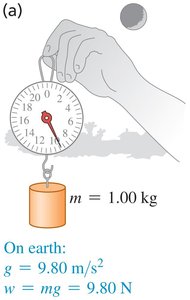
Example: The weight of an object on the Moon is less than on Earth because the Moon's gravitational acceleration is smaller.
Mass vs. Weight: Vehicle Example
Given the same force, a vehicle with less mass (e.g., a Mini-Cooper) will experience greater acceleration than a heavier vehicle (e.g., a Hummer).


Newton’s Third Law: Action/Reaction Pairs
Understanding Action-Reaction Forces
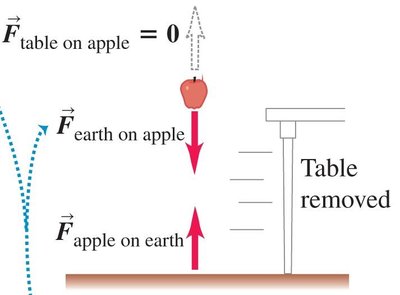
Newton’s Third Law states that forces always occur in pairs. If object A exerts a force on object B, then object B exerts an equal and opposite force on object A. These forces act on different objects and never cancel each other out.
Action/Reaction Pair Example: The force of a table on an apple and the force of the apple on the table.

Free-Body Diagrams
Purpose and Construction
A free-body diagram is a graphical representation used to visualize the forces acting on a single object. It is a crucial tool for solving problems involving forces and motion.
Represent the object as a point or simple shape.
Draw all forces acting on the object (not forces the object exerts on others).
Choose coordinate axes to simplify force components.
Sum forces in each direction to find the net force.
If the object is in equilibrium (constant velocity):
If the object is accelerating:
Worked Example: Lifting a Block
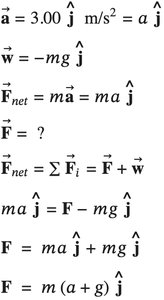
Given: A block of mass is lifted upward with acceleration .
Forces: Upward force , downward gravitational force .
Net force:
Newton’s Second Law:
Systematic Approach to Free-Body Diagrams
Identify the object of interest.
Draw all forces acting on the object.
Resolve forces into components along chosen axes.
Apply Newton’s laws to solve for unknowns.
Equilibrium and Forces in Multiple-Object Systems
Equilibrium Condition
An object is in equilibrium if the net force acting on it is zero, resulting in zero acceleration. This can occur if the object is at rest or moving with constant velocity.
Mathematically:
Multiple-Object Systems and Friction
When analyzing systems with multiple objects (e.g., blocks in contact), consider all forces acting on each object separately.
Friction and drag forces must be included if present, as they affect the net force and equilibrium conditions.
Summary Table: Newton’s Laws and Applications
Law | Statement | Mathematical Form | Application Example |
|---|---|---|---|
First Law | Object remains at rest or in uniform motion unless acted on by a net force | Book on a table | |
Second Law | Net force causes acceleration proportional to mass | Car accelerating when engine applies force | |
Third Law | For every action, equal and opposite reaction | Rocket propulsion |
Additional info: The notes also emphasize the importance of being systematic and organized when constructing free-body diagrams and solving force problems, as well as the need to identify the source of each force acting on an object.
