 Back
BackNewton’s Third Law and Interacting Objects: Step-by-Step Guidance
Study Guide - Smart Notes
 Tailored notes based on your materials, expanded with key definitions, examples, and context.
Q1. What is the magnitude of the force that the 6.00-kg block exerts on the 4.00-kg block?
Background
Topic: Newton's Third Law & Interacting Objects
This question tests your understanding of how forces are transmitted between objects in contact, specifically using Newton's third law and Newton's second law to analyze the interaction between two blocks on a frictionless surface.
Key Terms and Formulas
Newton's Third Law: For every action, there is an equal and opposite reaction.
Newton's Second Law:
System: Both blocks together
Force transmitted: The force that one block exerts on the other
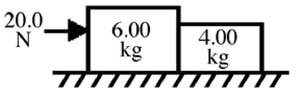
Step-by-Step Guidance
First, consider the two blocks as a single system. The total mass is .
Apply Newton's second law to the system: where .
Solve for the acceleration of the system: .
Now, focus on the 4.00-kg block. The only horizontal force acting on it is the force from the 6.00-kg block. Use Newton's second law for the 4.00-kg block: .
Try solving on your own before revealing the answer!
Final Answer: 8.00 N
The 6.00-kg block exerts a force of 8.00 N on the 4.00-kg block, which is what causes it to accelerate.
Q2. What is the acceleration of the 2.0-kg block?
Background
Topic: Interacting Objects with Pulleys and Friction
This question tests your ability to analyze a system of three masses connected by strings and pulleys, including the effect of kinetic friction on one block.
Key Terms and Formulas
Newton's Second Law:
Kinetic friction force:
Acceleration constraint: All connected masses accelerate together
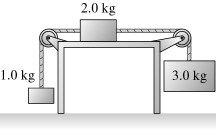
Step-by-Step Guidance
Draw free-body diagrams for each block. Identify all forces: gravity, tension, and friction (for the 2.0-kg block).
Write Newton's second law for each block. For the 2.0-kg block, include the friction force: .
For the hanging blocks, write: and .
Express the friction force: .
Set up the system of equations and combine them to solve for (the acceleration).
Try solving on your own before revealing the answer!
Final Answer: 1.7 m/s2
After substituting values and solving the equations, the acceleration of the 2.0-kg block is 1.7 m/s2.
This result accounts for the net force from both hanging masses and the friction acting on the block.
Q3. What mass should block B have in order to start block A sliding up the plane?
Background
Topic: Static Friction and Inclined Planes with Pulleys
This question tests your understanding of the conditions required to overcome static friction and initiate motion up an inclined plane, using Newton's laws and friction concepts.
Key Terms and Formulas
Static friction force:
Newton's Second Law: (here, at the threshold)
Components of forces along the incline
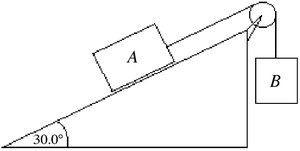
Step-by-Step Guidance
Draw free-body diagrams for both blocks. For block A, resolve forces parallel and perpendicular to the incline.
Calculate the normal force on block A: .
Find the maximum static friction: .
Set up the force balance along the incline: The tension must overcome both gravity (down the incline) and static friction to start motion up.
Relate the tension to the weight of block B: (assuming massless, frictionless pulley).
Try solving on your own before revealing the answer!
Final Answer: 2.7 kg
By setting up the force balance and solving for , you find the minimum mass needed to overcome static friction and gravity.
This ensures block A just begins to move up the incline.
Q4. Two objects are connected by a very light flexible string as shown. (a) Draw free-body diagrams for each object. (b) Calculate the magnitude of the acceleration of each object. (c) Calculate the tension in the string.
Background
Topic: Atwood Machine (Massless Pulley, Massless String)
This question tests your ability to analyze a classic Atwood machine setup, using Newton's laws to find acceleration and tension.
Key Terms and Formulas
Newton's Second Law:
Acceleration constraint: Both masses accelerate together
Tension in the string:
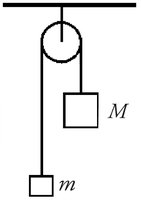
Step-by-Step Guidance
Draw free-body diagrams for both masses. For mass , forces are (down) and (up). For mass , forces are (down) and $T$ (up).
Write Newton's second law for each mass: and .
Add the two equations to eliminate and solve for .
Once is found, substitute back to solve for .
Try solving on your own before revealing the answer!
Final Answer: (a) Free-body diagrams as described; (b) ; (c)
By solving the system, you find the acceleration and tension for the given masses.
The free-body diagrams show the forces acting on each mass.
Q5. The figure shows a 100-kg block being released from rest from a height of 1.0 m. It then takes it 0.90 s to reach the floor. What is the mass m of the other block? The pulley has no appreciable mass or friction.
Background
Topic: Dynamics of Pulley Systems (Kinematics and Newton's Laws)
This question tests your ability to combine kinematics and dynamics to solve for an unknown mass in a pulley system, given time and distance.
Key Terms and Formulas
Kinematic equation: (since initial velocity is zero)
Newton's Second Law for each mass
Acceleration constraint: Both masses accelerate together
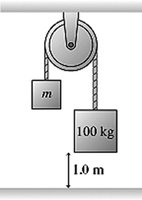
Step-by-Step Guidance
Use the kinematic equation to solve for the acceleration: .
Write Newton's second law for both masses: and .
Add the equations to eliminate and solve for .
Substitute the value of found from the kinematic equation.
Try solving on your own before revealing the answer!
Final Answer: 54 kg
By combining the kinematic and dynamic equations, you solve for the unknown mass .
This ensures the system accelerates so the 100-kg block falls 1.0 m in 0.90 s.
