 Back
BackOhm’s Law, Resistors, and DC Circuits: Study Notes
Study Guide - Smart Notes
 Tailored notes based on your materials, expanded with key definitions, examples, and context.
Ohm’s Law and Resistance
Introduction to Ohm’s Law
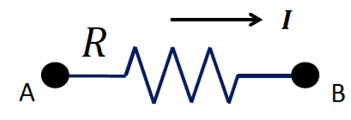
Ohm’s Law is a fundamental principle in physics that describes the relationship between voltage, current, and resistance in an electrical circuit. It is essential for analyzing and designing electrical circuits.
Ohm’s Law Statement: The current (I) through a conductor between two points is directly proportional to the voltage (V) across the two points, provided the temperature remains constant.
Mathematical Form: , where is the resistance.
Resistance (R): The property of a material that resists the flow of electric current, causing energy dissipation as heat.
Unit: Ohm (Ω)
Physical Meaning: Resistance is analogous to friction for electric charges moving through a conductor.

Types of Resistors
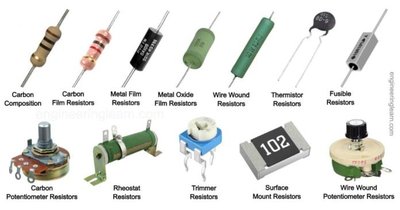
Resistors are components used to control current in circuits. They come in various types, each with specific applications and characteristics.
Carbon Composition, Carbon Film, Metal Film, Metal Oxide Film, Wire Wound: Common fixed-value resistors for general circuit applications.
Thermistors: Resistors whose resistance changes significantly with temperature.
Fusible Resistors: Act as both resistor and fuse, protecting circuits from overcurrent.
Potentiometers, Rheostats, Trimmers: Variable resistors used for tuning and calibration.
Surface Mount Resistors: Compact resistors for modern electronic devices.
Resistors in Series and Parallel
Series Connection
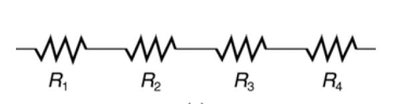
When resistors are connected end-to-end, they are in series. The same current flows through each resistor, and the total resistance is the sum of individual resistances.
Equivalent Resistance:
Voltage Division: The total voltage is divided among the resistors in proportion to their resistances.

Parallel Connection
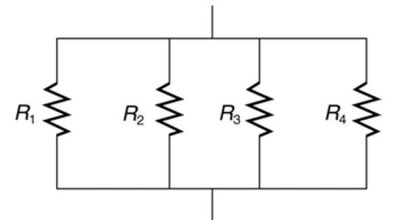
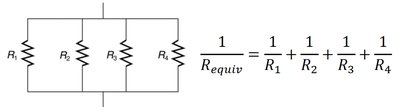
When resistors are connected across the same two points, they are in parallel. The voltage across each resistor is the same, but the total current is divided among the parallel branches.
Equivalent Resistance:
Current Division: The total current is the sum of the currents through each resistor.
Kirchhoff’s Rules
Current Node Rule (Kirchhoff’s Current Law)
At any junction (node) in an electrical circuit, the sum of currents entering the node equals the sum of currents leaving the node.
Mathematical Form:
Application: Used to analyze complex circuits with multiple branches.
Loop Rule (Kirchhoff’s Voltage Law)
The sum of the potential differences (voltage) around any closed loop in a circuit is zero. This is a statement of energy conservation in electrical circuits.
Mathematical Form:
Application: Used to solve for unknown voltages and currents in multi-loop circuits.
Practical Applications: Household Circuits and Safety
Household Circuits
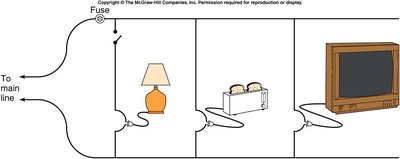
Household electrical wiring typically uses parallel circuits to ensure that each device receives the same voltage and can operate independently.
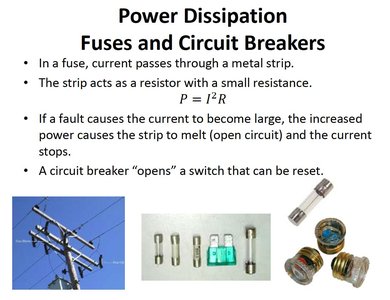
Fuses and Circuit Breakers: Protect circuits from excessive current by breaking the circuit if the current exceeds a safe value.
Common Hazards: Overloading outlets, short circuits, and ground faults can cause excessive current and potential fire hazards.
Real vs. Ideal Batteries
Internal Resistance
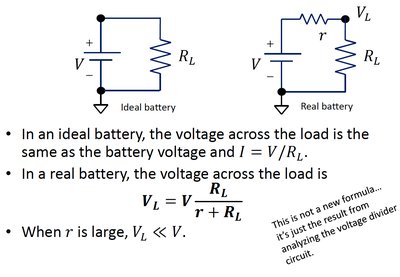
Real batteries have internal resistance, which causes the terminal voltage to drop when current is drawn. Ideal batteries are assumed to have zero internal resistance.
Terminal Voltage: where is the emf and is the internal resistance.
Power Dissipation: Some power is lost as heat inside the battery due to internal resistance.
Joule’s Law and Power Dissipation
Joule’s Law
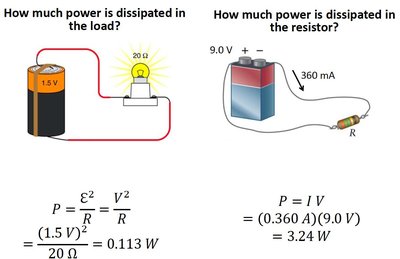
Joule’s Law relates the power dissipated in a resistor to the current and voltage across it.
Power Formula:
Application: Used to calculate the energy converted to heat in resistors and other circuit elements.
Fuses and Circuit Breakers
Fuses and circuit breakers are safety devices that protect electrical circuits from excessive current, which can cause overheating and fires.
Fuse: Contains a thin wire that melts and breaks the circuit if the current is too high.
Circuit Breaker: A switch that automatically opens the circuit when excessive current is detected and can be reset.
Summary Table: Series vs. Parallel Resistors
Property | Series | Parallel |
|---|---|---|
Current | Same through all resistors | Divided among branches |
Voltage | Divided among resistors | Same across all resistors |
Equivalent Resistance |
Example: In a household circuit, devices are connected in parallel so that each receives the full voltage and can be operated independently. Fuses and circuit breakers are used to prevent excessive current that could damage devices or cause fires.
