 Back
BackPHYS 201 Exam 2 – Step-by-Step Physics Guidance (Chapters 5–7)
Study Guide - Smart Notes
 Tailored notes based on your materials, expanded with key definitions, examples, and context.
Q8. A car drives at a constant speed over a semicircular hill with radius of curvature R = 100 m. What is the fastest speed the car can have without losing contact with the road?
Background
Topic: Circular Motion and Centripetal Force
This question tests your understanding of the forces acting on an object moving in a vertical circle, specifically the condition for maintaining contact with the surface at the top of the hill.
Key Terms and Formulas
Centripetal Force: The net force required to keep an object moving in a circle of radius at speed is .
Normal Force (): The force exerted by the surface on the object, which becomes zero when the object is just about to lose contact.
Gravitational Force (): The weight of the car acts downward.
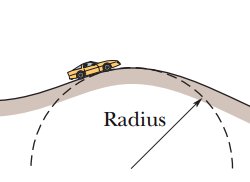
Step-by-Step Guidance
Draw a free-body diagram for the car at the top of the hill. Identify the forces acting: gravity () downward and normal force () upward from the road.
At the point where the car is about to lose contact, the normal force becomes zero. The only force providing the centripetal acceleration is gravity.
Set up Newton's second law for circular motion at the top: .
Notice that the mass cancels out, and you can solve for the maximum speed in terms of and .
Try solving on your own before revealing the answer!
Final Answer: 31.3 m/s
This is the maximum speed at which the car can go over the hill without losing contact with the road.
Q18. A 2.0 kg block is moved from rest by a compressed spring of spring constant 800 N/m. The block leaves the spring at the spring’s relaxed length and then travels over a horizontal floor with a coefficient of kinetic friction µk = 0.3. Friction brings the block to a stop after it has traveled a distance D = 6.0 m over the floor. By how much was the spring initially compressed?
Background
Topic: Work, Energy, and Friction
This question tests your ability to apply the work-energy principle, including the conversion of elastic potential energy to work done against friction.
Key Terms and Formulas
Elastic Potential Energy: where is the spring constant and is the compression.
Work Done by Friction:
Work-Energy Principle: The initial energy stored in the spring is used to do work against friction.
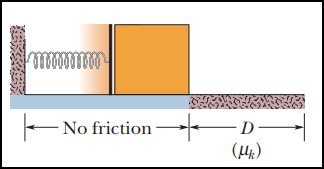
Step-by-Step Guidance
Write the energy conservation equation: The initial spring energy equals the work done against friction.
Set up the equation: .
Plug in the known values: , , , , .
Rearrange the equation to solve for (the initial compression of the spring).
Try solving on your own before revealing the answer!
Final Answer: 0.39 m
This is the amount the spring was initially compressed to provide enough energy to overcome friction over the given distance.
