Back
BackPHYS 202 Exam II Study Guidance: Electric Potential, Circuits, Capacitance, and Electric Fields
Study Guide - Smart Notes
 Tailored notes based on your materials, expanded with key definitions, examples, and context.
Q1. (Electric Potential) Calculate the magnitude of the potential difference between points A and B due to a 500.0 μC point charge.
Background
Topic: Electric Potential due to Point Charges
This question tests your understanding of how to calculate the electric potential at a point in space due to a point charge, and how to find the potential difference between two points.
Key Terms and Formulas:
Electric potential due to a point charge:
Potential difference:
N·m²/C² (Coulomb's constant)
= charge, = distance from the charge
Step-by-Step Guidance
Identify the distances from the point charge to points A and B ( and ).
Calculate the potential at point A:
Calculate the potential at point B:
Set up the expression for the potential difference:
Try solving on your own before revealing the answer!
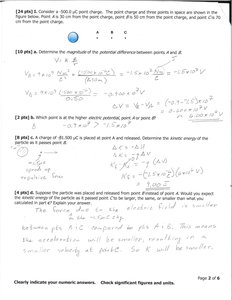
Q2. (Electric Potential) Which point is at the higher electric potential, point A or point B?
Background
Topic: Electric Potential Comparison
This question checks your understanding of how electric potential changes with distance from a point charge.
Key Terms and Formulas:
Electric potential decreases as distance from a positive point charge increases.
Use to compare values at different points.
Step-by-Step Guidance
Recall that for a positive charge, the closer point has a higher potential.
Compare the distances and to the charge.
Determine which point is closer and thus at higher potential.
Try solving on your own before revealing the answer!
Q3. (Electric Potential Energy) A charge of 50.0 μC is placed at point A and released. Determine its initial energy of interaction with the point charge.
Background
Topic: Electric Potential Energy
This question tests your ability to calculate the potential energy of a system of point charges.
Key Terms and Formulas:
Potential energy:
Where is the test charge and is the potential at the location due to the other charge.
Step-by-Step Guidance
Calculate the electric potential at point A due to the 500.0 μC charge:
Multiply the result by the test charge:
Try solving on your own before revealing the answer!
Q4. (Electric Force and Motion) Suppose the particle was placed and released from point A instead of point B. Would you expect the particle to move toward or away from the point charge? Explain using the concept of electric potential energy.
Background
Topic: Electric Potential Energy and Particle Motion
This question tests your understanding of how a charged particle moves in an electric field, based on potential energy considerations.
Key Terms and Formulas:
Particles move from higher to lower potential energy if free to move.
For like charges, the force is repulsive; for opposite charges, attractive.
Step-by-Step Guidance
Determine the sign of the test charge and the source charge.
Recall that a positive charge moves from higher to lower potential (away from a positive source charge).
Explain the direction of motion based on the potential energy gradient.
Try solving on your own before revealing the answer!
Q5. (Resistive Heating) A heater is designed to use 500 W when connected to 120 V. The heater uses a copper wire of length 4.0 m and diameter 0.50 mm. The resistivity of copper is Ω·m. Determine the current in the heater.
Background
Topic: Electric Circuits and Power
This question tests your ability to relate power, voltage, and current in an electric circuit.
Key Terms and Formulas:
Power:
Current:
Step-by-Step Guidance
Identify the given values: W, V.
Use the formula to set up the calculation for current.
Try solving on your own before revealing the answer!
Q6. (Resistive Heating) Determine the length of the wire used by the heater.
Background
Topic: Resistance of a Wire
This question tests your understanding of how to calculate the resistance of a wire and relate it to its physical dimensions.
Key Terms and Formulas:
Resistance:
Area of a wire:
Power:
Step-by-Step Guidance
Calculate the resistance using .
Find the cross-sectional area using the wire's diameter.
Rearrange to solve for .
Try solving on your own before revealing the answer!
Q7. (Capacitance) Pacemakers deliver a current to the heart by charging a capacitor and then discharging it. Calculate the capacitance of both capacitors (one with air gap, one with dielectric).
Background
Topic: Capacitance and Dielectrics
This question tests your ability to calculate the capacitance of parallel-plate capacitors, both with and without a dielectric material.
Key Terms and Formulas:
Capacitance (air):
Capacitance (dielectric):
F/m (permittivity of free space)
= dielectric constant
Step-by-Step Guidance
Identify the area and separation for each capacitor.
For the air-gap capacitor, use .
For the dielectric capacitor, use .
Try solving on your own before revealing the answer!
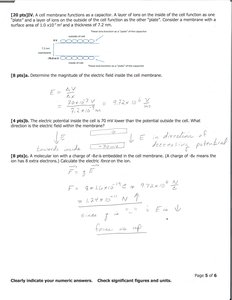
Q8. (Cell Membrane as Capacitor) Determine the magnitude of the electric field inside the cell membrane.
Background
Topic: Electric Field in a Capacitor
This question tests your understanding of the relationship between electric field, potential difference, and distance in a parallel-plate capacitor (or membrane).
Key Terms and Formulas:
Electric field:
= potential difference, = thickness of membrane
Step-by-Step Guidance
Identify the potential difference across the membrane and its thickness .
Set up the formula to calculate the electric field.
Try solving on your own before revealing the answer!
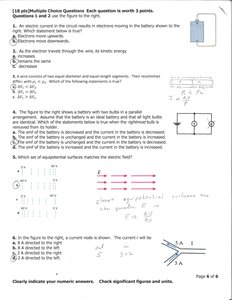
Q9. (Multiple Choice) An electric current in the circuit results in electrons moving in the battery shown to the right. Which statement is true?
Background
Topic: Electric Current and Circuits
This question tests your understanding of the direction of electron flow and conventional current in a simple circuit.
Key Terms and Formulas:
Conventional current flows from positive to negative terminal.
Electrons flow from negative to positive terminal.
Step-by-Step Guidance
Recall the definitions of conventional current and electron flow.
Analyze the battery diagram to determine the direction of electron movement.
Try solving on your own before revealing the answer!