 Back
BackPhysics 10310 Exam #1 – Step-by-Step Guidance for Selected Questions
Study Guide - Smart Notes
 Tailored notes based on your materials, expanded with key definitions, examples, and context.
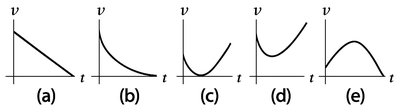
MC1. A stone is thrown at an angle above the horizontal and feels negligible air resistance. Which of the graphs below best depicts the stone’s speed v as a function of time while in the air?
Background
Topic: Projectile Motion
This question tests your understanding of how the speed of a projectile changes over time when air resistance is negligible. The stone is thrown at an angle, so its motion can be analyzed using the principles of kinematics and energy conservation.
Key Terms and Concepts:
Projectile motion: The motion of an object thrown into the air, subject only to gravity.
Speed: The magnitude of the velocity vector; always positive.
Negligible air resistance: Only gravity acts on the stone after it is thrown.
Step-by-Step Guidance
Recall that the stone’s velocity has both horizontal and vertical components. The horizontal component remains constant, while the vertical component changes due to gravity.
At launch, the stone has its maximum speed, which is the vector sum of its initial horizontal and vertical components.
As the stone rises, its vertical speed decreases due to gravity, reaching zero at the peak of its trajectory. The horizontal speed remains unchanged.
After the peak, the vertical speed increases in the downward direction, and the total speed increases again until just before impact.
Try solving on your own before revealing the answer!
Final Answer: Graph (e)
The speed decreases as the stone rises, reaches a minimum at the peak, and then increases as it falls, matching the shape of graph (e).
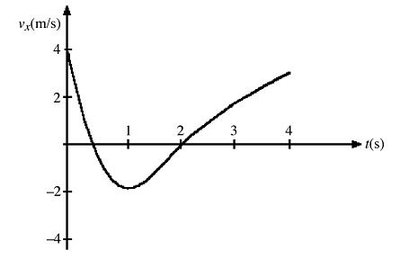
MC3. The figure to the right represents the velocity of a particle as it travels along the x-axis. At what value (or values) of t is the instantaneous acceleration equal to zero?
Background
Topic: Kinematics – Velocity and Acceleration
This question tests your ability to interpret a velocity vs. time graph and determine when the acceleration (the slope of the velocity graph) is zero.
Key Terms and Concepts:
Instantaneous acceleration: The rate of change of velocity at a specific instant; mathematically, it is the slope of the velocity vs. time graph.
Velocity vs. time graph: Shows how the velocity of an object changes over time.
Step-by-Step Guidance
Examine the graph and identify points where the slope (rate of change of velocity) is zero. These are points where the graph is flat (horizontal tangent).
Look for local minima or maxima on the graph, as these are typically where the slope is zero.
Estimate the time values at which these points occur by checking the t-axis.
Try solving on your own before revealing the answer!
Final Answer: t = 0.5 s and t = 2 s
At these times, the velocity graph has horizontal tangents, indicating zero instantaneous acceleration.
