 Back
BackPhysics 140 Practice Exam 2 – Step-by-Step Guidance for Questions 1–3
Study Guide - Smart Notes
 Tailored notes based on your materials, expanded with key definitions, examples, and context.
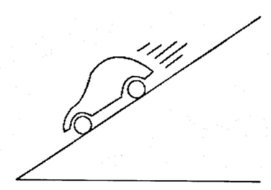
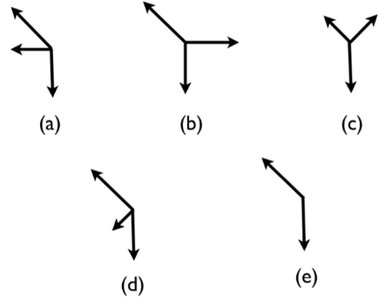
Q1. Which of the following free-body diagrams represents the car going downhill at constant speed (as depicted in the picture)?
Background
Topic: Newton's Laws of Motion, Free-Body Diagrams
This question tests your understanding of how to represent forces acting on an object (the car) moving at constant speed down an incline. You need to identify which diagram correctly shows the balance of forces.
Key Terms and Concepts:
Free-body diagram: A graphical illustration used to visualize the forces acting on an object.
Constant speed: Implies zero acceleration, so the net force on the car must be zero (Newton's First Law).
Forces involved: Gravity (down the incline), normal force (perpendicular to the surface), and friction or another force balancing gravity's component along the incline.
Step-by-Step Guidance
Recall that if the car is moving at constant speed, the net force along the direction of motion (down the incline) must be zero.
Identify the forces acting on the car: gravitational force (downward), normal force (perpendicular to the surface), and friction or another force (up the incline).
Decompose the gravitational force into components parallel and perpendicular to the incline.
Look for the diagram where the forces along the incline are balanced (the force up the incline equals the component of gravity down the incline).
Try solving on your own before revealing the answer!
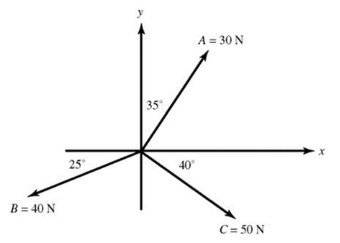
Q2. Three forces A, B, and C act on a body, as shown. A fourth force F is required to keep the body at rest. What is the x-component of force F?
Background
Topic: Vector Addition, Equilibrium of Forces
This question tests your ability to resolve forces into components and apply the condition for equilibrium (net force is zero).
Key Terms and Formulas:
Equilibrium: The sum of all forces in each direction (x and y) must be zero.
Force components: ,
Step-by-Step Guidance
Write the x-components of each force using their magnitudes and angles from the x-axis.
Sum the x-components of forces A, B, and C.
Set the sum of all x-components (including F) equal to zero, since the body is at rest.
Solve for the x-component of force F needed to balance the other forces.
Try solving on your own before revealing the answer!
Q3. A Physics 140 student and his little brother are taking a sleeper Amtrak train across the continent. At night, the student sees his brother’s toy hanging motionless at an angle to the vertical. The student is puzzled: the sum of the forces is not zero, yet the toy has zero acceleration. How can you resolve this conceptual difficulty?
Background
Topic: Newton's Laws, Non-inertial Reference Frames
This question tests your understanding of reference frames and apparent forces when analyzing equilibrium in accelerating systems.
Key Terms and Concepts:
Inertial frame: A frame of reference that is not accelerating; Newton's laws apply directly.
Non-inertial frame: A frame that is accelerating; fictitious (inertial) forces may need to be considered.
Equilibrium: In a non-inertial frame, apparent forces can make the sum of real forces appear nonzero.
Step-by-Step Guidance
Consider why the toy hangs at an angle: this suggests there is a horizontal acceleration of the train.
Think about the forces acting on the toy: gravity (downward) and tension (at an angle).
In the train’s frame (which is accelerating), the sum of the real forces is not zero, but the toy is stationary relative to the train.
Recall that in a non-inertial frame, you must introduce a fictitious force to account for the acceleration of the frame.
Try solving on your own before revealing the answer!
