Back
BackPhysics 207 Exam #1 Study Guidance: Electric Fields, Capacitors, Potential Energy, and Circuits
Study Guide - Smart Notes
 Tailored notes based on your materials, expanded with key definitions, examples, and context.
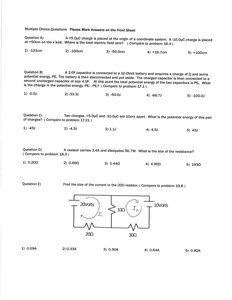
Q1. Where is the total electric field zero between a +5.0μC charge at the origin and a -10.0μC charge at +50cm on the x-axis?
Background
Topic: Electric Fields from Point Charges
This question tests your understanding of how electric fields from multiple point charges combine and how to find the location where their fields cancel each other out.
Key Terms and Formulas
Electric field from a point charge:
Superposition principle: The total electric field is the vector sum of fields from each charge.
is Coulomb's constant:
Step-by-Step Guidance
Set up the coordinate system: Place the +5.0μC charge at and the -10.0μC charge at m.
Let be the location where the electric field is zero. Write expressions for the electric field at $x$ due to each charge.
Remember that the direction of the field depends on the sign of the charge: positive charges create fields pointing away, negative charges create fields pointing toward them.
Set the sum of the fields equal to zero: .
Write the equation and solve for , but stop before plugging in the final values.
Try solving on your own before revealing the answer!
Q2. What is the change in potential energy when a charged 2.0F capacitor (initially at 10V) is connected to an uncharged 4.0F capacitor?
Background
Topic: Capacitors, Energy Conservation, and Charge Redistribution
This question tests your understanding of how energy changes when capacitors are connected and charge is redistributed.
Key Terms and Formulas
Initial energy:
Final energy:
Conservation of charge:
Final voltage:
Step-by-Step Guidance
Calculate the initial energy stored in the first capacitor using .
After connecting, use conservation of charge to find the total charge: .
Find the final voltage across both capacitors: .
Calculate the final energy: .
Set up the expression for the change in energy: , but do not compute the final value.
Try solving on your own before revealing the answer!
Q3. What is the potential energy of a pair of charges (+5.0μC and -10.0μC) separated by 10cm?
Background
Topic: Electrostatic Potential Energy
This question tests your ability to calculate the potential energy between two point charges.
Key Terms and Formulas
Potential energy:
is Coulomb's constant
and are the charges, is the separation distance
Step-by-Step Guidance
Identify the values: , , m.
Convert microcoulombs to coulombs: C.
Plug the values into the formula: .
Set up the calculation, but stop before computing the final value.
Try solving on your own before revealing the answer!
Q4. A resistor carries 3.4A and dissipates 56.7W. What is the resistance?
Background
Topic: Power Dissipation in Resistors
This question tests your understanding of the relationship between current, power, and resistance.
Key Terms and Formulas
Power:
is current, is resistance
Step-by-Step Guidance
Identify the known values: A, W.
Rearrange the formula to solve for resistance: .
Set up the calculation, but do not compute the final value.
Try solving on your own before revealing the answer!
Q5. Find the size of the current in the 200Ω resistor in the given circuit.
Background
Topic: Series and Parallel Circuits, Ohm's Law
This question tests your ability to analyze a circuit and apply Ohm's Law to find the current through a specific resistor.
Key Terms and Formulas
Ohm's Law:
Kirchhoff's Rules: Used to analyze complex circuits
Equivalent resistance for series and parallel combinations
Step-by-Step Guidance
Identify the configuration of the circuit: note the voltage sources and resistors.
Determine if the resistors are in series or parallel and find the equivalent resistance.
Apply Kirchhoff's rules or Ohm's Law to set up the equations for current.
Set up the calculation for the current in the 200Ω resistor, but stop before computing the final value.
Try solving on your own before revealing the answer!