 Back
BackPHYSICS 210 Exam 2 Practice – Step-by-Step Study Guidance
Study Guide - Smart Notes
 Tailored notes based on your materials, expanded with key definitions, examples, and context.
Q1. What is Newton’s 1st Law?
Background
Topic: Newton's Laws of Motion
This question tests your understanding of Newton's First Law, also known as the Law of Inertia. It is foundational for classical mechanics and describes the behavior of objects when no net force acts upon them.
Key Terms:
Inertia: The tendency of an object to resist changes in its state of motion.
Net Force: The vector sum of all forces acting on an object.
Step-by-Step Guidance
Recall the definition of Newton's First Law and what it says about objects at rest and in motion.
Think about what happens to an object if the net force acting on it is zero.
Consider how this law applies to both stationary and moving objects.
Try explaining the law in your own words before checking the answer!
Final Answer:
Newton’s First Law states that an object at rest remains at rest, and an object in motion continues in motion with constant velocity (in a straight line), unless acted upon by a net external force.
This means that motion (or lack of motion) will not change unless a force causes it to change.
Q2. Determine the center(s) of mass for the following system of particles.
Background
Topic: Center of Mass
This question tests your ability to calculate the center of mass for a system of discrete particles, given their positions and masses.
Key Terms and Formulas:
Center of Mass (COM): The average position of all the mass in a system, weighted by mass.
For particles at positions with masses :
Step-by-Step Guidance
List the coordinates and masses for each particle from the diagram.
Calculate the sum of the masses: .
Multiply each mass by its -coordinate and sum: .
Multiply each mass by its -coordinate and sum: .
Set up the formulas for and using the sums above, but do not compute the final values yet.
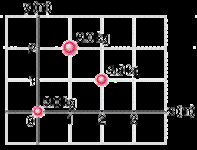
Try setting up the sums and formulas before calculating the final center of mass!
Final Answer:
The center of mass coordinates are:
Plug in the values and simplify to find the numerical coordinates of the center of mass.
Q3. A 1200 kg car travelling initially at 25 m/s comes to a full stop within 10 seconds upon applying the brakes. Find the amount of force applied by the brakes.
Background
Topic: Newton's Second Law & Kinematics
This question tests your ability to relate force, mass, and acceleration, and to use kinematic information to find acceleration.
Key Terms and Formulas:
Newton's Second Law:
Acceleration:
Step-by-Step Guidance
Identify the initial velocity ( m/s), final velocity ( m/s), and time interval ( s).
Calculate the acceleration using .
Use Newton's Second Law, , with the car's mass and the calculated acceleration.
Remember, the force will be negative, indicating it acts opposite to the motion.
Try calculating the acceleration and setting up the force equation before solving for the force!
Final Answer:
The force applied by the brakes is:
m/s
N
The negative sign indicates the force is directed opposite to the car's motion.
Q4. Which is an example of Newton’s 3rd Law?
Background
Topic: Newton's Third Law of Motion
This question tests your understanding of action-reaction force pairs.
Key Terms:
Action-Reaction Pair: For every action, there is an equal and opposite reaction.
Step-by-Step Guidance
Recall that Newton's Third Law involves two forces acting on two different objects.
For each answer choice, ask: Are these forces acting on different objects and are they equal and opposite?
Eliminate choices where both forces act on the same object or are not a true action-reaction pair.
Try identifying the correct action-reaction pair before checking the answer!
Final Answer:
The correct example is: Normal Force-Weight. The normal force is the reaction to the weight of the object pressing down on a surface.
Q5. A box with a weight of 100 N is in motion. It is then pulled by a 30 N horizontal force. Is this enough force to get it to keep moving?
Background
Topic: Friction and Forces
This question tests your understanding of static and kinetic friction, and how to determine if a force is sufficient to overcome friction and keep an object moving.
Key Terms and Formulas:
Static Friction (): (maximum value before motion starts)
Kinetic Friction (): (once the object is moving)
Normal Force (): For a horizontal surface, (weight)
Step-by-Step Guidance
Identify the coefficients of static () and kinetic () friction from the diagram.
Calculate the maximum static friction force: .
Calculate the kinetic friction force: .
Compare the applied force (30 N) to the friction forces to determine if the box will keep moving.
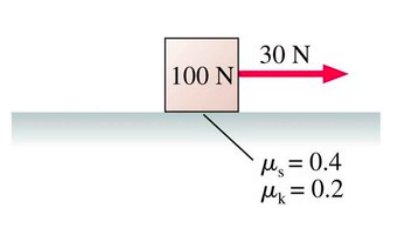
Try calculating the friction forces and comparing to the applied force before checking the answer!
Final Answer:
Maximum static friction: N. Kinetic friction: N. Since 30 N > 20 N, the box will keep moving once in motion.
Q6. Suppose you have a 2kg mass hanging on a spring. The resting position of the hanged mass ends up at 10 cm from the equilibrium position. What is the spring constant, k?
Background
Topic: Hooke's Law and Equilibrium
This question tests your ability to use Hooke's Law to relate the force exerted by a spring to its displacement and to solve for the spring constant.
Key Terms and Formulas:
Hooke's Law:
Equilibrium: At rest, the spring force balances the weight:
Step-by-Step Guidance
Identify the mass ( kg), displacement ( cm = 0.10 m), and acceleration due to gravity ( m/s).
Set up the equilibrium equation: .
Rearrange to solve for : .
Plug in the values, but do not compute the final value yet.
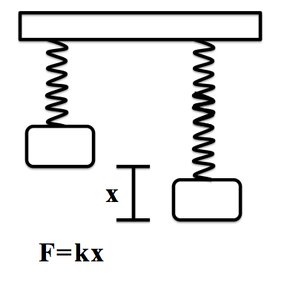
Try setting up the equation and plugging in the values before calculating k!
Final Answer:
N/m
The spring constant is 196 N/m.
Q7. A block of mass m is accelerated across a rough surface by a force of magnitude F that is exerted at an angle Φ with the horizontal, as shown above. The frictional force on the block exerted by the surface has magnitude f. What is the horizontal acceleration of the block?
Background
Topic: Forces on an Inclined Plane and Friction
This question tests your ability to resolve forces into components and apply Newton's Second Law in the presence of friction.
Key Terms and Formulas:
Newton's Second Law:
Force Components: (horizontal), (vertical)
Friction Force: (given)
Step-by-Step Guidance
Resolve the applied force into horizontal () and vertical () components.
Write the net horizontal force: .
Apply Newton's Second Law: .
Set up the equation for acceleration: .
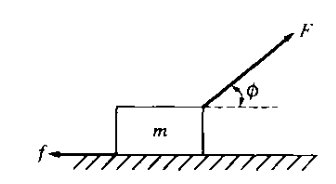
Try writing out the force components and setting up the acceleration equation before calculating!
Final Answer:
This gives the horizontal acceleration of the block.
Q8. Suppose you have a block mass m, sliding down a ramp that makes an angle θ from the horizontal. The coefficient of friction between the block and the ramp is μk. What is the acceleration of the block?
Background
Topic: Inclined Planes and Friction
This question tests your ability to analyze forces on an inclined plane and calculate acceleration considering friction.
Key Terms and Formulas:
Gravity Component Down Ramp:
Normal Force:
Kinetic Friction:
Step-by-Step Guidance
Write the net force down the ramp: .
Express friction in terms of the normal force: .
Substitute into the net force equation.
Set up the equation for acceleration: .
Try expressing the net force and acceleration in terms of the given variables before calculating!
Final Answer:
This formula gives the acceleration of the block down the ramp.
Q9. Using Newton’s Law of Gravitation, derive the acceleration due to Earth’s gravity ‘g’. (Mass of Earth ME = 5.97 x10^24 kg, Radius of Earth, RE = 6.37 x10^6 m).
Background
Topic: Universal Gravitation
This question tests your ability to use Newton's Law of Universal Gravitation to derive the acceleration due to gravity at Earth's surface.
Key Terms and Formulas:
Newton's Law of Gravitation:
Weight:
Gravitational Constant: N·m/kg$^2$
Step-by-Step Guidance
Set the gravitational force equal to the weight: .
Cancel from both sides.
Solve for : .
Plug in the given values for , , and , but do not compute the final value yet.
Try setting up the equation and plugging in the values before calculating g!
Final Answer:
This gives the acceleration due to gravity at Earth's surface.
Q10. Solve for the orbital velocity of the Earth around the Sun. (Mass of Earth ME = 5.97 x10^24 kg, Mass of Sun MS = 1.98 x10^30 kg, Distance between Sun and Earth, r = 1.49 x10^11 m)
Background
Topic: Circular Orbits and Gravitation
This question tests your ability to relate gravitational force to centripetal force for an object in circular orbit.
Key Terms and Formulas:
Gravitational Force:
Centripetal Force:
Step-by-Step Guidance
Set gravitational force equal to centripetal force: .
Cancel from both sides.
Solve for : .
Plug in the given values for , , and , but do not compute the final value yet.
Try setting up the equation and plugging in the values before calculating the orbital velocity!
Final Answer:
This gives the orbital velocity of the Earth around the Sun.
