 Back
BackPhysics 2321 Midterm I: Electrostatics and Electric Fields Study Guide
Study Guide - Smart Notes
 Tailored notes based on your materials, expanded with key definitions, examples, and context.
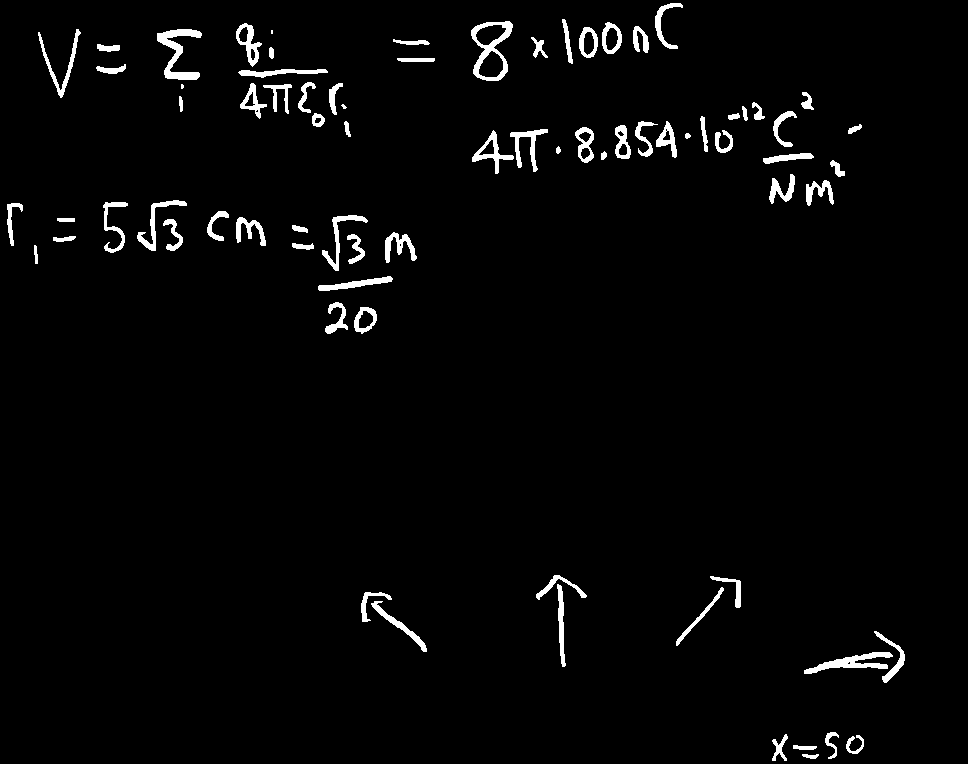
Q1. Consider a collection of 8 point charges arranged on the corners of a cube of side-length 50 centimeters. If each charge has a magnitude of 100 nC, and the electric potential is defined to be 0 at a point infinitely far from the cube, what is the potential at the center of the cube?
Background
Topic: Electric Potential due to Point Charges
This question tests your understanding of how to calculate the electric potential at a point due to multiple point charges, using the principle of superposition.
Key Terms and Formulas:
Electric potential due to a point charge:
Superposition principle: The total potential at a point is the algebraic sum of the potentials due to each charge.
(epsilon naught): Permittivity of free space,
Step-by-Step Guidance
Identify the distance from the center of the cube to each corner (where the charges are located). For a cube of side , this distance is .
Calculate the potential at the center due to one charge using .
Since all 8 charges are identical and equidistant from the center, multiply the potential from one charge by 8 to get the total potential at the center.
Substitute the given values: , , , and .
Try solving on your own before revealing the answer!
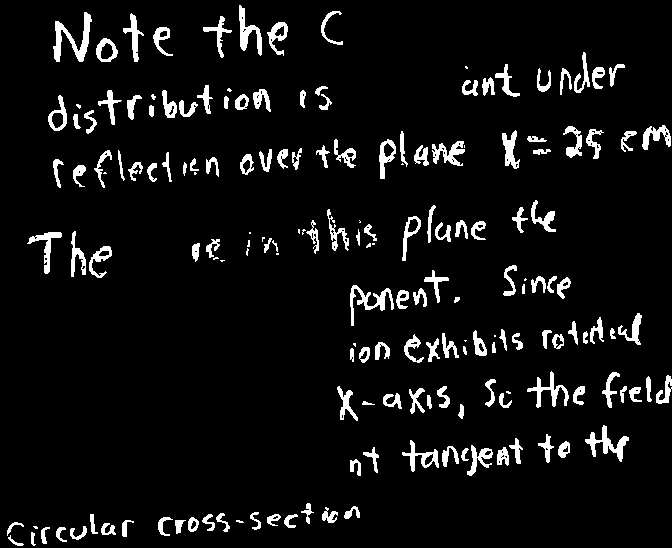
Q2. Consider a charged line segment with charge density nano-Coulombs per meter extending along the positive x axis from the origin to the position x = 50 centimeters. At which of the following points does the electric field point parallel to the z axis?
Background
Topic: Electric Field due to a Line of Charge
This question tests your understanding of the direction of the electric field produced by a line of charge and the use of symmetry in electric field problems.
Key Terms and Formulas:
Linear charge density: (charge per unit length)
Electric field due to a line of charge: Calculated using integration and symmetry arguments.
Step-by-Step Guidance
Visualize the geometry: The line of charge lies along the x-axis from to m.
Consider the symmetry of the setup. The electric field at a point will have a z-component only if the point is located off the x-y plane, directly above or below the line segment.
Analyze the given points to determine which are positioned such that the net electric field from the line segment points parallel to the z-axis.
Recall that the electric field due to a line of charge at a point in the x-y plane will have no z-component due to symmetry, but at points above or below the plane, the field can have a z-component.
Try solving on your own before revealing the answer!
Q3. Consider four point charges, each with charge equal to 7.0 nC, arranged in a square with side length 20 centimeters. What is the electric potential at the center of one of the sides of the square?
Background
Topic: Electric Potential due to Multiple Point Charges
This question tests your ability to use the superposition principle to find the electric potential at a specific point due to several charges arranged in a square.
Key Terms and Formulas:
Electric potential due to a point charge:
Superposition principle: Add the potentials from each charge at the point of interest.
Step-by-Step Guidance
Determine the distances from each charge to the center of one side of the square.
Calculate the potential at the point due to each charge using the formula above.
Add the contributions from all four charges to find the total potential at the specified point.
Be careful to use the correct distances for each charge, as some will be closer to the point than others.
Try solving on your own before revealing the answer!
Q4. Consider a ring of charge with radius 5 centimeters, centered on the origin and located in the x-y plane. The ring has total charge of 4 μC. An ideal dipole with dipole moment coulomb-meters is located along the positive z axis at cm. What is the preferred orientation of the dipole?
Background
Topic: Electric Dipoles in External Fields
This question tests your understanding of how a dipole aligns in the electric field produced by a ring of charge.
Key Terms and Formulas:
Electric dipole moment:
Torque on a dipole:
Preferred orientation: The dipole aligns with the electric field direction.
Step-by-Step Guidance
Recall that the electric field on the axis of a ring of charge points along the axis (z-direction).
The dipole will experience a torque that tends to align it with the electric field.
Determine the direction of the electric field at cm above the ring and how the dipole should orient to minimize its potential energy.
Try solving on your own before revealing the answer!
