 Back
BackPhysics 7A MT1 Review: Kinematics and Dynamics Study Guidance
Study Guide - Smart Notes
 Tailored notes based on your materials, expanded with key definitions, examples, and context.
Q1. Kinematics: Position as a Function of Time for Non-Constant Velocity
Background
Topic: Kinematics with Variable Velocity
This question explores how to determine the position of an object as a function of time when its velocity depends on position, not time. It requires using calculus to relate velocity and position.
Key Terms and Formulas
Velocity:
Given: (where is a constant)
Initial position: at
Step-by-Step Guidance
Start by writing the definition of velocity in terms of position and time: .
Substitute the given velocity function: .
Rearrange the equation to separate variables: .
Set up the integral for both sides, using the initial conditions at .
Try solving on your own before revealing the answer!
Q2. Projectile Motion: Deriving Trajectory and Key Points
Background
Topic: 2D Kinematics (Projectile Motion)
This question tests your understanding of how to use calculus to derive the equations of motion for a projectile under gravity, and how to analyze its trajectory.
Key Terms and Formulas
Position:
Velocity:
Acceleration:
Initial conditions: ,
Step-by-Step Guidance
Write the acceleration components: , .
Integrate acceleration to find velocity as a function of time for both and directions.
Integrate velocity to find position as a function of time for both and directions, using initial conditions.
To find the trajectory , solve for and substitute into .
Express in the form and identify , , and in terms of the given variables.
Try solving on your own before revealing the answer!
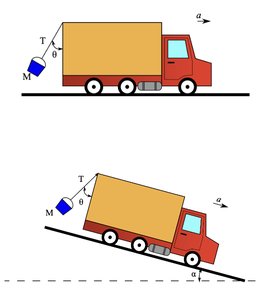
Q3. Dynamics: Bucket on a Rope Behind an Accelerating Truck
Background
Topic: Newton's Second Law, Forces in Non-Inertial Frames
This problem involves analyzing the forces on a mass (bucket) hanging from a rope attached to an accelerating truck, both on level ground and on an incline. It requires drawing free-body diagrams and resolving forces.
Key Terms and Formulas
Newton's Second Law:
Tension in the rope, gravitational force , and pseudo-force due to acceleration
Angle (on level ground), angle (on incline), incline angle
Step-by-Step Guidance
Draw a free-body diagram for the bucket, showing all forces: tension , gravity , and the pseudo-force (in the non-inertial frame of the truck).
Resolve the forces into horizontal and vertical components. Set up equations for equilibrium in both directions.
For the level ground case, relate the angle to and using trigonometry.
Write an expression for the tension in terms of , , and .
For the incline case, adjust the force components to account for the incline angle and repeat the equilibrium analysis for the new angle and tension .
Try solving on your own before revealing the answer!
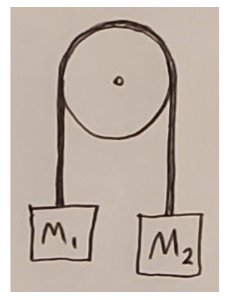
Q4. Dynamics: Atwood Machine (Two Masses and a Pulley)
Background
Topic: Newton's Laws, Tension, and Acceleration in Pulley Systems
This classic problem involves two masses connected by a rope over a pulley. It tests your ability to draw free-body diagrams, analyze forces, and solve for tension and acceleration.
Key Terms and Formulas
Newton's Second Law for each mass:
Tension in the rope
Gravitational force: ,
Acceleration of the system
Step-by-Step Guidance
Draw a free-body diagram for each mass, labeling all forces (tension and gravity).
Write Newton's Second Law for each mass, considering the direction of acceleration for each.
For , set up the equations and solve for the tension .
For arbitrary and , set up the equations and solve for and the acceleration .
If the pulley is accelerated upward with acceleration , modify the equations to include this effect and solve for the new tension.
Try solving on your own before revealing the answer!
