 Back
BackPhysics ATAR Exam Study Guidance
Study Guide - Smart Notes
 Tailored notes based on your materials, expanded with key definitions, examples, and context.
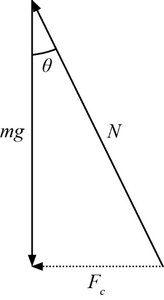
Q2. (a) Complete the vector diagram, showing how these two forces result in a centripetal force. Indicate where the angle θ is on your diagram.
Background
Topic: Circular Motion and Forces
This question tests your understanding of how forces combine to provide the centripetal force required for circular motion, particularly in the context of a banked track or similar scenario.
Key Terms and Formulas:
Centripetal Force (): The net force causing an object to move in a circle, always directed toward the center of the circle.
Normal Force (): The perpendicular contact force exerted by a surface.
Weight (): The gravitational force acting downward on the object.
Angle (): The angle of the banked track or incline.
Step-by-Step Guidance
Start by identifying the forces acting on the object: the gravitational force () acting vertically downward, and the normal force () acting perpendicular to the surface.
Draw these forces as vectors on your diagram. The angle should be shown between the normal force and the vertical (or between the normal and the resultant force, depending on the context).
Show how the horizontal component of the normal force provides the centripetal force () required for circular motion. The net force toward the center of the circle is the vector sum of the components.
Label the angle clearly on your diagram, and ensure that is shown as a horizontal vector pointing toward the center of the circle.
Try solving on your own before revealing the answer!
Final Answer:
The angle is correctly shown between the normal force and the vertical. The net force is horizontal and labeled, representing the centripetal force. The diagram should clearly show these relationships.
