 Back
BackPhysics College Exam Study Guidance: Mechanics, Energy, and Rotational Motion
Study Guide - Smart Notes
 Tailored notes based on your materials, expanded with key definitions, examples, and context.
Q1. A block of mass m sits on a ramp of angle θ without sliding due to friction. The coefficients of static and kinetic friction are μs and μk respectively. Find the magnitude of the friction acting on the block.
Background
Topic: Static Friction and Inclined Planes
This question tests your understanding of the forces acting on a block at rest on an inclined plane, specifically the role of static friction in preventing motion.
Key Terms and Formulas:
Static friction (): The force that prevents relative motion between surfaces in contact.
Normal force (): The perpendicular force exerted by a surface on an object.
Maximum static friction:
Forces on an incline: (down the ramp), (perpendicular to ramp)
Step-by-Step Guidance
Draw a free-body diagram for the block, showing gravity, normal force, and friction.
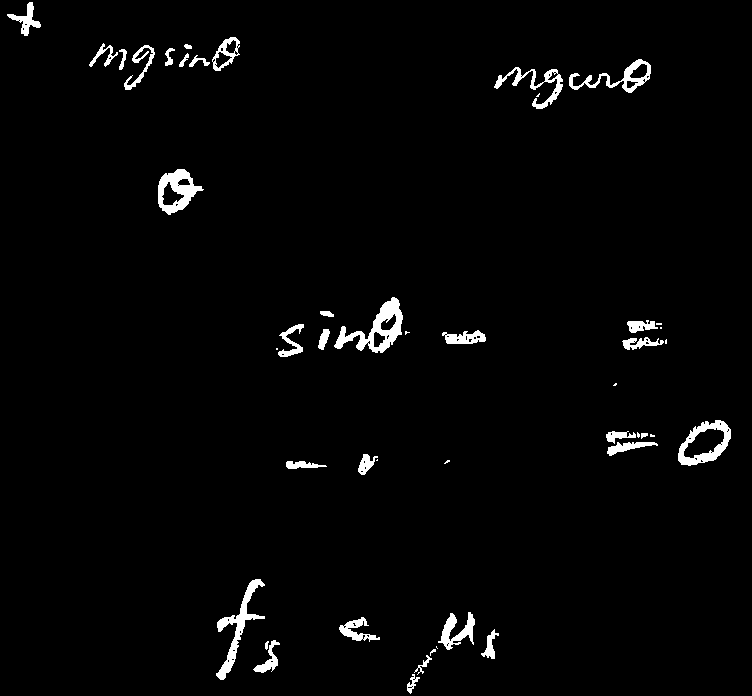
Resolve the gravitational force into components parallel and perpendicular to the ramp: (down the ramp) and (into the ramp).
Write the equilibrium condition for the block along the ramp: the static friction force must balance the component of gravity down the ramp.
Express the normal force as .
Set up the equation for static friction: . Check that to ensure the block does not slide.
Try solving on your own before revealing the answer!
Final Answer:
The friction force exactly balances the component of gravity down the ramp, so . This is less than or equal to the maximum static friction , confirming the block does not slide.
Q2. A box of mass M is at the bottom of a ramp of angle θ and at rest. In order to make the box move (and slide up the ramp) a rope is attached to the box and an assistant is pulling, and another brick of mass m is hung from the other end of the rope vertically as in the picture. For this scheme to work what must be the minimum mass m of the brick? The coefficient of static friction between the ramp and box is μs.
Background
Topic: Static Equilibrium and Friction on an Incline with Pulley Systems
This question tests your ability to analyze forces in a system involving friction, inclines, and pulleys, and to determine the minimum force (or mass) needed to initiate motion.
Key Terms and Formulas:
Static friction:
Normal force:
Forces along the ramp: (down the ramp), tension (up the ramp)
Weight of hanging mass:
Step-by-Step Guidance
Draw a free-body diagram for the box on the ramp and for the hanging mass.
Write the force balance for the box along the ramp: (at the threshold of motion).
Express the maximum static friction as .
Set the tension equal to the weight of the hanging mass: .
Combine the equations to solve for the minimum needed to overcome both gravity and friction.
Try solving on your own before revealing the answer!
Final Answer:
The minimum mass must provide enough force to overcome both the component of gravity down the ramp and the maximum static friction.
Q3. A ball of mass m is thrown vertically upwards and reaches the maximum height of h, and then falls back to the original position. What is the work done by the gravitational force on the ball in this whole process?
Background
Topic: Work Done by Gravity
This question tests your understanding of the work-energy theorem and the concept of conservative forces, specifically gravity.
Key Terms and Formulas:
Work done by gravity:
For gravity: (where is the net vertical displacement)
Step-by-Step Guidance
Identify the initial and final positions of the ball (both at the same height).
Recall that gravity is a conservative force, so the work done depends only on the net displacement.
Calculate the net vertical displacement for the entire trip.
Set up the formula for work done by gravity using .
Try solving on your own before revealing the answer!
Final Answer: $0$
The net displacement is zero (the ball returns to its starting point), so the total work done by gravity is zero.
Q4. Two bodies of masses m1 and m2 (m2 > m1) are connected by a massless rope and released from rest in a system as shown. Find the total kinetic energy of the system right before body 2 just hits the ground.
Background
Topic: Conservation of Energy in Two-Body Systems
This question tests your ability to apply the conservation of mechanical energy to a system of two masses connected by a rope.
Key Terms and Formulas:
Potential energy:
Kinetic energy:
Conservation of energy: (if no non-conservative forces do work)
Step-by-Step Guidance
Write the initial total potential energy of the system.
Write the final potential energy when body 2 just hits the ground.
Set up the conservation of energy equation: initial total energy = final total energy.
Express the total kinetic energy in terms of the change in potential energy.
Try solving on your own before revealing the answer!
Final Answer:
The total kinetic energy gained by the system equals the net loss in gravitational potential energy.
Q5. Alice and Bob play "tug-of-war" pulling each other on two ends of a rope on a frictionless horizontal surface. If initially they start from Alice at x = 0 and Bob at x = d, what is the location of their center of mass as they move toward each other?
Background
Topic: Center of Mass and Conservation of Momentum
This question tests your understanding of the center of mass in a two-body system and how it behaves in the absence of external forces.
Key Terms and Formulas:
Center of mass:
Conservation of momentum: In the absence of external forces, the center of mass does not move.
Step-by-Step Guidance
Assign positions to Alice and Bob: , .
Write the formula for the center of mass for two masses.
Plug in the positions and masses into the formula.
Recognize that, since there are no external forces, the center of mass remains at this position as they move.
Try solving on your own before revealing the answer!
Final Answer:
The center of mass remains at this fixed position throughout the motion.
Q6. Two identical blocks hang from the ceiling by strings side by side. One of the blocks (A) is raised by height h and released as in the picture. The two blocks collide and get stuck together. Find the maximum height to which the combined block rises after the collision.
Background
Topic: Conservation of Momentum and Energy in Collisions
This question tests your understanding of inelastic collisions and the conversion of kinetic energy to potential energy.
Key Terms and Formulas:
Conservation of momentum:
Kinetic energy to potential energy:
Potential energy:
Step-by-Step Guidance
Calculate the velocity of block A just before the collision using energy conservation.
Apply conservation of momentum for the perfectly inelastic collision (blocks stick together).
Find the velocity of the combined mass immediately after the collision.
Set up the energy conservation equation to find the maximum height the combined mass reaches.
Try solving on your own before revealing the answer!
Final Answer:
After the collision, the combined block rises to half the original height due to the loss of kinetic energy in the inelastic collision.
Q7. A uniform rod of length l and mass m is attached from a ceiling from one end with a hinge so that it can swing freely. Now the rod is pulled up to one side by angle θ, as in the picture and let go. Which of the following expresses the Newton's 2nd law correctly? (If you need the rotational inertia of a uniform rod of mass m and length l, it is around the center of mass; around one end of the rod.)
Background
Topic: Rotational Dynamics and Newton's Second Law for Rotation
This question tests your understanding of torque, moment of inertia, and angular acceleration for a rotating rigid body.
Key Terms and Formulas:
Torque:
Moment of inertia for a rod about one end:
Torque due to gravity:
Step-by-Step Guidance
Write the expression for torque about the hinge due to gravity.
Recall Newton's second law for rotation: .
Substitute the moment of inertia for a rod about one end.
Set up the equation relating torque and angular acceleration.
Try solving on your own before revealing the answer!
Final Answer:
This equation correctly relates the torque due to gravity to the angular acceleration of the rod about the hinge.
Q8. Two point masses of mass m and 2m respectively are connected by a massless rod of length l as in the figure. Find the rotational inertia of the system around an axis perpendicular to the rod and passing through the center of mass of the rod.
Background
Topic: Rotational Inertia (Moment of Inertia) of Point Mass Systems
This question tests your ability to calculate the moment of inertia for a system of point masses about a specified axis.
Key Terms and Formulas:
Moment of inertia:
Center of mass position for two masses:
Step-by-Step Guidance
Find the position of the center of mass of the system.
Calculate the distance of each mass from the center of mass.
Apply the formula for moment of inertia: .
Express the result in terms of and .
Try solving on your own before revealing the answer!
Final Answer:
This is the rotational inertia of the system about the center of mass axis perpendicular to the rod.
Q9. A uniform rod of length l and mass m is attached from a ceiling from one end with a hinge so that it can swing freely. Now the rod is pulled up to one side by angle θ, as in the picture and let go. Which of the following expresses the Newton's 2nd law correctly? (If you need the rotational inertia of a uniform rod of mass m and length l, it is around the center of mass; around one end of the rod.)
Background
Topic: Rotational Dynamics and Newton's Second Law for Rotation
This question tests your understanding of torque, moment of inertia, and angular acceleration for a rotating rigid body.
Key Terms and Formulas:
Torque:
Moment of inertia for a rod about one end:
Torque due to gravity:
Step-by-Step Guidance
Write the expression for torque about the hinge due to gravity.
Recall Newton's second law for rotation: .
Substitute the moment of inertia for a rod about one end.
Set up the equation relating torque and angular acceleration.
Try solving on your own before revealing the answer!
Final Answer:
This equation correctly relates the torque due to gravity to the angular acceleration of the rod about the hinge.
