 Back
BackPhysics Exam 2 Study Guide: Forces, Motion, and Equilibrium
Study Guide - Smart Notes
 Tailored notes based on your materials, expanded with key definitions, examples, and context.
Q1. Two bodies P and Q on a smooth horizontal surface are connected by a light cord. The mass of P is greater than that of Q. A horizontal force F is applied to Q, accelerating the bodies to the right. What is the magnitude of the force exerted by the connecting cord on body P?
Background
Topic: Newton's Laws of Motion, Tension in Cords
This question tests your understanding of how forces are transmitted through a cord connecting two masses, and how Newton's second and third laws apply to systems of connected objects.

Key Terms and Formulas:
Tension (): The force transmitted through the cord.
Newton's Second Law:
System acceleration: Both blocks accelerate together, so
Force on P: The tension in the cord is what accelerates P.
Step-by-Step Guidance
Identify the total mass of the system: .
Apply Newton's second law to the entire system: .
Determine the acceleration: .
Apply Newton's second law to block P: The only horizontal force on P is the tension , so .
Try solving on your own before revealing the answer!
Final Answer: Tension is less than F, but not zero ()
The tension is less than the applied force because it only needs to accelerate block P, not both blocks.
Q2. Two objects are connected by a very light flexible string as shown in the figure, where M = 1.60 kg and m = 1.00 kg. Ignore friction and the mass of the pulley.
Background
Topic: Atwood's Machine, Newton's Second Law
This question tests your ability to analyze a classic Atwood's machine setup, where two masses are connected by a string over a pulley, and you must determine acceleration and tension.
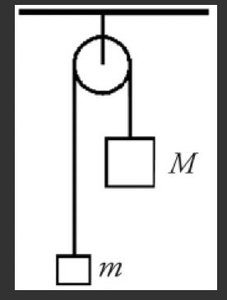
Key Terms and Formulas:
Newton's Second Law:
Tension (): The force in the string.
Acceleration:
Step-by-Step Guidance
Draw free-body diagrams for each mass (M and m).
Write Newton's second law for each mass: (downward): ; (upward): .
Add the two equations to eliminate and solve for .
Once you have , substitute back to solve for .
Try solving on your own before revealing the answer!
Final Answer: ,
Using and , plug in the values to get the results.
Q3. A wooden block A of mass 7.0 kg slides on a frictionless table when pulled using a massless string and pulley array by a hanging box B of mass 9.0 kg, as shown in the figure. What is the acceleration of block A as it slides on the frictionless table?
Background
Topic: Pulley Systems, Newton's Second Law, Constraint Relations
This question tests your understanding of how to analyze a system with a frictionless table and a pulley, and how the acceleration of one block relates to the other.
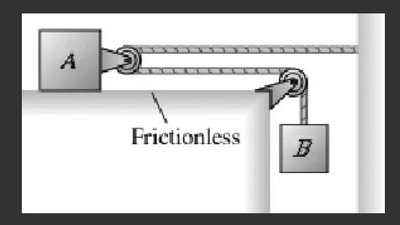
Key Terms and Formulas:
Newton's Second Law:
Constraint: The acceleration of block A is related to block B by the pulley setup.
For frictionless systems:
Step-by-Step Guidance
Draw free-body diagrams for both blocks.
Write Newton's second law for block A (horizontal) and block B (vertical).
Set up the equations: for block A, for block B.
Add the equations to eliminate and solve for .
Try solving on your own before revealing the answer!
Final Answer:
Using , plug in the values to find the acceleration.
