Back
BackPhysics Exam 3 Study Guidance: Rotational Motion, Oscillations, and Equilibrium
Study Guide - Smart Notes
 Tailored notes based on your materials, expanded with key definitions, examples, and context.
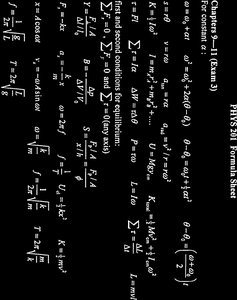
Q1. Two spheres, solid cylinders, or other objects of the same mass but different radii are released from rest at the same height on an inclined plane. Which of the following statements is correct?
Background
Topic: Rotational Dynamics and Rolling Motion
This question tests your understanding of rotational inertia (moment of inertia), energy conservation, and how different shapes roll down an incline.
Key Terms and Formulas:
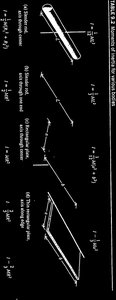
Moment of Inertia (I): A measure of an object's resistance to changes in its rotation. Depends on mass distribution.
Conservation of Energy:
Rolling without Slipping:
Step-by-Step Guidance
Recall that for rolling objects, both translational and rotational kinetic energy must be considered.
Write the conservation of energy equation for each object as it rolls down the incline.
Remember that the moment of inertia is different for different shapes (e.g., solid sphere, solid cylinder, hollow cylinder).
Analyze how the distribution of mass (moment of inertia) affects the final speed at the bottom of the incline.
Try solving on your own before revealing the answer!
Q2. A uniform solid cylinder of mass 40 kg and radius 0.500 m is mounted on an axle through its center. It starts from rest and begins to rotate with constant angular acceleration . What is its rotational kinetic energy after it has turned through ?
Background
Topic: Rotational Kinetic Energy and Angular Motion
This question tests your ability to relate angular acceleration, angular displacement, and rotational kinetic energy.
Key Terms and Formulas:
Rotational Kinetic Energy:
Moment of Inertia for Solid Cylinder:
Angular Kinematics:
Step-by-Step Guidance
Calculate the moment of inertia for the solid cylinder using its mass and radius.
Use the angular kinematics equation to find the final angular velocity after turning through .
Plug the values of and into the rotational kinetic energy formula.
Be careful with units and ensure all quantities are in SI units.
Try solving on your own before revealing the answer!
Q3. A uniform solid sphere is rolling without slipping on a horizontal surface. What fraction of its total kinetic energy is translational?
Background
Topic: Rolling Motion and Energy Partition
This question tests your understanding of how kinetic energy is divided between translational and rotational forms for rolling objects.
Key Terms and Formulas:
Total Kinetic Energy:
Moment of Inertia for Solid Sphere:
Rolling without Slipping:
Step-by-Step Guidance
Write the expressions for translational and rotational kinetic energy for the sphere.
Substitute the moment of inertia for a solid sphere and the rolling condition into the total kinetic energy formula.
Express the translational kinetic energy as a fraction of the total kinetic energy.
Try solving on your own before revealing the answer!

Q4. A uniform disk with mass 40 kg and radius 0.500 m is mounted on an axle through its center. It starts from rest and rotates with constant angular acceleration . After it has rotated for 4.00 s, what is the translational speed of a point on the rim of the disk?
Background
Topic: Rotational Kinematics and Tangential Speed
This question tests your ability to relate angular acceleration, time, and the resulting tangential (translational) speed at the rim of a rotating disk.
Key Terms and Formulas:
Angular Velocity:
Tangential Speed:
Step-by-Step Guidance
Calculate the angular velocity after 4.00 s using the angular acceleration and initial angular velocity.
Use the radius of the disk to find the tangential speed at the rim using .
Check that all units are consistent (radians, seconds, meters).
Try solving on your own before revealing the answer!
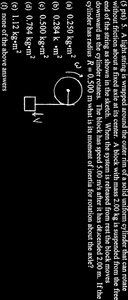
Q5. A light string is wrapped around the rim of a uniform cylinder (radius 0.500 m) mounted on a horizontal frictionless axle at its center. A block with mass 20.0 kg is suspended from the free end of the string. The system is released from rest and the block moves downward as the disk rotates. If the block has speed 5.00 m/s after it has descended 2.00 m, what is the moment of inertia for rotation about the axle?
Background
Topic: Rotational Dynamics, Energy Conservation, and Atwood's Machine
This question tests your ability to apply energy conservation and rotational dynamics to a system involving both linear and rotational motion.
Key Terms and Formulas:
Conservation of Energy:
Relationship between and :
Step-by-Step Guidance
Write the conservation of energy equation for the block-cylinder system as the block descends.
Express the rotational kinetic energy in terms of using .
Plug in the given values for mass, height, speed, and radius to set up the equation for .
Try solving on your own before revealing the answer!
Q6. A solid disk with radius 0.300 m is mounted on an axle through its center. It starts from rest and rotates with constant angular acceleration . What is the tangential component of the acceleration of a point on the rim of the disk after 4.00 s?
Background
Topic: Rotational Kinematics and Tangential Acceleration
This question tests your understanding of the relationship between angular acceleration and tangential acceleration at the rim of a rotating disk.
Key Terms and Formulas:
Tangential Acceleration:
Step-by-Step Guidance
Identify the angular acceleration and the radius of the disk.
Use the formula to set up the calculation for tangential acceleration.
Check that the units are consistent (radians, meters, seconds).
Try solving on your own before revealing the answer!
Q7. A solid disk is mounted on an axle and rotates through its center. The disk is initially at rest and then starts to rotate with constant angular acceleration. If it turns through 10.0 revolutions in 10.0 s, what is its angular acceleration?
Background
Topic: Rotational Kinematics
This question tests your ability to use angular kinematics equations to relate angular displacement, time, and angular acceleration.
Key Terms and Formulas:
Angular Displacement:
Conversion:
Step-by-Step Guidance
Convert the angular displacement from revolutions to radians.
Set up the angular kinematics equation with (starts from rest).
Solve for angular acceleration .
Try solving on your own before revealing the answer!
Q8. A block is attached to a horizontal spring and moves in simple harmonic motion on a frictionless surface. The amplitude of the motion is 0.040 m and the angular frequency is 10.0 rad/s. What is the maximum acceleration of the block during its motion?
Background
Topic: Simple Harmonic Motion (SHM)
This question tests your understanding of the relationship between amplitude, angular frequency, and maximum acceleration in SHM.
Key Terms and Formulas:
Maximum Acceleration in SHM:
Amplitude (): Maximum displacement from equilibrium.
Angular Frequency ():
Step-by-Step Guidance
Identify the amplitude and angular frequency from the problem statement.
Plug these values into the formula .
Check that the units are consistent (meters, radians/second).
Try solving on your own before revealing the answer!
Q9. A uniform disk of unknown mass is mounted on a frictionless axle at its center. A light string is wrapped around the disk and a force of 6.00 N is applied to the string, causing the disk to rotate with angular velocity. What is the mass of the disk?
Background
Topic: Rotational Dynamics and Torque
This question tests your ability to relate torque, force, radius, and moment of inertia to find the mass of a rotating disk.
Key Terms and Formulas:
Torque:
Moment of Inertia for Disk:
Newton's Second Law for Rotation:
Step-by-Step Guidance
Write the torque equation for the force applied at the rim of the disk.
Express the moment of inertia in terms of the unknown mass and the radius .
Set up the equation relating torque and angular acceleration to solve for .
Try solving on your own before revealing the answer!