 Back
BackPhysics Exam IV Study Guidance: Waves, Sound, Optics, and Magnetism
Study Guide - Smart Notes
 Tailored notes based on your materials, expanded with key definitions, examples, and context.
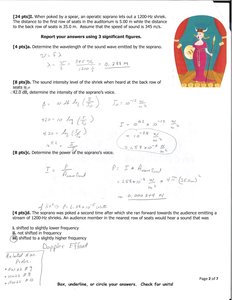
Q1. When poked by a spear, an operatic soprano lets out a 1200-Hz shriek. The distance to the first row of seats in the auditorium is 5.00 m while the distance to the back row of seats is 25.0 m. Assume the speed of sound is 343 m/s.
Background
Topic: Sound Waves and Wave Properties
This question tests your understanding of the relationship between frequency, wavelength, and the speed of sound, as well as sound intensity and power.
Key Terms and Formulas:
Frequency (): Number of oscillations per second (Hz)
Wavelength (): Distance between successive crests of a wave (m)
Speed of sound (): in air
Wavelength formula:
Intensity (): , where is power and is area
Sound intensity level (): ,
Step-by-Step Guidance
Calculate the wavelength of the sound using . Rearrange to .
Find the area over which the sound spreads at the back row (assume spherical spreading: with m).
Use the intensity formula to relate the power of the soprano's voice to the intensity at the back row.
Set up the equation for sound intensity level at the back row using .
Try solving on your own before revealing the answer!
Final Answer:
Wavelength: m
Intensity at back row: W/m
Power: W
These values are found by plugging the given numbers into the formulas above and solving step by step.
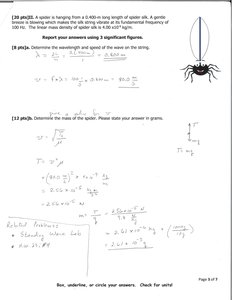
Q2. A spider is hanging from a 0.400-m long length of spider silk. A gentle breeze is blowing, which makes the silk vibrate at its fundamental frequency of 100 Hz. The linear mass density of spider silk is 1.0 × 10⁻⁶ kg/m.
Background
Topic: Standing Waves on a String
This question tests your understanding of standing waves, wave speed, and the relationship between tension, mass density, and frequency.
Key Terms and Formulas:
Fundamental frequency ():
Wave speed ():
Linear mass density (): mass per unit length (kg/m)
Tension (): force in the string (N)
Step-by-Step Guidance
Use the formula for the fundamental frequency: , solve for .
Plug in the values for and to find the wave speed .
Use to solve for the tension in the silk.
Since the tension is due to the weight of the spider, set and solve for the mass .
Try solving on your own before revealing the answer!
Final Answer:
Wave speed: m/s
Mass of spider: kg (or 0.64 g)
These are found by using the relationships between frequency, wave speed, and tension.
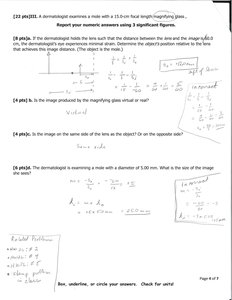
Q3. A dermatologist examines a mole with a 15.0-cm focal length magnifying glass.
Background
Topic: Geometric Optics – Lenses and Magnification
This question tests your understanding of lens equations, image formation, and magnification.
Key Terms and Formulas:
Lens equation:
Magnification:
Virtual vs. real image: Determined by the sign of
Step-by-Step Guidance
Identify the object distance () and focal length () from the problem statement.
Use the lens equation to solve for the image distance ().
Determine if the image is real or virtual based on the sign of .
Calculate the magnification using .
Try solving on your own before revealing the answer!
Final Answer:
Image is virtual, upright, and magnified. The exact position and size can be found by solving the lens and magnification equations with the given values.
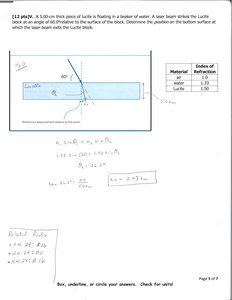
Q4. A 5.00-cm thick piece of lucite is floating in a beaker of water. A laser beam strikes the lucite block at an angle of 60.0° relative to the surface of the block. Determine the position on the bottom surface at which the laser beam exits the lucite block.
Background
Topic: Refraction and Snell's Law
This question tests your understanding of how light bends when passing through different media and how to use Snell's Law to find the path of a light ray.
Key Terms and Formulas:
Snell's Law:
Index of refraction (): Ratio of speed of light in vacuum to that in the medium
Geometry: Use trigonometry to find the horizontal displacement as the ray travels through the block
Step-by-Step Guidance
Apply Snell's Law at the air-lucite interface to find the angle of refraction inside the lucite.
Draw a diagram showing the path of the beam through the block.
Use trigonometry to relate the thickness of the block and the angle inside the lucite to the horizontal distance traveled by the beam.
Try solving on your own before revealing the answer!
Final Answer:
The beam exits the bottom surface at a horizontal distance of 4.04 cm from the entry point. This is found by calculating the angle inside the lucite and using trigonometry.
Q5. The figure below shows an object with many rays. Identify the three principal rays and use them to locate the image.
Background
Topic: Ray Diagrams and Image Formation
This question tests your ability to draw and interpret ray diagrams for lenses or mirrors, and to use principal rays to locate images.
Key Terms and Formulas:
Principal rays: Parallel ray, focal ray, and central ray
Image location: Where the rays converge (real) or appear to diverge from (virtual)
Step-by-Step Guidance
Identify and draw the three principal rays from the tip of the object: (1) parallel to axis then through focus, (2) through center of lens/mirror, (3) through focus then parallel to axis.
Find the intersection point of the rays to locate the image.
Try solving on your own before revealing the answer!
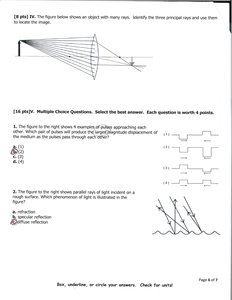
Final Answer:
The image is formed where the three principal rays intersect. The exact location depends on the geometry shown in the diagram.
Q6. Multiple Choice Questions (Waves, Reflection, Refraction, Magnetism)
Background
Topic: General Physics Concepts – Waves, Reflection, Refraction, Magnetism
These questions test your conceptual understanding of wave behavior, light interaction with surfaces, and magnetic forces.
Key Terms and Concepts:
Wave superposition and interference
Reflection and refraction of light
Magnetic force on current-carrying loops
Step-by-Step Guidance
For each question, carefully analyze the diagram and recall the relevant physical principle (e.g., constructive/destructive interference, law of reflection, right-hand rule for magnetism).
Eliminate clearly incorrect options based on your understanding of the concepts.
Choose the best answer based on the evidence in the diagram and your knowledge.
Try solving on your own before revealing the answer!
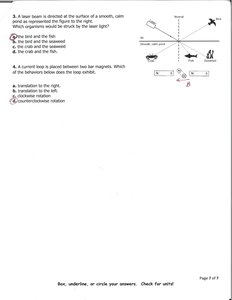
Final Answers:
1. (C) 2. (B) 3. (B) 4. (D)
Each answer is based on the correct application of the relevant physical law or principle.
