Back
BackPhysics Exam Practice Problems – Step-by-Step Guidance
Study Guide - Smart Notes
 Tailored notes based on your materials, expanded with key definitions, examples, and context.
Q1. What is the total pressure at the bottom of a cylindrical container full of alcohol (density 810 kg/m³), with a diameter of 10 m and a depth of 5 m?
Background
Topic: Fluid Statics (Hydrostatic Pressure)
This question tests your understanding of how to calculate the pressure at the bottom of a fluid column, considering both atmospheric and hydrostatic pressure.
Key Terms and Formulas
Hydrostatic Pressure:
= atmospheric pressure (usually 1.01 × 10⁵ Pa unless otherwise specified)
= density of the fluid (kg/m³)
= acceleration due to gravity (9.8 m/s²)
= depth of the fluid (m)
Step-by-Step Guidance
Identify the known values: kg/m³, m, m/s², Pa.
Calculate the hydrostatic pressure due to the alcohol: .
Add the atmospheric pressure to the hydrostatic pressure: .
Try solving on your own before revealing the answer!
Final Answer: Pa
Pa$
Pa$
The total pressure is the sum of atmospheric and hydrostatic pressure.
Q2. Suppose you add 10 liters of fluid (density 1,000 kg/m³) to a large open cylindrical tank of radius 1 m. What is the rise in depth of the fluid?
Background
Topic: Volume and Geometry in Fluid Statics
This question tests your ability to relate the volume of fluid added to the change in height in a cylindrical container.
Key Terms and Formulas
Volume of a cylinder:
= volume added (m³)
= radius of the tank (m)
= change in height (m)
Step-by-Step Guidance
Convert the volume from liters to cubic meters: $10= 0.01$ m³.
Set up the formula for the change in height: .
Rearrange to solve for : .
Try solving on your own before revealing the answer!
Final Answer: m
m$
The rise in depth is calculated by dividing the volume by the area of the base.
Q3. A rectangular block of copper (density 8,900 kg/m³) with dimensions 0.1 m × 0.1 m × 0.3 m is floating in water (density 1,000 kg/m³). What is the fraction of the block submerged?
Background
Topic: Buoyancy and Archimedes' Principle
This question tests your understanding of how to calculate the fraction of a floating object's volume that is submerged based on densities.
Key Terms and Formulas
Buoyant force equals weight of displaced fluid:
Weight of block:
Fraction submerged:
Step-by-Step Guidance
Calculate the density ratio: .
Set up the formula for fraction submerged: .
Plug in the values for copper and water densities.
Try solving on your own before revealing the answer!
Final Answer: 8.9
The block will sink because its density is much greater than water.
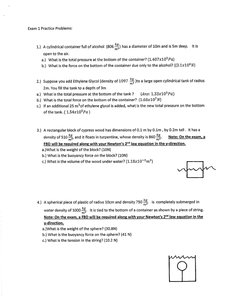
Q4. A spherical piece of plastic of radius 10 cm and density 750 kg/m³ is completely submerged in water and held by a string. What is the tension in the string?
Background
Topic: Buoyancy, Forces in Fluids
This question tests your ability to calculate the tension in a string holding a submerged object, considering buoyant force and weight.
Key Terms and Formulas
Buoyant force:
Weight of object:
Tension:
Volume of sphere:
Step-by-Step Guidance
Calculate the volume of the sphere: with m.
Calculate the weight of the plastic: .
Calculate the buoyant force: .
Set up the tension formula: .
Try solving on your own before revealing the answer!
Final Answer: 25 N
After calculating the forces, the tension is found to be 25 N.
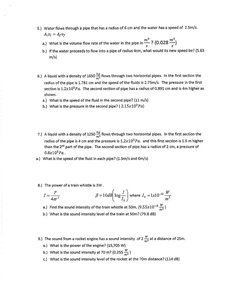
Q5. Water flows through a pipe that has a radius of 5 cm and the water has a speed of 2 m/s. What is the volume flow rate of the water in the pipe?
Background
Topic: Fluid Dynamics (Continuity Equation)
This question tests your ability to calculate the volume flow rate using the area and velocity of the fluid.
Key Terms and Formulas
Volume flow rate:
Area of circle:
= velocity (m/s)
Step-by-Step Guidance
Calculate the area of the pipe: with m.
Multiply the area by the velocity to get the volume flow rate: .
Try solving on your own before revealing the answer!
Final Answer: 0.016 m³/s
m²$
m³/s$
The flow rate is the product of area and velocity.
Q6. The sound from a jack hammer has a sound intensity level of 90 dB at a distance of 30 m. What is the sound intensity?
Background
Topic: Sound Intensity and Decibels
This question tests your ability to convert sound intensity level (dB) to actual intensity (W/m²).
Key Terms and Formulas
Sound intensity level:
= reference intensity ( W/m²)
= sound intensity level (dB)
= sound intensity (W/m²)
Step-by-Step Guidance
Set up the formula: .
Plug in the values for and .
Solve for by rearranging the formula.
Try solving on your own before revealing the answer!
Final Answer: W/m²
W/m²$
The intensity is calculated using the decibel formula.