 Back
BackPhysics Final Exam Study Guidance – Circuits and Magnetism
Study Guide - Smart Notes
 Tailored notes based on your materials, expanded with key definitions, examples, and context.
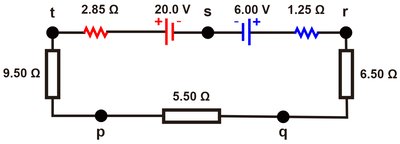
Q5. Determine the power at which electrical energy is converted to other energy forms in the 6.0 V power supply.
Background
Topic: Power in Electrical Circuits
This question tests your understanding of how to calculate the power delivered by a voltage source in a circuit with multiple resistors and batteries.
Key Terms and Formulas
Power (): The rate at which energy is transferred or converted.
Kirchhoff's Rules: Used to analyze complex circuits by applying conservation of energy and charge.
Ohm's Law:
Step-by-Step Guidance
Identify the location of the 6.0 V power supply in the circuit and note all resistors and other sources connected in the loop.
Apply Kirchhoff's loop rule to the circuit loop containing the 6.0 V supply to set up an equation for the current.
Sum the voltage drops across all resistors and sources in the loop, making sure to account for the direction of current and sign conventions for batteries.
Express the total resistance in the loop and solve for the current using Ohm's Law.
Set up the formula for power delivered by the 6.0 V supply: .
Try solving on your own before revealing the answer!
Final Answer: 2.91 W
The power is calculated by multiplying the current flowing through the supply by its voltage.
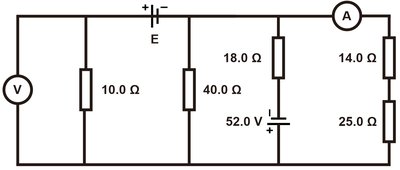
Q6. Determine the ammeter reading when the 18.0 Ω resistor is replaced with a low resistance shunt.
Background
Topic: Solving Resistor Circuits
This question tests your ability to analyze a circuit with multiple resistors and batteries, and to determine the current measured by an ammeter when a resistor is replaced by a shunt.
Key Terms and Formulas
Ohm's Law:
Series and Parallel Resistors: depends on configuration.
Kirchhoff's Rules: Used to analyze the circuit and find the current.
Step-by-Step Guidance
Identify the configuration of the circuit after the 18.0 Ω resistor is replaced with a shunt (very low resistance).
Calculate the equivalent resistance of the branch containing the ammeter and the shunt.
Use the total voltage (52.0 V) and the equivalent resistance to set up Ohm's Law for the current.
Apply Kirchhoff's rules to ensure all branches and batteries are accounted for in the calculation.
Set up the formula for the ammeter reading: .
Try solving on your own before revealing the answer!
Final Answer: 1.33 A
The shunt allows most of the current to flow through the ammeter, giving a higher reading.
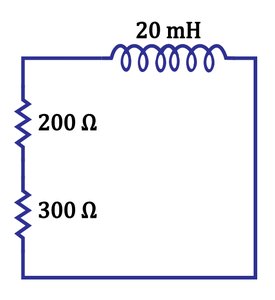
Q12. Calculate the time after t = 0 s when the current is (1/4)I₀ in the LR circuit.
Background
Topic: LR Circuits (Inductor-Resistor Circuits)
This question tests your understanding of the exponential decay of current in an LR circuit after the circuit is switched on or off.
Key Terms and Formulas
Inductance (): The property of a circuit that opposes changes in current.
Time constant ():
Current decay:
Step-by-Step Guidance
Identify the values for inductance () and total resistance ().
Calculate the time constant: .
Set up the exponential decay equation for current: .
Set and solve for in terms of .
Express using logarithms: .
Try solving on your own before revealing the answer!
Final Answer: 5.5 µs
This is the time it takes for the current to drop to one-fourth its initial value in the LR circuit.
