Back
BackPhysics Final Exam Study Guidance – Electric Field, Gauss' Law, and More
Study Guide - Smart Notes
 Tailored notes based on your materials, expanded with key definitions, examples, and context.
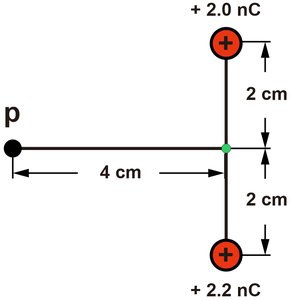
Q1. Calculate the electric field at point p due to the two charges, giving the result in component form.
Background
Topic: Electric Field from Point Charges
This question tests your ability to calculate the electric field at a specific point due to multiple point charges, using vector addition and component analysis.
Key Terms and Formulas:
Electric field due to a point charge:
Superposition principle: The total electric field is the vector sum of fields from each charge.
Key constants:
Component form:
Step-by-Step Guidance
Identify the positions of the charges and point p. The charges are at (0, +2 cm) and (0, -2 cm), and point p is at (-4 cm, 0).
Calculate the distance from each charge to point p using the Pythagorean theorem: .
Determine the direction of the electric field produced by each charge at point p. Since both charges are positive, the field points away from each charge.
Calculate the electric field magnitude from each charge at point p using , then resolve each field into x and y components.
Add the x and y components from both charges to find the total electric field at point p in vector form.
Try solving on your own before revealing the answer!
Final Answer: (-20 i + 0.4 j) kN/C
This result comes from adding the x and y components of the fields from both charges.
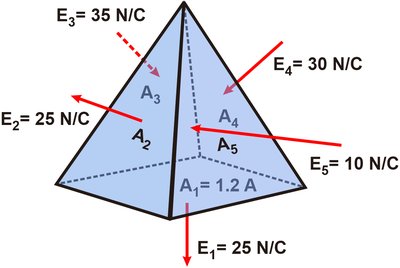
Q2. Does the pyramid-shaped object contain positive, negative, or zero charge? Explain using electric flux.
Background
Topic: Gauss' Law and Electric Flux
This question tests your understanding of Gauss' Law, which relates the net electric flux through a closed surface to the net charge enclosed by that surface.
Key Terms and Formulas:
Electric flux:
Gauss' Law:
Net flux: Sum the flux through all faces to determine the net charge inside.
Step-by-Step Guidance
Calculate the electric flux through each face: for each face.
Sum the fluxes from all five faces to find the total net flux through the pyramid.
Apply Gauss' Law: If the net flux is positive, the object contains positive charge; if negative, negative charge; if zero, no net charge.
Check the direction of each electric field relative to the surface normal to determine the sign of each flux.
Try solving on your own before revealing the answer!
Final Answer: Positive charge
By summing the fluxes, the result is positive, so Gauss' Law tells us the enclosed charge is positive.
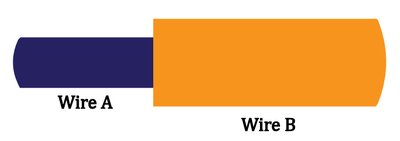
Q6. If wire A has a diameter of 0.8 cm and electron drift speed of m/s, what is the electron drift speed in wire B (diameter 1.6 cm), given the same current?
Background
Topic: Microscopic View of Current
This question tests your understanding of how drift speed relates to current, cross-sectional area, and charge carrier density in wires.
Key Terms and Formulas:
Current:
= number density of electrons, = elementary charge, = cross-sectional area, = drift speed
For same current and material, and are constant.
Step-by-Step Guidance
Write the current equation for both wires:
Express the cross-sectional area: ; calculate and using the diameters.
Set up the ratio: , then solve for in terms of and the areas.
Plug in the values for diameters and drift speed to find .
Try solving on your own before revealing the answer!
Final Answer: m/s
Since the current is the same, the drift speed decreases as area increases.
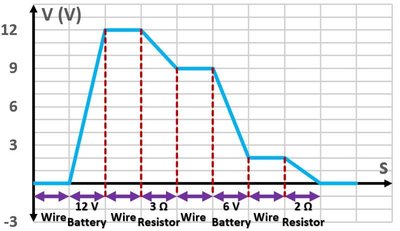
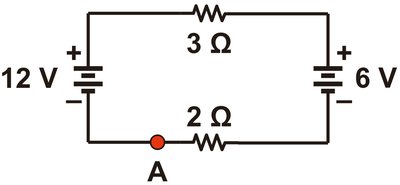
Q7. Plot a graph of voltage as a function of location in the circuit, tracing the loop clockwise from point A.
Background
Topic: Kirchhoff's Junction Rule and Voltage Drops
This question tests your ability to analyze voltage changes in a circuit as you move through batteries and resistors, using Kirchhoff's rules.
Key Terms and Formulas:
Kirchhoff's Loop Rule: The sum of voltage changes around a closed loop is zero.
Voltage drop across resistor:
Voltage rise across battery:
Step-by-Step Guidance
Start at point A and note the initial voltage.
Move through the 12 V battery (voltage rises), then through the 3 Ω resistor (voltage drops by ).
Continue through the 6 V battery (voltage rises), then through the 2 Ω resistor (voltage drops by ).
Plot the voltage at each segment, showing rises and drops as you trace the loop.
Try solving on your own before revealing the answer!
Final Answer: Graph (matches image_5)