 Back
BackPhysics Final Exam Study Guide: Torque and Equilibrium in the Human Arm
Study Guide - Smart Notes
 Tailored notes based on your materials, expanded with key definitions, examples, and context.
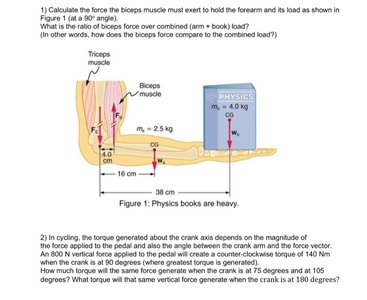
Q1. Calculate the force the biceps muscle must exert to hold the forearm and its load as shown in Figure 1 (at a 90° angle). What is the ratio of biceps force over combined (arm + book) load?
Background
Topic: Torque and Rotational Equilibrium
This question tests your understanding of how forces and torques balance in static equilibrium, specifically in the context of the human arm holding a weight. You will use the principle that the sum of torques about any pivot point (here, the elbow) must be zero for equilibrium.
Key Terms and Formulas
Torque (\( \tau \)): The rotational equivalent of force, calculated as \( \tau = rF \sin\theta \), where \( r \) is the distance from the pivot, \( F \) is the force, and \( \theta \) is the angle between the force and lever arm.
Equilibrium Condition: For static equilibrium, the sum of all torques about the pivot must be zero: \( \sum \tau = 0 \).
Forces involved: Weight of the forearm (\( m_1g \)), weight of the book (\( m_2g \)), and the force from the biceps muscle (\( F_B \)).
Step-by-Step Guidance
Identify all forces acting on the forearm: the upward force from the biceps muscle (\( F_B \)), the downward force from the weight of the forearm (\( m_1g \)), and the downward force from the weight of the book (\( m_2g \)).
Choose the elbow joint as the pivot point. Write the torque equation for equilibrium, taking counterclockwise torques as positive and clockwise as negative.
Express the torque produced by each force about the elbow:
Torque by biceps: \( \tau_B = r_B F_B \sin(\theta_B) \)
Torque by forearm: \( \tau_1 = r_1 m_1 g \sin(\theta_1) \)
Torque by book: \( \tau_2 = r_2 m_2 g \sin(\theta_2) \)
Note: In this setup, the angles are typically 90°, so \( \sin(90°) = 1 \).
Set up the equilibrium equation: \( r_B F_B = r_1 m_1 g + r_2 m_2 g \).
Substitute the given values for \( r_B \), \( r_1 \), \( r_2 \), \( m_1 \), and \( m_2 \) (from the diagram: \( r_B = 4 \) cm, \( r_1 = 16 \) cm, \( r_2 = 38 \) cm, \( m_1 = 2.5 \) kg, \( m_2 = 4.0 \) kg), and solve for \( F_B \) symbolically.
Try solving on your own before revealing the answer!
Final Answer:
\( F_B \approx 470 \) N (rounded to two significant digits)
The biceps force is much larger than the combined weight of the arm and book due to the short lever arm of the biceps compared to the weights. The ratio \( F_B / (m_1g + m_2g) \) is approximately 7.5.
