 Back
BackPhysics Foundations and Kinematics: Structured Study Notes
Study Guide - Smart Notes
 Tailored notes based on your materials, expanded with key definitions, examples, and context.
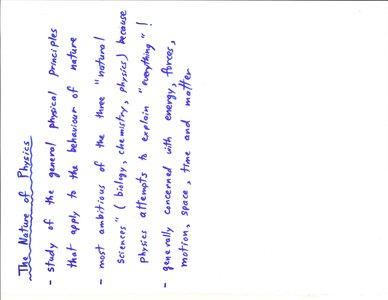
The Nature of Physics
Definition and Scope
Physics is the study of the general physical principles that apply to the behavior of nature. It is considered the most ambitious of the natural sciences, as it attempts to explain and predict processes in biology, chemistry, and other sciences. Physics is generally concerned with energy, forces, motion, space, time, and matter.
Key Point: Physics seeks to understand the fundamental laws governing the universe.
Key Point: Applications span across multiple scientific disciplines.
Example: The laws of motion and energy conservation are foundational in both physics and engineering.
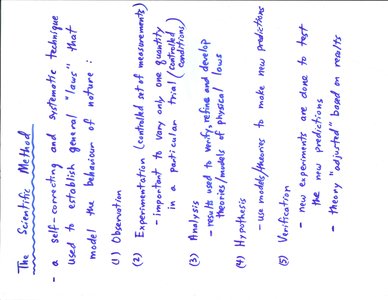
The Scientific Method
Steps and Purpose
The scientific method is a self-correcting and systematic technique used to establish general laws that model the behavior of nature. It involves observation, experimentation, analysis, hypothesis formation, and verification.
Observation: Careful collection of measurements and data.
Experimentation: Control and vary one quantity at a time to test conditions.
Analysis: Use data to refine and develop theories/models of physical laws.
Hypothesis: Propose models or theories to make new predictions.
Verification: Conduct new experiments to test predictions; adjust theory based on results.
Example: Testing Newton's laws by observing falling objects and adjusting models as needed.
Fundamental Physical Quantities and Units
SI Units and Physical Quantities
Physical quantities are measured using standardized units, most commonly the International System of Units (SI). Fundamental quantities include length, mass, time, temperature, and electric current.
Length: Measured in meters (m).
Mass: Measured in kilograms (kg).
Time: Measured in seconds (s).
Temperature: Measured in kelvin (K).
Electric Current: Measured in amperes (A).
Example: The speed of an object is calculated as distance (meters) divided by time (seconds).






SI System and Unit Consistency
The SI system ensures consistency in scientific measurements. The same quantity is always measured using the same unit, allowing for clear communication and comparison of results.
Key Point: SI units are internationally recognized and standardized.
Example: Length is always measured in meters in SI, regardless of the context.


Significant Figures and Precision
Definitions and Examples
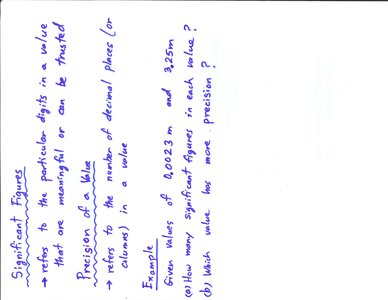
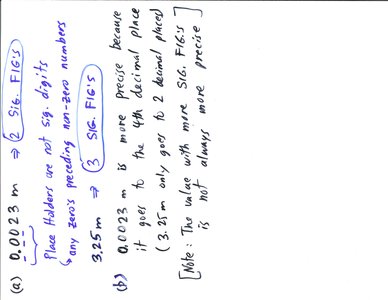
Significant figures refer to the particular digits in a value that are meaningful or can be trusted. Precision of a value refers to the number of decimal places (or columns) in a value.
Key Point: The number of significant figures indicates the reliability of a measurement.
Example: 0.0023 m has 2 significant figures; 3.25 m has 3 significant figures.

Uncertainty and Error
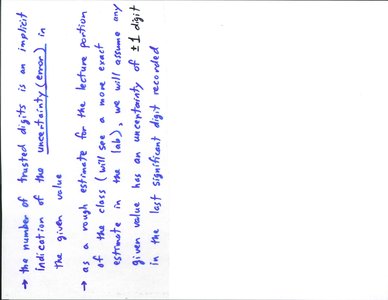
The number of trusted digits is an implicit indication of the uncertainty (error) in the given value. As a rough estimate, any given value has an uncertainty of ±1 digit in the last significant digit recorded.
Key Point: Uncertainty is inherent in all measurements.
Example: If a value is recorded as 3.25 m, the uncertainty is ±0.01 m.
Scientific and Engineering Notation
Expressing Large and Small Values
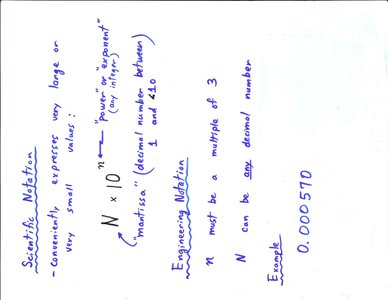
Scientific notation conveniently expresses very large or very small values using the format , where N is the mantissa (decimal number between 1 and 10) and n is the exponent. Engineering notation is similar but n must be a multiple of 3.
Key Point: Scientific notation simplifies calculations and comparisons.
Example: 0.000570 can be written as .

Significant Figure Rules for Basic Operations
Multiplication, Division, Addition, and Subtraction
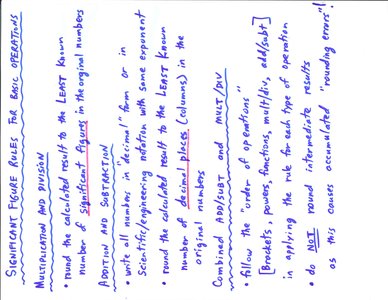
When performing calculations, the number of significant figures in the result is determined by the least precise measurement. For multiplication and division, round the calculated result to the least known number of significant figures. For addition and subtraction, round to the least number of decimal places.
Key Point: Proper rounding prevents accumulation of errors.
Example: When adding 3.25 m and 0.0023 m, the result should be rounded to two decimal places.

Kinematics: Motion Along a Straight Line
Distance and Position
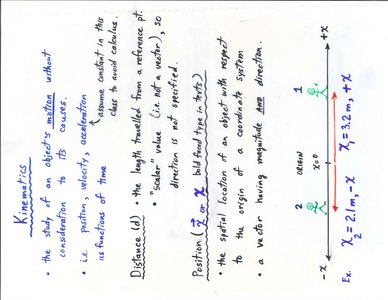
Kinematics is the study of an object's motion without consideration for the causes. Position and distance are functions of time. Distance is the length traveled from a reference point and is a scalar value. Position is the spatial location of an object in a coordinate system and can be represented as a vector.
Key Point: Position and distance are foundational concepts in motion analysis.
Example: If an object moves from x1 = 2.1 m to x2 = 3.2 m, the displacement is x2 - x1 = 1.1 m.
Average and Instantaneous Speed
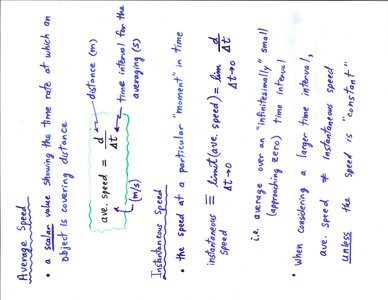
Average speed is the rate at which an object covers distance over a time interval. Instantaneous speed is the speed at a particular moment in time.
Formula:
Formula:
Example: If an object travels 10 m in 2 s, its average speed is 5 m/s.
Displacement
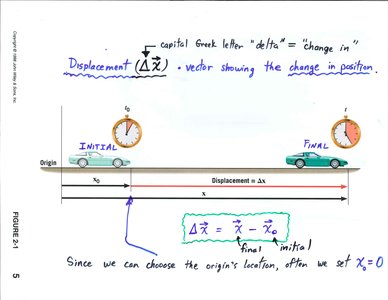
Displacement is a vector showing the change in position, represented by the capital Greek letter delta (Δ). It is calculated as the final position minus the initial position.
Formula:
Example: If an object moves from x0 = 0 to x = 5 m, its displacement is 5 m.
Average and Instantaneous Velocity
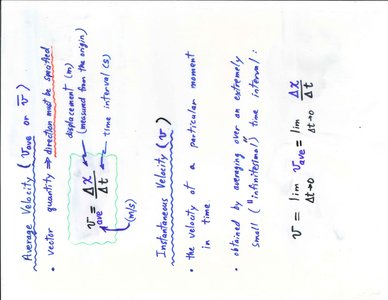
Average velocity is a vector quantity defined as displacement divided by time interval. Instantaneous velocity is the velocity at a particular moment in time.
Formula:
Formula:
Example: If an object moves 10 m east in 2 s, its average velocity is 5 m/s east.
Average Acceleration
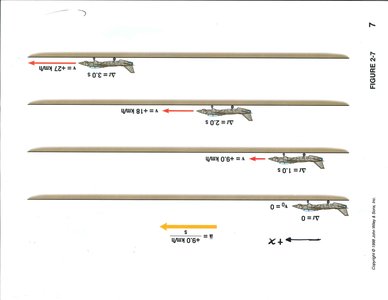
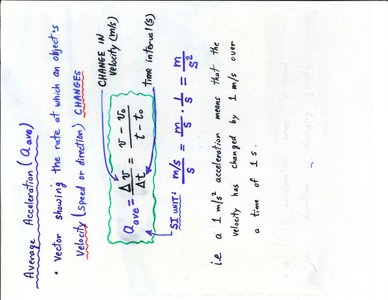
Average acceleration is the rate at which an object's velocity changes over a time interval. It is a vector quantity.
Formula:
Example: If velocity changes from 0 to 10 m/s in 2 s, average acceleration is 5 m/s2.
Deceleration
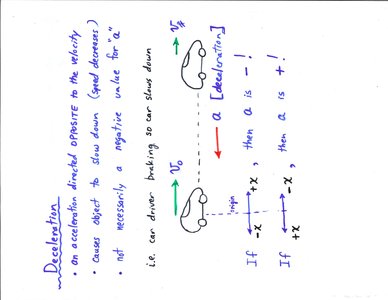
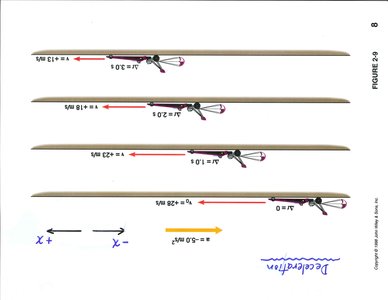
Deceleration is an acceleration directed opposite to the velocity, causing an object to slow down. It is not necessarily a negative value for acceleration.
Key Point: Deceleration occurs when the velocity decreases.
Example: A car braking to slow down experiences deceleration.
Constant Acceleration Kinematics
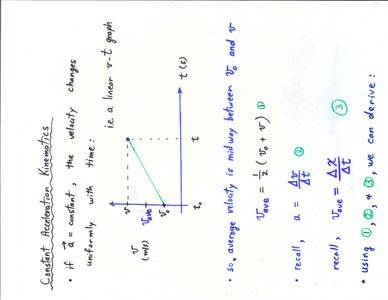
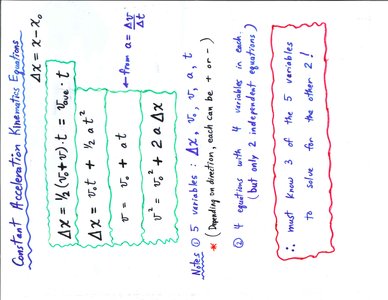
If acceleration is constant, the velocity changes uniformly with time. The average velocity is midway between initial and final velocities, and several kinematic equations can be derived.
Formula:
Formula:
Formula:
Formula:
Example: If a car starts from rest and accelerates at 2 m/s2 for 3 s, its final velocity is m/s.
Graphical Representation of Motion
Graphs of position, velocity, and acceleration versus time are useful for visualizing motion. Linear graphs indicate constant velocity or acceleration.
Key Point: The slope of a position-time graph gives velocity; the slope of a velocity-time graph gives acceleration.
Example: A straight line on a velocity-time graph indicates constant acceleration.
Motion Diagrams
Motion diagrams illustrate the direction and magnitude of velocity and acceleration vectors at different points in time.
Key Point: Arrows indicate the direction of motion and changes in velocity.
Example: A skier moving down a slope with increasing velocity is shown with longer arrows as time progresses.
Additional info:
Some content was inferred and expanded for academic completeness, such as the explicit formulas for kinematic equations and the explanation of SI units.
