 Back
BackPhysics Homework 8: Step-by-Step Study Guidance
Study Guide - Smart Notes
 Tailored notes based on your materials, expanded with key definitions, examples, and context.
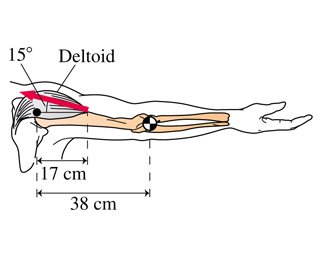
Q1. What force must the deltoid muscle provide to keep the arm in this position?
Background
Topic: Static Equilibrium and Torque
This question tests your understanding of how muscles generate forces to maintain static equilibrium in the human body, specifically using torque calculations.
Key Terms and Formulas
Torque ():
Static Equilibrium: The sum of all torques about any point must be zero.
Force of gravity:
Step-by-Step Guidance
Identify the forces acting on the arm: the weight of the arm () and the force from the deltoid muscle ().
Calculate the torque due to the weight of the arm about the shoulder joint. Use m (distance to center of mass) and kg.
Set up the torque equation for static equilibrium: .
Express the torque from the deltoid muscle using its force, distance ( m), and angle ().
Try solving on your own before revealing the answer!
Final Answer: 220 N
The deltoid must provide a force much greater than the weight of the arm due to the small angle and short lever arm.
Q2. By what factor does this force exceed the weight of the arm?
Background
Topic: Ratio of Forces
This question asks you to compare the force generated by the deltoid muscle to the actual weight of the arm.
Key Terms and Formulas
Weight of the arm:
Ratio:
Step-by-Step Guidance
Calculate the weight of the arm using kg and m/s.
Use the previously calculated deltoid force.
Set up the ratio formula: .
Try solving on your own before revealing the answer!
Final Answer: 5
The deltoid force is about 5 times greater than the weight of the arm, due to the mechanical disadvantage.
Q3. What is the critical angle for the unloaded double-decker bus?
Background
Topic: Stability and Center of Gravity
This question tests your understanding of how the center of gravity and track width affect the tipping angle of a vehicle.

Key Terms and Formulas
Critical angle ():
= track width, = height of center of gravity
Step-by-Step Guidance
Identify the values: m, m (unloaded).
Set up the formula: .
Calculate and then use the arctangent function to find .
Try solving on your own before revealing the answer!
Final Answer: 35.3°
The critical angle is found using the ratio of track width to twice the height of the center of gravity.
Q4. What is the force required to support the wheelbarrow?
Background
Topic: Static Equilibrium and Torque
This question tests your ability to use torque and equilibrium to find the force needed to support a load.

Key Terms and Formulas
Torque ():
Static Equilibrium:
Step-by-Step Guidance
Identify the forces: weight of the wheelbarrow and load, and the supporting force at the handles.
Calculate the torque due to the weight about the axle using m and kg.
Set up the equilibrium equation: .
Try solving on your own before revealing the answer!
Final Answer: 340 N
The supporting force is calculated using the torque balance about the axle.
Q5. What is the tension in the cable supporting the sign?
Background
Topic: Static Equilibrium and Forces
This question tests your ability to analyze forces in a system in static equilibrium, specifically using trigonometry to resolve tensions.
Key Terms and Formulas
Force components: and
Static Equilibrium: and
Step-by-Step Guidance
Identify the forces: weight of the sign ( kg), tension in the cable, and the angle ().
Set up the equilibrium equations for vertical and horizontal forces.
Use the torque equation about the pivot point to solve for the tension in the cable.
Try solving on your own before revealing the answer!
Final Answer: 165 N
The tension is found by balancing torques and using the geometry of the setup.
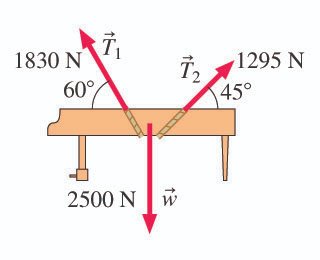
Q6. How much work is done by the weight of the piano as it is lowered?
Background
Topic: Work and Energy
This question tests your understanding of work done by a force over a distance, specifically gravitational work.

Key Terms and Formulas
Work ():
Weight:
Step-by-Step Guidance
Identify the mass of the piano ( kg) and the distance lowered ( m).
Calculate the weight: .
Set up the work formula: .
Try solving on your own before revealing the answer!
Final Answer: 1.0 × 10⁴ J
The work is calculated by multiplying the weight by the distance the piano is lowered.
