 Back
BackPhysics I Exam Study Guidance: Vectors, Kinematics, Projectile Motion, and Forces
Study Guide - Smart Notes
 Tailored notes based on your materials, expanded with key definitions, examples, and context.
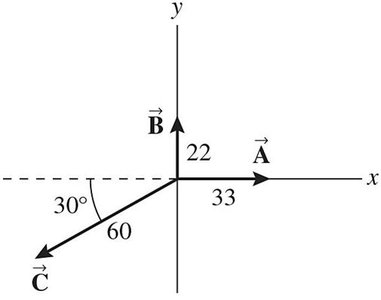
Q4. The figure shows three vectors, \( \vec{A} \), \( \vec{B} \), and \( \vec{C} \), along with their magnitudes. Determine the magnitude and direction of the vector given by \( \vec{A} - \vec{B} - \vec{C} \).
Background
Topic: Vector Addition and Subtraction
This question tests your ability to use vector components to add and subtract vectors, and then find the magnitude and direction of the resulting vector.
Key Terms and Formulas
Vector components: Each vector can be broken into x and y components.
Resultant vector: The sum or difference of vectors, calculated component-wise.
Magnitude:
Direction:
Step-by-Step Guidance
Break each vector into its x and y components. Use trigonometry for \( \vec{C} \): , , , (since \( \vec{C} \) points down and left)
Calculate the numerical values for \( C_x \) and \( C_y \):
Set up the subtraction: \( \vec{A} - \vec{B} - \vec{C} \) means subtracting each component:
Plug in the values for each component and simplify to get \( R_x \) and \( R_y \).
Try solving on your own before revealing the answer!
Final Answer: 85 m at 5.4° above the +x-axis
After calculating the components and using the formulas for magnitude and direction, you find the resultant vector's magnitude and angle.
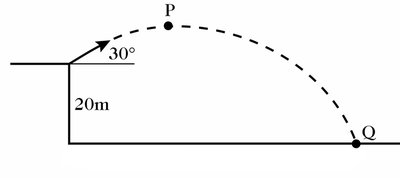
Q14. A projectile is fired from the edge of a cliff as shown in the figure. The initial velocity components are 940 m/s (horizontal) and 96 m/s (vertical). The projectile reaches maximum height at point P and then falls and strikes the ground at point Q. How high is point P above point Q, assuming no air resistance?
Background
Topic: Projectile Motion (Vertical Displacement)
This question tests your understanding of how to calculate the maximum height reached by a projectile, given its initial vertical velocity.
Key Terms and Formulas
Maximum height:
: Initial vertical velocity
: Acceleration due to gravity (9.8 m/s2)
Step-by-Step Guidance
Identify the initial vertical velocity: m/s.
Recall the formula for maximum height above the starting point: .
Plug in the values for and into the formula.
Calculate to find the height difference between P and Q.
Try solving on your own before revealing the answer!
Final Answer: 490 m
Using the formula and plugging in the values gives the height difference between P and Q.
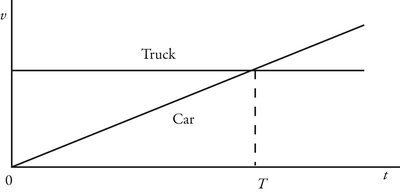
Q35. The motions of a car and a truck along a straight road are represented by the velocity-time graphs in the figure. The two vehicles are initially alongside each other at time t = 0. At time T, what is true about these two vehicles since time t = 0?
Background
Topic: Graphical Analysis of Motion
This question tests your ability to interpret velocity-time graphs and compare the distances traveled by two objects.
Key Terms and Formulas
Velocity-time graph: The area under the curve represents displacement.
Constant velocity: Horizontal line on the graph.
Increasing velocity: Sloped line on the graph.
Step-by-Step Guidance
Observe the graph: The truck has constant velocity, while the car's velocity increases linearly.
Recall that the area under each curve (from t = 0 to t = T) represents the distance traveled by each vehicle.
Compare the areas: For the truck, it's a rectangle; for the car, it's a triangle.
Think about which area is larger at time T, and what that means for the distance traveled.
Try solving on your own before revealing the answer!
Final Answer: The truck will have traveled further than the car.
The area under the truck's curve is greater than the area under the car's curve at time T.
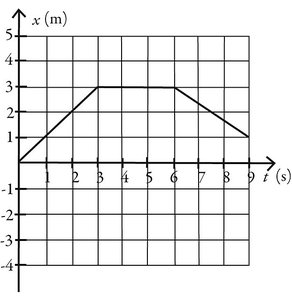
Q38. The figure shows the position of an object as a function of time. During the time interval from t = 0.0 s to t = 9.0 s: (a) What is the length of the path the object followed? (b) What is the displacement of the object?
Background
Topic: Kinematics – Distance vs. Displacement
This question tests your ability to distinguish between the total path length (distance) and displacement (straight-line change in position).
Key Terms and Formulas
Distance: Total length of the path traveled.
Displacement: Straight-line distance from initial to final position.
Step-by-Step Guidance
Read the graph to determine the object's position at each time interval.
Calculate the total path length by summing the segments where the object moves.
Find the displacement by subtracting the initial position from the final position.
Compare the two values to understand the difference between distance and displacement.
Try solving on your own before revealing the answer!
Final Answer: (a) 5.0 m (b) 1.0 m
The total path length is the sum of all segments, while displacement is the net change in position.
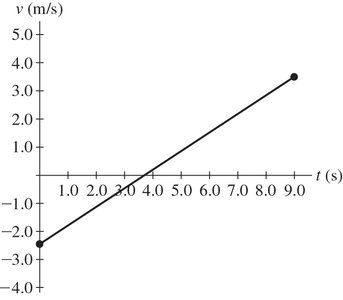
Q55. The motion of a particle is described in the velocity vs. time graph shown in the figure. Over the nine-second interval shown, we can say that the speed of the particle:
Background
Topic: Velocity-Time Graphs and Speed Analysis
This question tests your ability to interpret a velocity-time graph and describe how the speed of a particle changes over time.
Key Terms and Formulas
Speed: The magnitude of velocity (always positive).
Velocity-time graph: Shows how velocity changes with time.
Step-by-Step Guidance
Observe the graph: The velocity starts negative and increases to positive values.
Recall that speed is the absolute value of velocity.
Describe how the speed changes: As velocity moves from negative to positive, the speed decreases (approaching zero), then increases again.
Think about the physical meaning: The particle slows down, stops, then speeds up in the opposite direction.
Try solving on your own before revealing the answer!
Final Answer: The speed decreases and then increases.
The graph shows a transition from negative to positive velocity, indicating a decrease and then increase in speed.
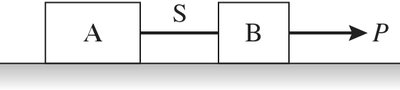
Q69. Two boxes, A and B, are connected by a horizontal string S on a horizontal floor. A very light wire pulls horizontally on box B, as shown in the figure, with a force of 100 N. The reaction force to this pull is:
Background
Topic: Newton's Third Law (Action-Reaction Pairs)
This question tests your understanding of action-reaction pairs in Newton's laws.
Key Terms and Formulas
Newton's Third Law: For every action, there is an equal and opposite reaction.
Action-reaction pair: Forces that are equal in magnitude and opposite in direction, acting on different objects.
Step-by-Step Guidance
Identify the force: The wire pulls on box B with 100 N.
Recall Newton's Third Law: The reaction force is exerted by box B on the wire.
Think about the direction and magnitude of the reaction force.
Make sure you understand which objects are involved in the action-reaction pair.
Try solving on your own before revealing the answer!
Final Answer: The pull of box B on the wire.
Box B exerts an equal and opposite force on the wire, as per Newton's Third Law.
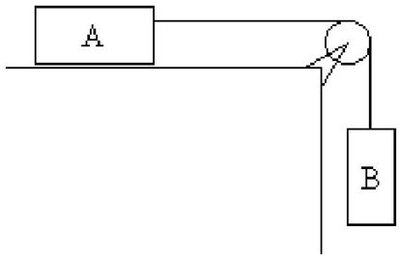
Q71. In the figure, block A has a mass of 3.00 kg. It rests on a smooth horizontal table and is connected by a very light horizontal string over an ideal pulley to block B, which has a mass of 2.00 kg. When block B is gently released from rest, how long does it take block B to travel 80.0 cm?
Background
Topic: Multiple-Object Accelerating Systems (Atwood Machine)
This question tests your ability to analyze a system of connected masses and calculate the time for a given displacement.
Key Terms and Formulas
Acceleration: (for frictionless Atwood machine)
Displacement: (starting from rest)
Masses: (on table), (hanging)
Step-by-Step Guidance
Calculate the acceleration of the system using the formula for an Atwood machine.
Set up the kinematic equation for displacement: .
Plug in the values for (0.80 m) and (from step 1).
Rearrange the equation to solve for .
Try solving on your own before revealing the answer!
Final Answer: 0.639 s
After calculating the acceleration and solving the kinematic equation, you find the time for block B to travel 80.0 cm.
