 Back
BackPhysics II: Electricity, Magnetism, Optics, and Modern Physics – Course Structure and Key Concepts
Study Guide - Smart Notes
 Tailored notes based on your materials, expanded with key definitions, examples, and context.
Course Overview
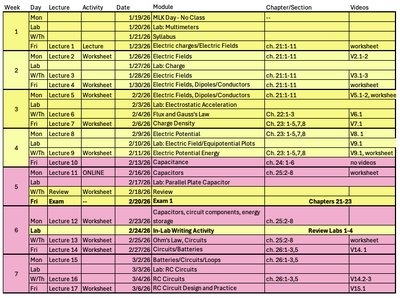
This course, Physics II (Phys 1120), is a calculus-based continuation of Physics I, focusing on electricity, magnetism, optics, and introductory modern physics. The curriculum is designed to provide students with a comprehensive understanding of fundamental physical laws, their mathematical representations, and practical applications. The course includes lectures, labs, worksheets, and exams, structured to reinforce both theoretical and experimental skills.
Course Structure and Weekly Topics
Electricity and Magnetism
The first half of the course covers the principles of electricity and magnetism, including electric fields, electric potential, capacitance, electric circuits, magnetic fields, and electromagnetic induction. These topics are foundational for understanding how electric and magnetic phenomena interact and are applied in technology.
Electric Charge and Electric Fields: Study of point charges, distributed charges, and conductors. Calculation of electric forces and fields using Coulomb's Law and superposition principle.
Electric Potential: Relationship between electric potential, potential energy, and electric field. Calculation of potential due to point charges and continuous charge distributions.
Capacitance and Dielectrics: Understanding capacitors, their storage of energy, and the effect of dielectric materials.
Electric Circuits: Analysis of DC circuits, including resistors, capacitors, and RC circuits. Application of Ohm's Law and Kirchhoff's rules.
Magnetic Fields and Forces: Calculation of magnetic fields produced by currents and magnetic materials. Determination of forces and torques on moving charges and currents.
Electromagnetic Induction: Application of Faraday's Law and Lenz's Law to understand induced emf and inductance.
Optics and Wave Phenomena
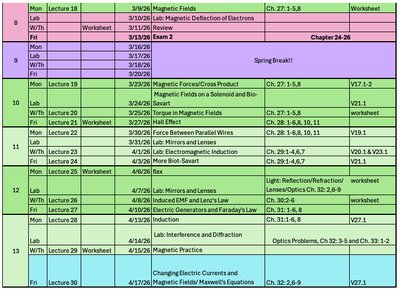
The second half of the course explores the properties of light, including reflection, refraction, interference, and diffraction. Students learn to analyze optical systems and understand the dual nature of light.
Reflection and Refraction: Study of light behavior at interfaces using the laws of reflection and Snell's Law.
Lenses and Mirrors: Analysis of image formation, magnification, and optical instruments.
Interference and Diffraction: Understanding wave superposition, constructive and destructive interference, and diffraction patterns.
Electromagnetic Waves: Properties of EM waves, production, and the Poynting vector.
Modern Physics and Nuclear Physics
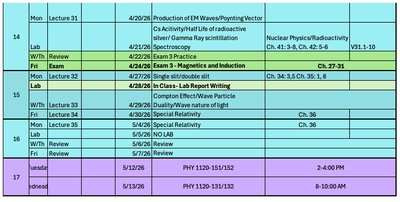
The final portion introduces quantum concepts and nuclear physics, including the photoelectric effect, Compton effect, and ionizing radiation. Students learn to compare the wave and particle nature of light and matter, and understand the implications for atomic and nuclear phenomena.
Photon Theory of Light: Explanation of the photoelectric effect and calculation of photon energy using .
Quantum Nature of Matter: Calculation of De Broglie wavelength for particles.
Special Relativity: Application of Einstein’s postulates, time dilation, length contraction, and mass-energy equivalence .
Nuclear Physics: Study of radioactive decay, gamma ray spectroscopy, and effects of ionizing radiation.
Laboratory Objectives and Skills
Experimental Analysis and Scientific Communication
Laboratory activities are designed to reinforce theoretical concepts through hands-on experimentation. Students develop proficiency in data analysis, error quantification, and scientific writing.
Application of Physical Laws: Solve problems and make quantitative predictions using analytical and numerical tools.
Graphical Analysis: Use graphs, curve-fitting, and regression to extract quantitative information from data.
Uncertainty and Error Analysis: Quantify measurement uncertainties and distinguish between random and systematic errors.
Scientific Writing: Communicate findings clearly in lab reports, using proper tables and figures.
Assessment and Grading
Evaluation Methods
Student performance is assessed through quizzes, homework, lab assignments, practica, midterm exams, and a cumulative final exam. The grading scale and policies ensure fair evaluation and encourage consistent engagement.
Quizzes and Homework: Regular pre-lecture and lab quizzes, online homework assignments.
Lab Assignments and Practica: Technical reports and in-class writing activities.
Exams: Three midterm exams and a comprehensive final exam.
Learning Objectives Pyramid
Hierarchy of Cognitive Skills
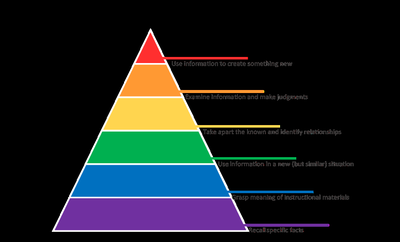
The course emphasizes a progression from basic recall of facts to higher-order thinking skills, including analysis, synthesis, and creation. This pyramid illustrates the levels of cognitive engagement expected from students.
Key Formulas and Concepts
Coulomb's Law:
Electric Field:
Electric Potential:
Capacitance:
Ohm's Law:
Faraday's Law:
De Broglie Wavelength:
Mass-Energy Equivalence:
Summary Table: Course Modules and Chapters
Module | Chapter/Section | Key Topics |
|---|---|---|
Electric Fields | Ch. 21-23 | Electric charge, fields, potential |
Circuits | Ch. 25-26 | Current, resistance, RC circuits |
Magnetism | Ch. 27-28 | Magnetic fields, forces, induction |
Optics | Ch. 32-35 | Reflection, refraction, interference, diffraction |
Modern Physics | Ch. 36-38 | Photoelectric effect, relativity, quantum mechanics |
Nuclear Physics | Ch. 41-43 | Radioactivity, nuclear energy, particles |
Additional info: The course schedule and learning objectives are inferred from the syllabus and weekly schedule tables. The pyramid image is included as it directly illustrates the cognitive learning objectives referenced in the course description.
