 Back
BackPhysics II for Engineers: Step-by-Step Study Guidance
Study Guide - Smart Notes
 Tailored notes based on your materials, expanded with key definitions, examples, and context.
Q1a. Deriving the Electric Potential of a Dipole at a Distant Point
Background
Topic: Electrostatics – Electric Potential of a Dipole
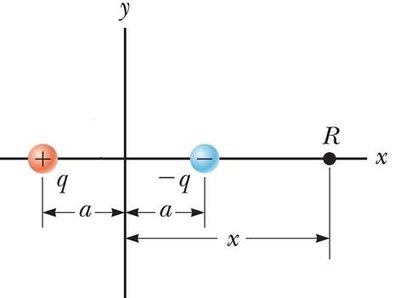
This question tests your understanding of how to derive the electric potential at a point along the axis of a dipole, starting from the potential due to a single point charge.
Key Terms and Formulas:
Electric potential due to a point charge:
Dipole: Two equal and opposite charges separated by distance
For large (far from dipole):
Step-by-Step Guidance
Write the expression for the potential at point due to each charge: and .
Add the potentials to get the total potential at : .
Combine the fractions and simplify the numerator and denominator.
For , use a binomial approximation to simplify the expression further.
Try solving on your own before revealing the answer!
Final Answer:
This result shows the potential falls off as for points far from the dipole.
Q1a ii. Electron Released Near a Dipole: Calculating Speed
Background
Topic: Energy Conservation in Electrostatics
This question tests your ability to use the change in electric potential energy to find the speed of an electron moving in the field of a dipole.
Key Terms and Formulas:
Potential energy change:
Conservation of energy:
Electron charge: C
Electron mass: kg
Step-by-Step Guidance
Calculate the potential at m and m using the dipole formula from part i.
Find the change in potential .
Calculate the change in potential energy: (since the electron has charge ).
Set equal to the kinetic energy and solve for .
Try solving on your own before revealing the answer!
Final Answer:
The speed is found by using the calculated .
This uses energy conservation: the electron's gain in kinetic energy equals the loss in potential energy.
Q1b. Calculating Currents in a Multi-Loop Circuit
Background
Topic: DC Circuits – Kirchhoff's Laws
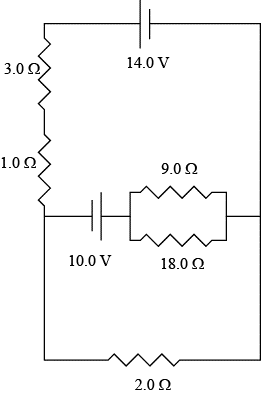
This question tests your ability to analyze a circuit with multiple loops and resistors using Kirchhoff's rules.
Key Terms and Formulas:
Kirchhoff's Current Law (KCL): at a junction
Kirchhoff's Voltage Law (KVL): around a loop
Ohm's Law:
Step-by-Step Guidance
Label the currents in each branch (e.g., through 3 Ω and 1 Ω, through 9 Ω and 18 Ω).
Write KVL equations for each loop, including the voltage sources and resistors.
Write KCL equations at the junctions to relate the currents.
Set up the system of equations and solve for the currents in each resistor.
Try solving on your own before revealing the answer!
Final Answer:
The values and directions of the currents are found by solving the simultaneous equations from KVL and KCL.
Check the sign of each current to determine its direction relative to your initial assumptions.
Q3a. Fraction of Light Intensity Through Three Polarizers
Background
Topic: Polarization of Light
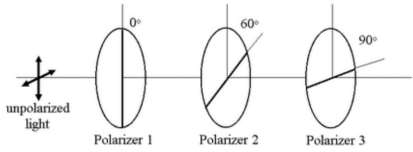
This question tests your understanding of how light intensity changes as it passes through multiple polarizers at different angles.
Key Terms and Formulas:
Malus's Law:
For unpolarized light, first polarizer:
Subsequent polarizers:
Step-by-Step Guidance
Calculate the intensity after Polarizer 1: .
Calculate the intensity after Polarizer 2: .
Calculate the intensity after Polarizer 3: .
Multiply the fractions to find the total fraction of emerging from the system.
Try solving on your own before revealing the answer!
Final Answer:
The fraction is .
This shows how the orientation of each polarizer affects the transmitted intensity.
