 Back
BackPhysics of Matter: States, Properties, and Thermal Phenomena
Study Guide - Smart Notes
 Tailored notes based on your materials, expanded with key definitions, examples, and context.
States of Matter
Classification and Properties
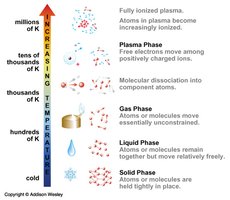
The physical state of matter is determined by the arrangement and behavior of its constituent particles. Matter exists in four primary states:
Solid: Rigid, retains shape unless acted upon by a force. Particles are tightly bound and only vibrate.
Liquid: Flows readily, conforms to the shape of its container, has a well-defined boundary, and higher density than gases.
Gas: Flows readily, conforms to the shape of its container, lacks a well-defined surface, and is easily compressed.
Plasma: Similar to gas but conducts electricity and interacts strongly with magnetic fields; exists at high temperatures.
Atomic and Molecular Structure
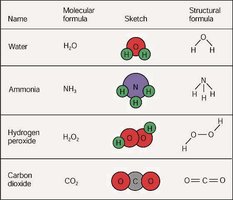
Matter is composed of atoms, which consist of a nucleus (protons and neutrons) surrounded by electrons. The number of protons (atomic number) distinguishes each element.
Elements: Pure substances made of one type of atom.
Compounds: Substances formed from two or more elements chemically bonded.
Behavior of Atoms and Molecules
Solids, Liquids, and Gases
The behavior of atoms and molecules varies by state:
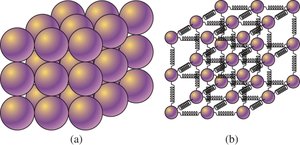
Solids: Strong attractive forces; atoms/molecules are rigidly bound and vibrate in place.
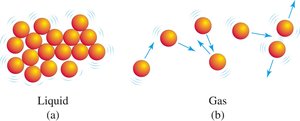
Liquids: Particles are bound but not rigidly; move relative to each other but remain in contact.
Gases: Weak attractive forces; particles move freely and are widely separated, interacting only during collisions.
Crystalline vs. Amorphous Solids
Crystals: Solids with regular geometric patterns.
Amorphous solids: Lack regular structure.
Gas Pressure
Gas molecules exert force on container walls, producing pressure. If molecules are stationary, no pressure is exerted. 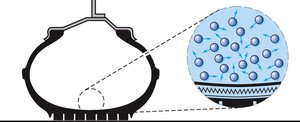
Compressibility of Gases
Gases are easily compressed due to the large spaces between particles. Compression forces atoms closer, potentially forming a liquid. 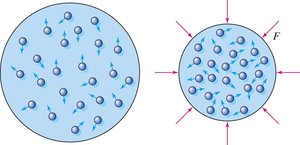
Fluid Mechanics
Definition of Fluids
A fluid is any substance that flows, including liquids and gases.
Liquids: Fixed volume, deform to container shape.
Gases: Expand to fill any container.
Density
Density () is mass () per unit volume ():
Density of solids and liquids changes slightly with temperature and pressure.
Density of gases changes greatly with temperature and pressure.
Pressure
Pressure () is force () per unit area ():
Pressure is exerted by fluids on their containers and vice versa.
Atmospheric pressure at sea level:
Pressure in Fluids
Pressure at any point in a liquid depends on the depth below the surface. 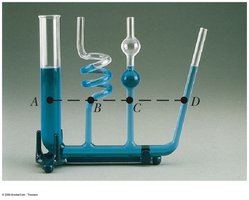
Buoyancy and Archimedes' Principle
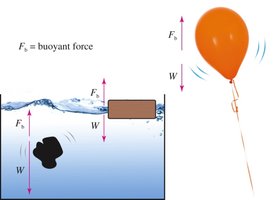
The buoyant force on an object in a fluid equals the weight of the fluid displaced.
If , the object sinks.
If , the object floats.
Pascal's Principle
A change in pressure applied to an enclosed fluid is transmitted undiminished throughout the fluid.
Bernoulli's Principle
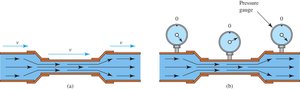
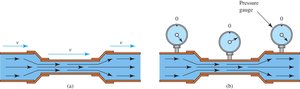
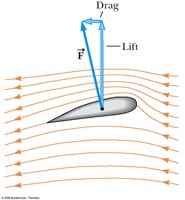
In fluid flow, faster-moving fluids exert less pressure. Bernoulli's equation is based on conservation of energy: 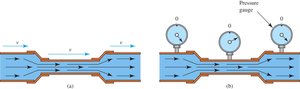
Temperature and Heat
Thermal Equilibrium and Zeroth Law
Objects in contact reach the same temperature, establishing thermal equilibrium. The Zeroth Law states: If A and B are each in thermal equilibrium with C, then A and B are in thermal equilibrium with each other.
Temperature Scales
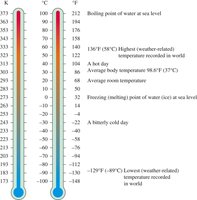
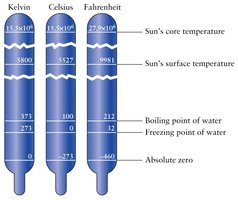
Temperature is measured in Fahrenheit, Celsius, and Kelvin.
Kelvin: Absolute scale, proportional to average kinetic energy.
Celsius: Water freezes at 0°C, boils at 100°C.
Fahrenheit: Water freezes at 32°F, boils at 212°F.
Temperature and Kinetic Energy
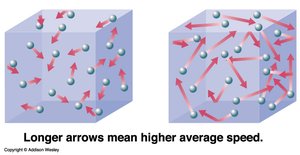
The Kelvin temperature is proportional to the average kinetic energy of particles. As temperature increases, average speed and momentum of particles increase. 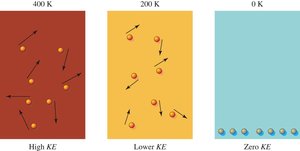
Heat and Internal Energy
Heat is the energy transferred due to temperature difference. It is not the same as temperature.
Heat transfer increases internal energy, raising temperature.
Different substances have different specific heat capacities.
Joule's Experiment and First Law of Thermodynamics
Energy added as heat or work increases internal energy. First Law: Energy is conserved; total energy (including heat) remains constant in an isolated system. 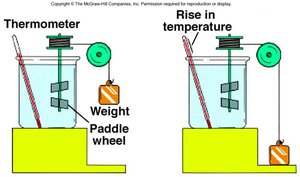
Heat Transfer
Modes of Heat Transfer
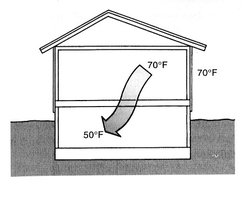
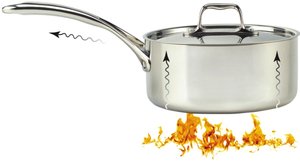
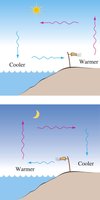
Heat flows from hot to cold via three mechanisms:
Conduction: Transfer through direct contact.
Convection: Transfer by fluid movement.
Radiation: Transfer via electromagnetic waves.

Electromagnetic Radiation and Light
Wave Nature of Light
Light is electromagnetic radiation, consisting of waves with definite wavelength and amplitude. 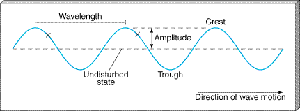
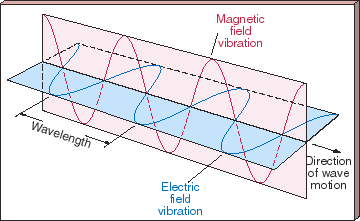
Electromagnetic Spectrum
The spectrum includes radio, microwave, infrared, visible, ultraviolet, X-rays, and gamma rays. Only some (UV, X-ray, gamma) are harmful to cells. 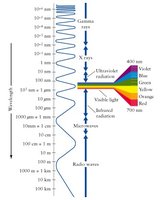
Radiation from Hot Objects
Hot objects emit radiation over a range of wavelengths.
Room temperature objects emit mostly infrared.
Objects hotter than ~1000°C emit visible light.
Second Law of Thermodynamics and Entropy
Second Law
Heat flows spontaneously from hot to cold, not the reverse.
Entropy
Entropy measures disorder; it always increases in irreversible processes. Energy is conserved but tends to degrade to heat, becoming less available for work.
Special Properties of Water
Density Anomaly
Water contracts when heated from 0°C to 4°C, then expands from 4°C to 100°C. This property allows lakes to freeze from the surface downward, supporting aquatic life. Additional info: This is due to the unique structure of water molecules and hydrogen bonding.
