 Back
BackPhysics of Matter: States, Structure, and Thermal Properties
Study Guide - Smart Notes
 Tailored notes based on your materials, expanded with key definitions, examples, and context.
States and Structure of Matter
Classification of Matter
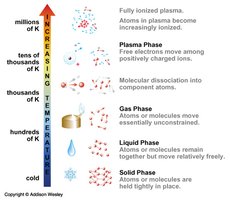
Matter exists in four fundamental states: solid, liquid, gas, and plasma. Each state is characterized by distinct physical properties and particle arrangements.
Solid: Rigid structure; retains shape unless acted upon by a force. Particles are closely packed and vibrate about fixed positions.
Liquid: Flows readily; conforms to the shape of its container; has a well-defined surface. Particles are close but can move past one another.
Gas: Flows readily; conforms to the shape of its container; does not have a well-defined surface; easily compressed. Particles are far apart and move freely.
Plasma: Similar to gas but consists of charged particles; conducts electricity and interacts with magnetic fields; found at high temperatures.
Atomic and Molecular Structure
All matter is composed of atoms, which consist of a dense nucleus (protons and neutrons) surrounded by electrons. The number of protons (atomic number) defines the element. Atoms combine to form molecules, which are the building blocks of compounds.
Element: Substance made of only one kind of atom.
Compound: Substance formed from two or more elements chemically bonded in fixed proportions.
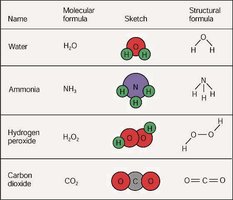
Name | Molecular Formula | Sketch | Structural Formula |
|---|---|---|---|
Water | H2O | O with two H attached | H-O-H |
Ammonia | NH3 | N with three H attached | H-N-H (with one H above N) |
Hydrogen Peroxide | H2O2 | Two O with two H attached | H-O-O-H |
Carbon Dioxide | CO2 | C with two O attached | O=C=O |
Crystalline and Amorphous Solids
Solids can be classified based on the arrangement of their particles:
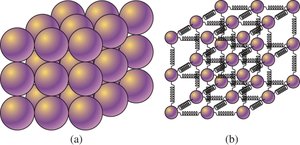
Crystalline solids: Atoms or molecules are arranged in a regular, repeating geometric pattern (crystal lattice).
Amorphous solids: Lack a regular structure; particles are arranged randomly.
Behavior of Atoms and Molecules in Different States
The behavior of particles varies with the state of matter:
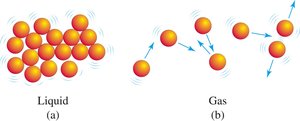
Solids: Strong attractive forces; particles vibrate but do not move freely.
Liquids: Moderate attractive forces; particles move past each other but remain in contact.
Gases: Weak attractive forces; particles move independently and are widely separated.
Fluids and Pressure
Definition of Fluids
A fluid is any substance that can flow, including both liquids and gases. Fluids take the shape of their container and can be compressed (gases more so than liquids).
Pressure in Fluids
Pressure is defined as the force exerted per unit area:
Pressure in a fluid is exerted equally in all directions at a given depth.
Atmospheric pressure at sea level is approximately N/m2.
Compressibility of Gases
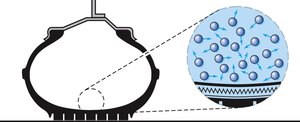
Gases are easily compressed because most of their volume is empty space between particles. Compressing a gas reduces this space, increasing pressure.
Pascal’s Principle
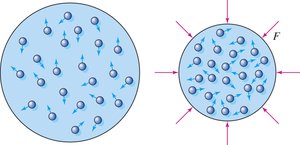
Pascal’s Principle states that a change in pressure applied to an enclosed fluid is transmitted undiminished throughout the fluid. This principle is the basis for hydraulic systems.
Pressure in Liquids
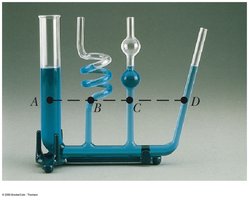
The pressure at any point in a liquid depends on the depth below the surface. The deeper you go, the greater the pressure due to the weight of the liquid above.
Archimedes’ Principle and Buoyancy
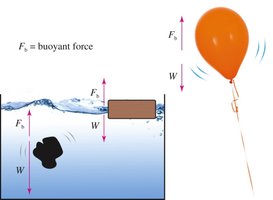
Archimedes’ Principle states that the buoyant force on an object immersed in a fluid is equal to the weight of the fluid displaced by the object. This explains why objects float or sink depending on their density relative to the fluid.
If , the object sinks.
If , the object floats.
Bernoulli’s Principle
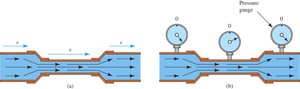
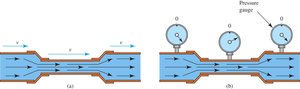
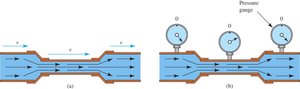
Bernoulli’s Principle relates the speed of a fluid to its pressure. In a streamline flow, an increase in the speed of the fluid occurs simultaneously with a decrease in pressure or potential energy.
Faster fluid flow = lower pressure
Slower fluid flow = higher pressure
Lift and Airfoils
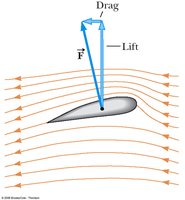
Bernoulli’s Principle explains the lift force on airplane wings: air moves faster over the top surface, creating lower pressure above the wing and generating lift.
Temperature and Heat
Temperature and Its Measurement
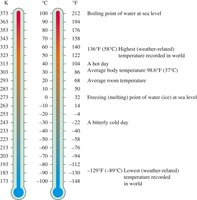
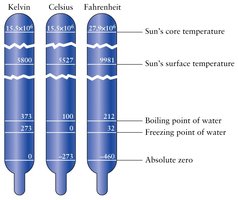
Temperature is a measure of the average kinetic energy of the particles in a substance. It is measured in Fahrenheit (°F), Celsius (°C), and Kelvin (K).
Kelvin is the SI unit and is directly proportional to average kinetic energy.
Temperature conversions:
Kinetic Theory and Temperature
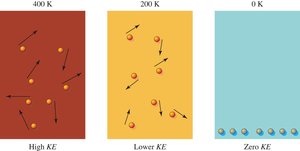
As temperature increases, the average kinetic energy and speed of particles increase. At absolute zero (0 K), particle motion theoretically ceases.
Heat and Internal Energy
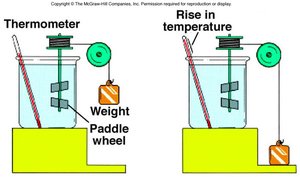
Heat is the energy transferred between objects due to a temperature difference. It is not the same as temperature. The internal energy of a substance is the total energy of all its particles.
Specific Heat Capacity
Different substances require different amounts of energy to change temperature. Specific heat capacity () is the amount of heat required to raise the temperature of 1 kg of a substance by 1 K.
Water has a high specific heat capacity, making it effective for thermal regulation.
Heat Transfer Mechanisms
Conduction
Heat is transferred through direct contact between particles. Metals are good conductors; insulators are poor conductors.

Convection
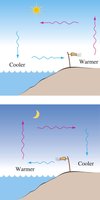
Heat is transferred by the movement of fluids (liquids or gases). Warm fluid rises, cool fluid sinks, creating convection currents.
Radiation
Heat is transferred by electromagnetic waves and does not require a medium. All objects emit radiation depending on their temperature.

Thermodynamics
First Law of Thermodynamics
The total energy of an isolated system is conserved. Energy can be transformed between heat, work, and internal energy, but cannot be created or destroyed.
Second Law of Thermodynamics and Entropy
Heat flows spontaneously from hot to cold objects. Entropy is a measure of disorder; in any real process, the total entropy of the universe increases.
Energy becomes less available for doing work as entropy increases.
