 Back
BackPhysics Study Guidance: Circular Motion, Projectile Motion, and Work
Study Guide - Smart Notes
 Tailored notes based on your materials, expanded with key definitions, examples, and context.
Q2. Kent threw a water balloon at Sarah and missed. The balloon hit the wall exactly 1.75 s after it was released. What was the initial velocity (magnitude and direction) of the water balloon?
Background
Topic: Projectile Motion
This question tests your understanding of two-dimensional kinematics, specifically projectile motion. You need to determine the initial velocity of a projectile given its time of flight and displacement in both the horizontal and vertical directions.
Key Terms and Formulas
Projectile motion: The motion of an object thrown or projected into the air, subject only to acceleration due to gravity.
Horizontal motion:
Vertical motion:
Initial velocity components: ,
Magnitude of velocity:
Direction:
Step-by-Step Guidance
Identify the known values: total time of flight s, horizontal distance m, initial and final vertical positions ( m, m).
Write the equations for horizontal and vertical motion. For horizontal: . For vertical: .
Rearrange the horizontal equation to solve for : .
Plug the known values into the vertical motion equation and solve for : .
Once you have and , set up the formulas for the magnitude and direction of the initial velocity, but do not calculate them yet.
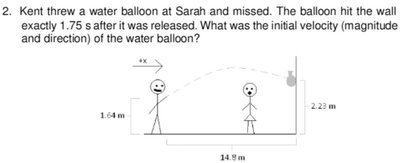
Try solving on your own before revealing the answer!
Final Answer:
Initial velocity magnitude: m/s
Direction: above the horizontal
We used the kinematic equations for projectile motion, solved for the horizontal and vertical components, and then combined them to find the magnitude and direction.
Q3. It takes Earth 365 days to complete one orbit around our Sun. Knowing that the magnitude of the average acceleration the Earth experiences over half an orbit is m/s, what is the average speed with which it travels? Express your answer in m/s.
Background
Topic: Circular Motion
This question is about uniform circular motion, specifically relating the centripetal acceleration of an object in orbit to its speed. The Earth's speed in its orbit can be found using the relationship between acceleration and velocity for circular motion.
Key Terms and Formulas
Uniform circular motion: Motion in a circle at constant speed.
Centripetal acceleration:
Orbital period: days (convert to seconds)
Circumference of orbit:
Average speed:
Step-by-Step Guidance
Start by noting the given centripetal acceleration m/s and the period days.
Convert the period from days to seconds: s.
Use the formula for centripetal acceleration to solve for the radius in terms of : .
Substitute into the average speed formula: , so .
Rearrange this equation to solve for in terms of and , but do not compute the final value yet.
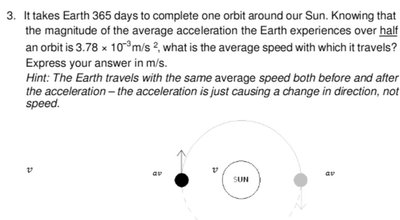
Try solving on your own before revealing the answer!
Final Answer:
Average speed: m/s
We used the relationship between centripetal acceleration and speed, and the period of Earth's orbit, to find the average speed.
