 Back
BackPhysics Study Guidance: Waves, Sound, and Interference
Study Guide - Smart Notes
 Tailored notes based on your materials, expanded with key definitions, examples, and context.
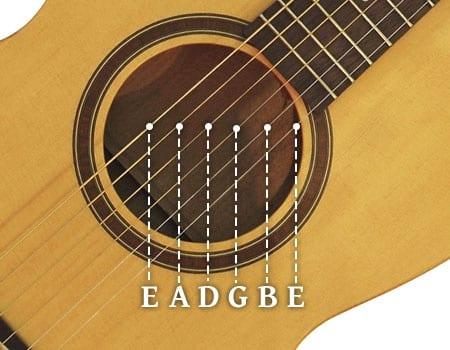
Q1. On a six-string guitar, the high E string has a linear density of kg/m and the low E string has a linear density of kg/m.
a) If the high E string is plucked, what is the speed of the wave if the tension of the string is 56.40 N?
Background
Topic: Waves on a String
This question tests your understanding of how wave speed on a stretched string depends on the tension and the string's linear density.
Key formula:
The speed of a wave on a string is given by:
= wave speed (m/s)
= tension in the string (N)
= linear mass density (kg/m)
Step-by-Step Guidance
Identify the known values: N, kg/m.
Write the formula for wave speed: .
Substitute the given values into the formula.
Calculate the value inside the square root first: .
Try solving on your own before revealing the answer!
Final Answer: 427 m/s
m/s
The wave speed is determined by the ratio of tension to linear density.
b) Calculate the tension of the low E string needed for the same wave speed.
Background
Topic: Waves on a String
This part asks you to solve for the tension required to achieve the same wave speed on a string with a different linear density.
Key formula:
Rearrange the wave speed formula to solve for tension:
= tension (N)
= wave speed (m/s) (from part a)
= linear mass density (kg/m) (for low E string)
Step-by-Step Guidance
Use the wave speed found in part (a): m/s.
Identify the linear density for the low E string: kg/m.
Plug these values into the formula: .
Calculate first, then multiply by .
Try solving on your own before revealing the answer!
Final Answer: 1055 N
N
This tension ensures the low E string has the same wave speed as the high E string.
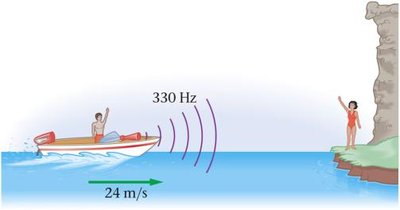
Q5. Jack is speeding toward Bell Island with a speed of 24.0 m/s when he sees Jill standing on shore at the base of a cliff. Jack sounds his 330-Hz horn.
a) What frequency does Jill hear?
Background
Topic: Doppler Effect
This question tests your understanding of how the observed frequency of a sound changes when the source and observer are moving relative to each other.
Key formula:
For a moving source and stationary observer:
= observed frequency
= source frequency (330 Hz)
= speed of sound in air (typically 343 m/s)
= speed of observer (0 m/s, Jill is stationary)
= speed of source (24.0 m/s, Jack moving toward Jill)
Step-by-Step Guidance
Identify the known values: Hz, m/s, m/s, m/s.
Write the Doppler effect formula for a moving source and stationary observer.
Substitute the values into the formula: .
Calculate the denominator first: .
Try solving on your own before revealing the answer!
Final Answer: 355 Hz
Hz
Jill hears a higher frequency because Jack is moving toward her.
b) Jack can hear the echo of his horn reflected back to him by the cliff. Calculate the frequency Jack hears in the echo from the cliff.
Background
Topic: Doppler Effect (Reflected Sound)
This part involves the Doppler effect twice: once as the sound travels to the cliff, and again as it reflects back to Jack.
Key formula:
First, calculate the frequency received by the cliff (stationary observer):
Then, treat the cliff as the new source, and Jack as the observer moving toward the source:
= frequency Jack hears in the echo
= frequency received by the cliff
= Jack's speed (24.0 m/s)
Step-by-Step Guidance
Calculate the frequency received by the cliff using the Doppler formula for a moving source.
Use this frequency as the new source frequency for the reflected sound.
Apply the Doppler formula for a moving observer (Jack) and stationary source (cliff).
Substitute all values and simplify the expressions step by step.
Try solving on your own before revealing the answer!
Final Answer: 380 Hz
Jack hears a higher frequency in the echo due to his motion toward the reflecting cliff.
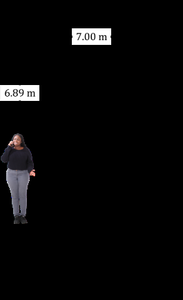
Q7. Sally the sound stage manager is checking the acoustics before the big concert. The amplifiers are separated by 7.00 m. The amplifiers are perfectly in phase, and each one emits sound with a power W at a frequency of Hz. You may assume the speed of sound is 343 m/s. Sally stands 6.89 m in front of one amplifier as shown.
a) At Sally’s position, is the interference constructive or destructive? Support your answer.
Background
Topic: Interference of Sound Waves
This question tests your understanding of constructive and destructive interference, which depends on the path difference between waves from two sources.
Key formula:
Path difference
Constructive interference occurs when (where is an integer).
Destructive interference occurs when .
= wavelength of sound
, = distances from Sally to each amplifier
Step-by-Step Guidance
Calculate the wavelength of the sound: , where m/s and Hz.
Find Sally's distance to each amplifier: m, m.
Calculate the path difference: .
Compare to to determine if the interference is constructive or destructive.
Try solving on your own before revealing the answer!
Final Answer: Constructive
The path difference is a multiple of the wavelength, so Sally experiences constructive interference.
