 Back
BackPhysics Study Guide: Kinematics, Dynamics, and Energy Concepts
Study Guide - Smart Notes
 Tailored notes based on your materials, expanded with key definitions, examples, and context.
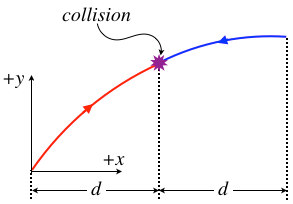
Q5. Which graph represents the vertical component of the velocity of the projectile fired from the ground, just before collision?
Background
Topic: Projectile Motion and Velocity Components
This question tests your understanding of how the vertical velocity of a projectile changes over time, especially when two projectiles collide head-on at a specific location.
Key Terms and Formulas:
Projectile motion: The motion of an object under gravity after being launched.
Vertical velocity (): The component of velocity in the vertical direction.
Gravity (): The acceleration due to gravity, typically downward.
Initial velocity (): The initial vertical component of velocity.
Equation for vertical velocity:
Step-by-Step Guidance
Recall that for a projectile launched from the ground at an angle, the vertical velocity starts positive (upward) and decreases linearly due to gravity.
As time progresses, gravity causes the vertical velocity to decrease, eventually reaching zero at the peak, then becoming negative (downward) as the projectile descends.
Since the collision occurs halfway between the starting points, consider the time just before the collision and whether the projectile is still rising or has started falling.
Examine the provided graphs and identify which one shows a vertical velocity that starts positive and decreases linearly, matching the expected behavior for the projectile fired from the ground.
Try solving on your own before revealing the answer!
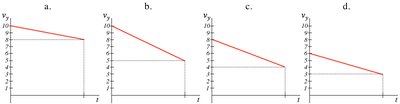
Final Answer: Graph a.
Graph a shows the vertical velocity starting positive and decreasing linearly, which matches the expected behavior for a projectile launched from the ground at an angle, just before collision.
The other graphs do not correctly represent the vertical velocity for this scenario.
