 Back
BackPhysics Study Guide: Rotational Motion, Torque, Moment of Inertia, and Angular Momentum
Study Guide - Smart Notes
 Tailored notes based on your materials, expanded with key definitions, examples, and context.
Q1. Define a radian and convert degrees to radians and vice-versa.
Background
Topic: Angular Measurement
This question tests your understanding of angular units and how to convert between degrees and radians, which is fundamental for rotational motion problems.
Key Terms and Formulas
Radian: The angle subtended at the center of a circle by an arc equal in length to the radius.
Degree: A unit of angular measurement; one full revolution is 360°.
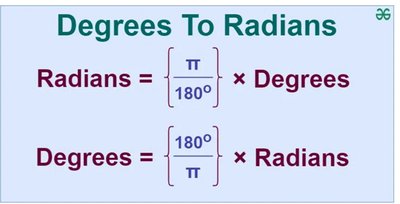
Conversion formulas:
Step-by-Step Guidance
Recall that equals radians. This is the basis for conversion between the two units.
To convert degrees to radians, multiply the degree value by .
To convert radians to degrees, multiply the radian value by .
Try converting a sample value, such as , to radians using the formula above.
Try solving on your own before revealing the answer!
Final Answer: radians
radians$
This conversion is essential for solving rotational motion problems in physics, as most equations use radians.
Q2. Identify that counterclockwise motion is in the positive direction and clockwise motion is in the negative direction.
Background
Topic: Direction of Angular Quantities
This question tests your understanding of the sign convention for rotational motion, which is important for correctly applying equations in physics.
Key Terms
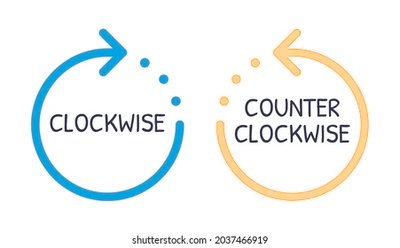
Counterclockwise (CCW): Positive direction for angular displacement, velocity, and acceleration.
Clockwise (CW): Negative direction for angular quantities.
Step-by-Step Guidance
Visualize a circle and imagine rotation about its center.
Assign positive values to counterclockwise rotation and negative values to clockwise rotation.
Apply this convention when solving problems involving angular displacement, velocity, or acceleration.
Try solving on your own before revealing the answer!
Final Answer: Counterclockwise is positive; clockwise is negative.
This sign convention is used throughout rotational motion problems to ensure consistency in calculations.
Q3. Relate the arc length (x) to the angular displacement (θ) and the distance (r) from the axis of rotation.
Background
Topic: Arc Length in Circular Motion
This question tests your ability to connect linear and angular quantities in rotational motion.
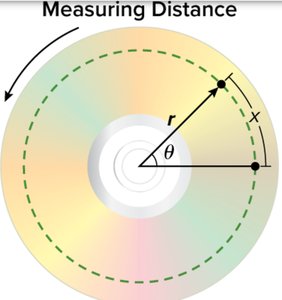
Key Formula
x = arc length (meters)
r = radius (meters)
θ = angular displacement (radians)
Step-by-Step Guidance
Identify the radius (r) of the circle and the angular displacement (θ) in radians.
Use the formula to relate the arc length to these quantities.
Check that θ is in radians before using the formula.
Plug in the values for r and θ to set up the calculation for arc length.
Try solving on your own before revealing the answer!
Final Answer: Arc length
By multiplying the radius by the angular displacement in radians, you find the length of the arc.
Q4. Apply the relationship between average angular velocity (ω), angular displacement (Δθ), and the time interval (Δt) for that displacement.
Background
Topic: Angular Velocity
This question tests your understanding of how angular velocity relates to angular displacement and time.
Key Formula
ω = angular velocity (rad/s)
Δθ = angular displacement (radians)
Δt = time interval (seconds)
Step-by-Step Guidance
Identify the angular displacement (Δθ) and the time interval (Δt).
Use the formula to relate these quantities.
Ensure that Δθ is in radians and Δt is in seconds for correct units.
Set up the calculation by plugging in the values for Δθ and Δt.
Try solving on your own before revealing the answer!
Final Answer:
This formula gives the average angular velocity over a time interval.
Q5. Relate the linear velocity (v) to the angular velocity (ω) and the distance (r) from the axis of rotation.
Background
Topic: Linear and Angular Velocity
This question tests your ability to connect linear and angular motion in rotational systems.
Key Formula
v = linear velocity (m/s)
r = radius (m)
ω = angular velocity (rad/s)
Step-by-Step Guidance
Identify the radius (r) and angular velocity (ω) of the rotating object.
Use the formula to relate linear and angular velocity.
Check that ω is in rad/s and r is in meters for correct units.
Set up the calculation by plugging in the values for r and ω.
Try solving on your own before revealing the answer!
Final Answer:
This formula shows how the speed of a point on a rotating object depends on its distance from the axis and the angular velocity.
Q6. Apply the relationship between average angular acceleration (α), change in angular velocity (Δω), and the time interval (Δt) for that change.
Background
Topic: Angular Acceleration
This question tests your understanding of how angular acceleration is calculated from changes in angular velocity over time.
Key Formula
α = angular acceleration (rad/s²)
Δω = change in angular velocity (rad/s)
Δt = time interval (s)
Step-by-Step Guidance
Identify the initial and final angular velocities to find Δω.
Determine the time interval (Δt) over which the change occurs.
Use the formula to relate these quantities.
Set up the calculation by plugging in the values for Δω and Δt.
Try solving on your own before revealing the answer!
Final Answer:
This formula gives the average angular acceleration over a time interval.
Q7. Define the term torque and apply the relation to calculate the magnitude of torque.
Background
Topic: Torque in Rotational Motion
This question tests your understanding of torque, which is the rotational equivalent of force.
Key Formula
τ = torque (N·m)
F = force (N)
r = lever arm (m)
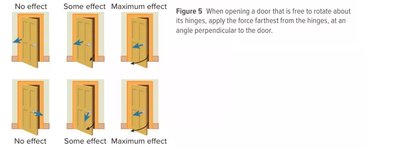
θ = angle between force and lever arm
Step-by-Step Guidance
Identify the force applied, the distance from the axis (lever arm), and the angle between the force and the lever arm.
Use the formula to calculate the torque.
If the force is perpendicular to the lever arm, and the formula simplifies to .
Set up the calculation by plugging in the values for F, r, and θ.
Try solving on your own before revealing the answer!
Final Answer:
This formula calculates the turning effect of a force applied at a distance from an axis.
Q8. Calculate the net torque when more than one torque acts on a body about a rotation axis.
Background
Topic: Net Torque and Equilibrium
This question tests your ability to sum torques and determine rotational equilibrium.
Key Formula
Assign positive sign to counterclockwise torques and negative sign to clockwise torques.
Step-by-Step Guidance
Identify all forces and their distances from the axis of rotation.
Calculate the torque produced by each force using .
Assign the correct sign to each torque based on its direction (CCW or CW).
Add up all torques to find the net torque.
Try solving on your own before revealing the answer!
Final Answer:
Net torque determines whether an object will rotate or remain in equilibrium.
Q9. Define moment of inertia and calculate it for a single point mass rotating about an axis.
Background
Topic: Moment of Inertia
This question tests your understanding of rotational inertia and how it is calculated for simple systems.
Key Formula
I = moment of inertia (kg·m²)
m = mass (kg)
r = distance from axis (m)
Step-by-Step Guidance
Identify the mass and its distance from the axis of rotation.
Use the formula to calculate the moment of inertia.
Plug in the values for m and r to set up the calculation.
Try solving on your own before revealing the answer!
Final Answer:
This formula gives the rotational inertia for a point mass at a distance r from the axis.
Q10. State Newton's second law for rotational motion and apply it to solve problems.
Background
Topic: Rotational Dynamics
This question tests your understanding of the relationship between net torque, moment of inertia, and angular acceleration.
Key Formula
= net torque (N·m)
I = moment of inertia (kg·m²)
α = angular acceleration (rad/s²)
Step-by-Step Guidance
Identify the net torque acting on the object.
Determine the moment of inertia for the object.
Use the formula to relate torque, inertia, and acceleration.
Set up the calculation by plugging in the values for and I.
Try solving on your own before revealing the answer!
Final Answer:
This formula is the rotational analog of Newton's second law for linear motion.
Q11. Define angular momentum and write its equation form.
Background
Topic: Angular Momentum
This question tests your understanding of angular momentum and its calculation for rotating objects.
Key Formula
L = angular momentum (kg·m²/s)
I = moment of inertia (kg·m²)
ω = angular velocity (rad/s)
Step-by-Step Guidance
Identify the moment of inertia and angular velocity of the object.
Use the formula to calculate angular momentum.
Plug in the values for I and ω to set up the calculation.
Try solving on your own before revealing the answer!
Final Answer:
This formula gives the angular momentum for a rotating object.
Q12. Explain the law of conservation of angular momentum and express it in equation form.
Background
Topic: Conservation Laws
This question tests your understanding of how angular momentum is conserved in the absence of external torque.
Key Formula
If no external torque acts, the total angular momentum remains constant.
Step-by-Step Guidance
Identify the initial and final moments of inertia and angular velocities.
Set up the equation to relate the two states.
Use this equation to solve for unknowns in conservation problems.
Try solving on your own before revealing the answer!
Final Answer:
This equation expresses the conservation of angular momentum in a closed, isolated system.
