 Back
BackPhysics Study Guide: Work, Energy, Momentum, and Rotational Motion (Chapters 6-9)
Study Guide - Smart Notes
 Tailored notes based on your materials, expanded with key definitions, examples, and context.
Work and Energy
Definition of Work
Work is a measure of energy transfer that occurs when an object is moved by a force. It is defined mathematically as:
Work (W): The product of force and displacement in the direction of the force.
Formula:
Units: Joules (J)
Example: Lifting a box vertically involves work equal to the weight of the box times the height lifted.
Kinetic Energy
Kinetic energy is the energy possessed by an object due to its motion.
Kinetic Energy (KE):
Units: Joules (J)
Example: A moving car has kinetic energy proportional to its mass and the square of its speed.
Potential Energy
Potential energy is stored energy due to an object's position or configuration.
Gravitational Potential Energy (PE):
Units: Joules (J)
Example: A rock at the top of a hill has gravitational potential energy.
Conservation of Energy
Principle of Conservation
The total energy in a closed system remains constant; energy can be transformed from one form to another but cannot be created or destroyed.
Mechanical Energy: Sum of kinetic and potential energy.
Conservation Equation:
Example: A pendulum swings, converting potential energy to kinetic energy and back.
Heat Transfer and Internal Energy
Heat Transfer
Heat is the transfer of thermal energy between systems due to temperature difference.
Methods: Conduction, convection, and radiation.
Formula for Heat:
Units: Joules (J)
Example: Heating water in a kettle involves heat transfer from the heating element to the water.
Internal Energy
Internal energy is the total energy contained within a system, including kinetic and potential energies of particles.
Change in Internal Energy:
First Law of Thermodynamics: Energy added as heat increases internal energy or does work.
Example: Compressing a gas increases its internal energy.
Momentum and Conservation of Momentum
Momentum
Momentum is the product of an object's mass and velocity, representing the quantity of motion.
Momentum (p):
Units: kg·m/s
Example: A moving truck has more momentum than a moving bicycle at the same speed.
Impulse
Impulse is the change in momentum resulting from a force applied over a time interval.
Impulse (J):
Units: kg·m/s or N·s
Example: Kicking a soccer ball applies an impulse, changing its momentum.
Conservation of Momentum
In a closed system, the total momentum before and after a collision remains constant.
Conservation Equation:
Types of Collisions: Elastic (kinetic energy conserved), inelastic (kinetic energy not conserved).
Example: Two ice skaters push off each other and move in opposite directions, conserving momentum.
Rotational Motion (Maybe Included)
Rotational Kinematics
Rotational motion describes the movement of objects around a fixed axis.
Angular Displacement (θ): Measured in radians.
Angular Velocity (ω):
Angular Acceleration (α):
Example: A spinning wheel has angular velocity and acceleration.
Rotational Energy
Rotational kinetic energy is the energy due to rotation.
Formula:
Moment of Inertia (I): Depends on mass distribution relative to axis.
Example: A figure skater spinning faster by pulling arms in reduces moment of inertia and increases angular velocity.
Conservation of Angular Momentum
Angular momentum is conserved in a closed system unless acted upon by external torque.
Angular Momentum (L):
Conservation Equation:
Example: A planet orbiting the sun conserves angular momentum.
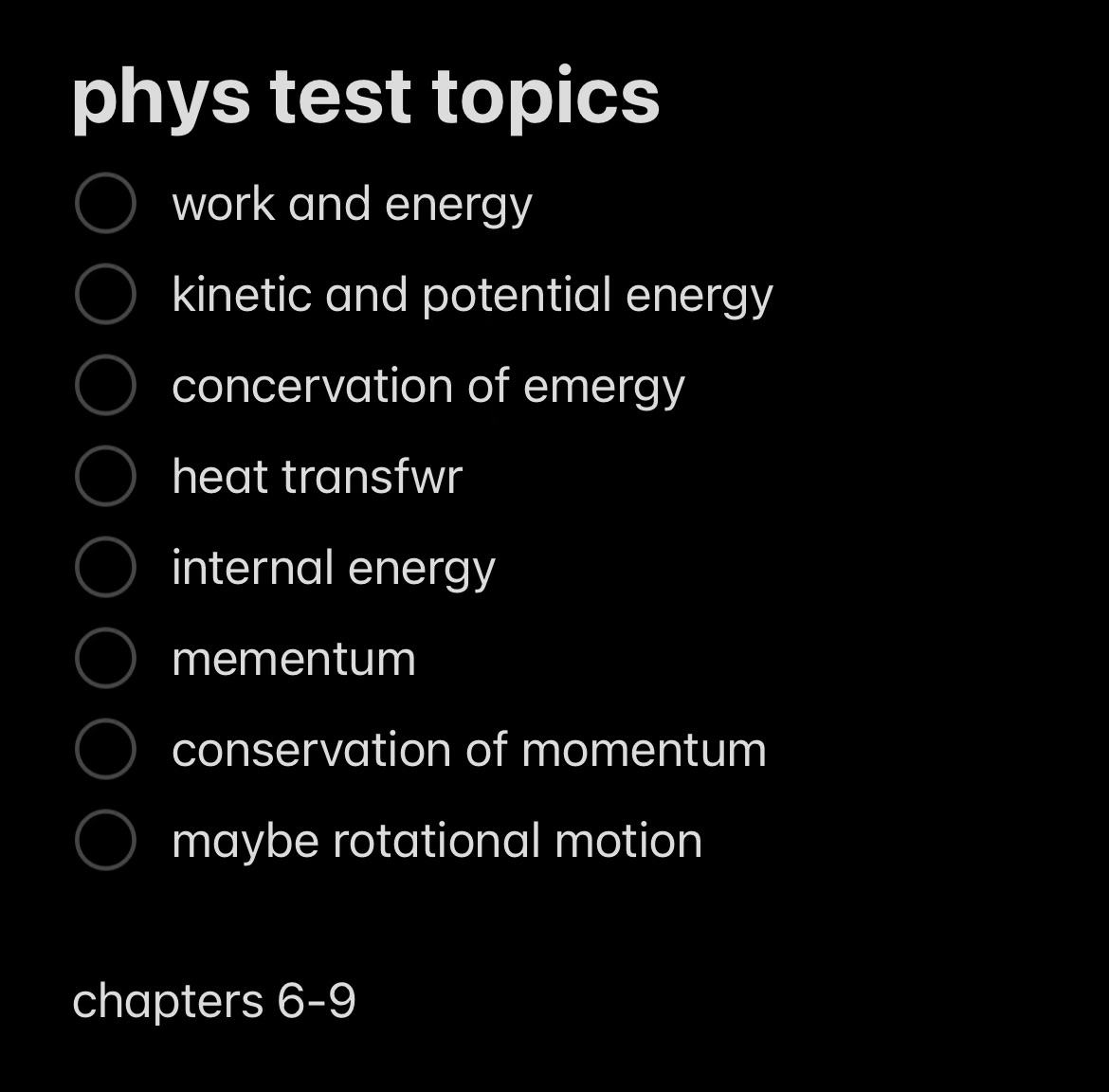
Additional info: Academic context and formulas have been expanded for completeness. Topics are grouped according to chapters 6-9 as indicated in the materials.
