 Back
BackPotential Energy and Energy Conservation: Structured Study Notes
Study Guide - Smart Notes
 Tailored notes based on your materials, expanded with key definitions, examples, and context.
Potential Energy and Energy Conservation
Introduction to Energy Concepts
Energy is a fundamental concept in physics, describing the ability of a system to perform work or produce change. In mechanical systems, energy can be stored and transformed between different forms, such as kinetic and potential energy. Understanding how energy is conserved and transferred is essential for analyzing physical phenomena.
Gravitational Potential Energy
Gravitational potential energy is the energy associated with an object's position in a gravitational field. It is particularly relevant in problems involving vertical motion.
Definition: The gravitational potential energy Ugrav of a particle of mass m at height y is given by: where g is the acceleration due to gravity.
Key Properties:
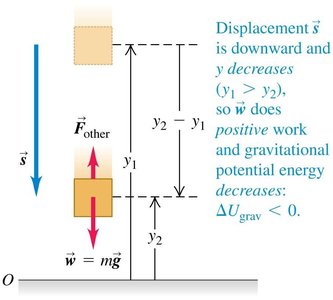
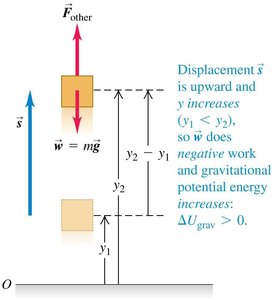
As an object moves upward, y increases and Ugrav increases.
As an object moves downward, y decreases and Ugrav decreases.
Work-Energy Relationship: The change in gravitational potential energy is related to the work done by gravity.
Example: A basketball descending toward the hoop converts gravitational potential energy into kinetic energy, increasing its speed.


The Conservation of Mechanical Energy
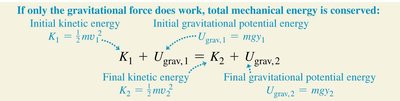
Mechanical energy is the sum of kinetic and potential energy in a system. When only conservative forces (such as gravity) act, the total mechanical energy is conserved.
Conservation Law: where K is kinetic energy and Ugrav is gravitational potential energy.
Conserved Quantity: A quantity that remains constant throughout a process.
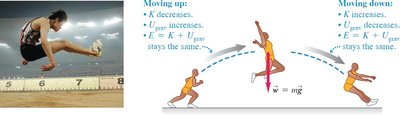
Example: In a vertical jump, as the athlete rises, kinetic energy decreases and potential energy increases, but their sum remains constant.
When Forces Other Than Gravity Do Work
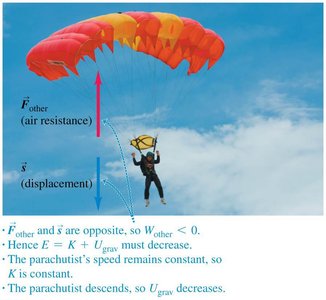
When non-gravitational forces (such as air resistance) act on a system, mechanical energy is not conserved. These forces can do positive or negative work, changing the total energy.
Example: A parachutist descending experiences air resistance, which opposes motion and reduces mechanical energy.
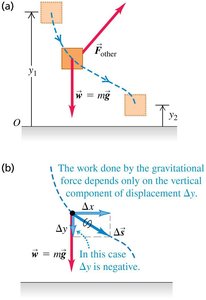
Work and Energy Along a Curved Path
The expression for gravitational potential energy applies regardless of whether the object's path is straight or curved. The work done by gravity depends only on the vertical displacement.
Formula:
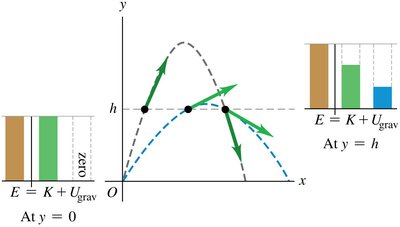
Example: Two balls launched from the same height with the same speed but at different angles will have the same change in gravitational potential energy.
Elastic Potential Energy
Elastic potential energy is stored in objects that can return to their original shape after being deformed, such as springs.
Definition: For an ideal spring, elastic potential energy is given by: where k is the spring constant and x is the displacement from equilibrium.
Key Properties:
Elastic potential energy is always non-negative.
The graph of Uel versus x is a parabola.
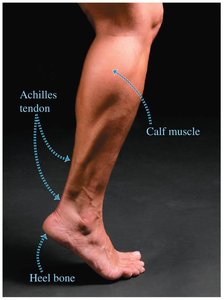
Example: The Achilles tendon acts like a spring, storing and releasing energy during running.
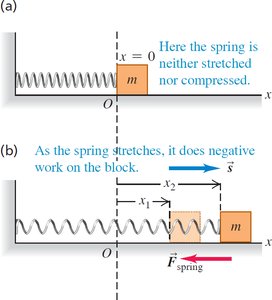
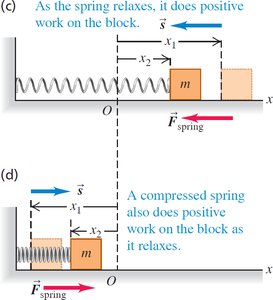
Work Done by a Spring
A spring can do work on an object as it stretches or compresses. The direction of work depends on whether the spring is being stretched or relaxed.
Work by Spring:
Negative work when stretching.
Positive work when relaxing or compressing.
Example: A block attached to a spring experiences work as the spring stretches or compresses.
Situations with Both Gravitational and Elastic Forces
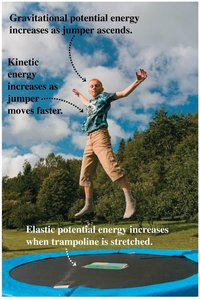
When both gravitational and elastic forces are present, the total potential energy is the sum of the two contributions.
Formula:
Example: A trampoline jumper has both gravitational and elastic potential energy.
Conservative and Nonconservative Forces
Forces are classified as conservative or nonconservative based on their effect on energy.
Conservative Forces:
Allow conversion between kinetic and potential energy.
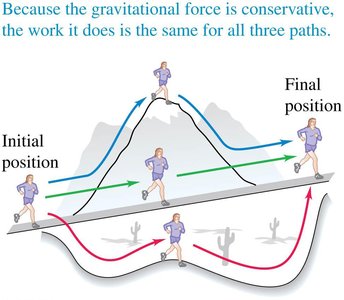
Work done is reversible and independent of path.
Examples: gravity, spring force.
Nonconservative Forces:
Do not store potential energy; convert mechanical energy to other forms (e.g., internal energy).
Examples: friction, air resistance.
Example: The work done by gravity is the same regardless of the path taken between two points.

Conservation of Energy
The law of conservation of energy states that energy is never created or destroyed, only transformed between forms. Nonconservative forces change the internal energy of a system.
General Energy Conservation Equation: where K is kinetic energy, U is potential energy, and Uint is internal energy.
Force and Potential Energy in One Dimension
In one-dimensional motion, the force associated with a potential energy function is the negative derivative of the potential energy with respect to position.
Formula:
Interpretation: Where U(x) changes rapidly, the force is large. The force always acts to reduce potential energy.
Example: For an ideal spring:

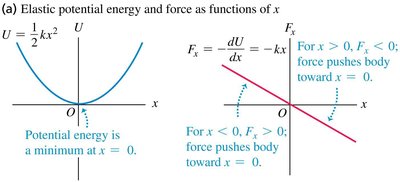
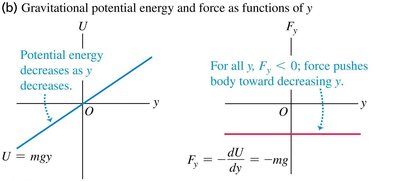
Force and Potential Energy in Three Dimensions
In three-dimensional motion, the components of a conservative force are given by the negative partial derivatives of the potential energy function.
Formulas:
Gradient: The vector sum of these derivatives is called the gradient of U:
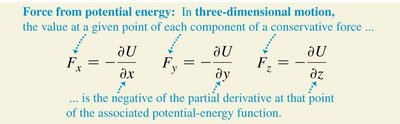
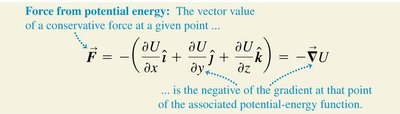
Example: In mountainous terrain, the gradient of gravitational potential energy determines the direction and magnitude of the force.

Energy Diagrams
Energy diagrams graphically represent the potential-energy function and total mechanical energy of a system. They are useful for visualizing motion limits and equilibrium points.
Key Features:
The intersection of the total energy line with the potential energy curve indicates the limits of motion.
Stable equilibrium occurs at minima of U; unstable equilibrium at maxima.
Example: A glider attached to a spring on an air track.
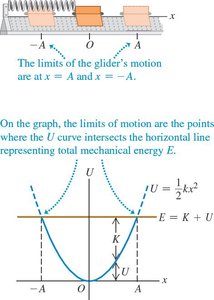
Force and a Graph of Its Potential-Energy Function
The force at any point is the negative slope of the potential energy function. Points where the slope is zero are equilibrium points.
Stable Equilibrium: At a minimum of U, the force acts to restore the object to equilibrium.
Unstable Equilibrium: At a maximum of U, the force acts to move the object away from equilibrium.
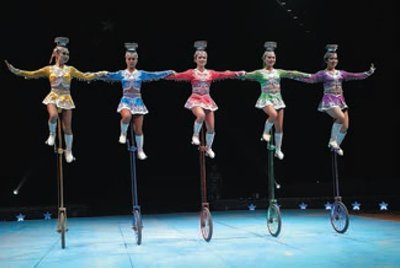
Example: Acrobats balancing on unicycles are in unstable equilibrium; any deviation causes them to fall further.
Summary Table: Conservative vs. Nonconservative Forces
Property | Conservative Force | Nonconservative Force |
|---|---|---|
Potential Energy Function | Exists | Does not exist |
Work Path Dependence | Independent of path | Dependent on path |
Energy Conversion | Kinetic → Potential | Mechanical → Internal |
Examples | Gravity, Spring | Friction, Air Resistance |
Additional info: Table entries inferred for completeness.
