 Back
BackPotential Energy and Energy Conservation: Study Notes
Study Guide - Smart Notes
 Tailored notes based on your materials, expanded with key definitions, examples, and context.
Potential Energy and Energy Conservation
Introduction to Potential Energy
Potential energy is a form of energy associated with the position or configuration of an object within a force field, such as gravity or elasticity. In physics, potential energy is crucial for understanding how energy is stored and transferred in mechanical systems.
Gravitational Potential Energy
Gravitational potential energy is the energy stored in an object due to its position in a gravitational field. It is most commonly encountered in problems involving vertical motion.
Definition: The energy associated with a particle's position relative to the Earth.
Formula: where m is mass, g is acceleration due to gravity, and y is the vertical coordinate.
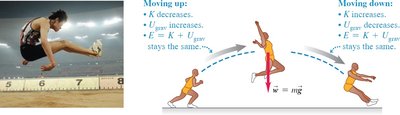
Application: As an object moves upward, its gravitational potential energy increases; as it descends, this energy is converted to kinetic energy.
Example: A basketball descending towards the hoop converts gravitational potential energy to kinetic energy, increasing its speed.


Conservation of Mechanical Energy
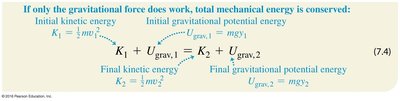
The total mechanical energy of a system is the sum of its kinetic and potential energies. When only conservative forces (such as gravity) act, mechanical energy is conserved.
Conserved Quantity: A quantity that remains constant throughout the motion.
Energy Conservation Equation: where is kinetic energy and is gravitational potential energy.
Example: An athlete's kinetic energy is transformed into potential energy during a jump, and gravity increases kinetic energy upon landing.
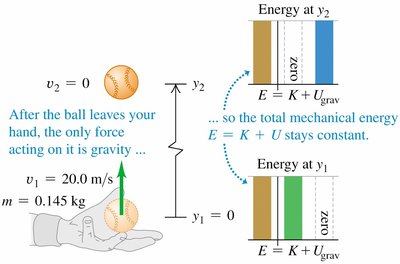
Application: For a thrown ball, after it leaves the hand, only gravity acts, and total mechanical energy remains constant.
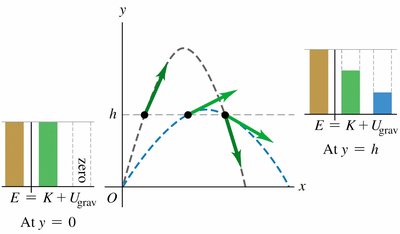
Projectile Motion: For projectiles with the same initial height and speed, the speed at a given elevation is always the same if air resistance is ignored.
Conservative Forces and Path Independence
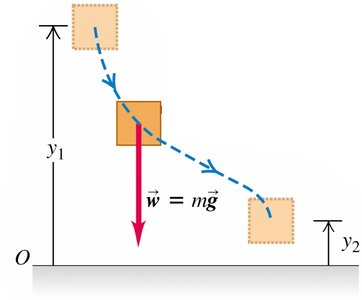
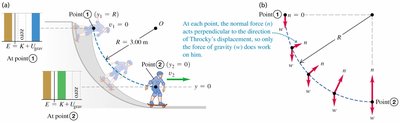
Conservative forces, such as gravity, have the property that the work done is independent of the path taken between two points. The change in potential energy depends only on the initial and final positions.
Work of Gravity:
Path Independence: The work done by gravity along a curved path is the same as along a straight path.
Example: Gravity does work on a circular skateboarding ramp, and only the vertical displacement matters.
Nonconservative Forces
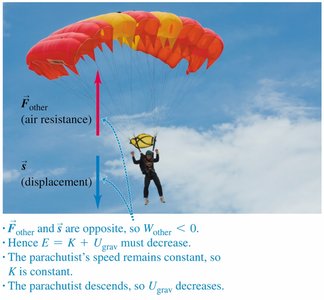
Nonconservative forces, such as air resistance and friction, dissipate mechanical energy and cannot be described by a potential energy function. When these forces act, mechanical energy is not conserved.
Work by Nonconservative Forces:
Example: A parachutist descending experiences air resistance, which reduces total mechanical energy.
Elastic Potential Energy
Elastic potential energy is the energy stored in an elastic object, such as a spring, when it is stretched or compressed. This energy can be recovered when the object returns to its original shape.
Definition: Energy stored due to deformation of an elastic object.
Hooke's Law: where k is the spring constant and x is the displacement from equilibrium.
Elastic Potential Energy Formula:
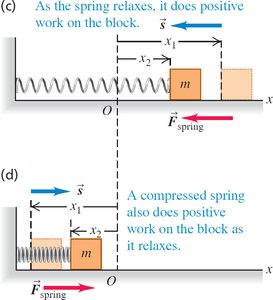
Work Done by a Spring: The spring does work on a block as it is stretched or compressed.
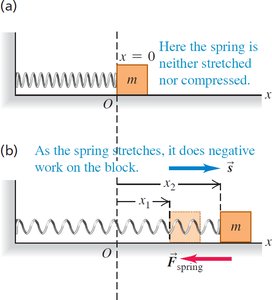
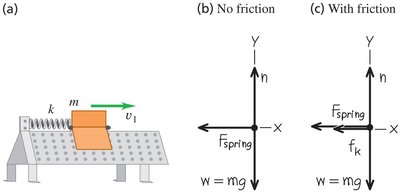
Example: A glider attached to an air track by a spring demonstrates elastic potential energy.
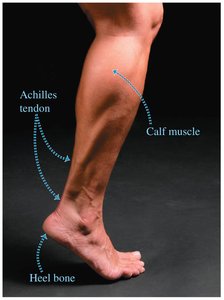
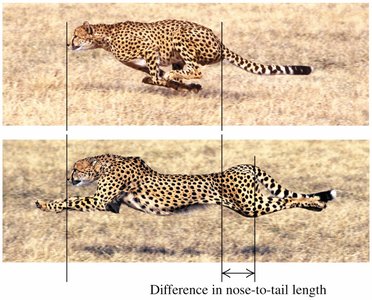
Biological Example: The Achilles tendon acts like a natural spring, storing and releasing elastic potential energy.
Graph: The graph of elastic potential energy for an ideal spring is a parabola, and the energy is never negative.
Situations with Both Gravitational and Elastic Forces
In scenarios where both gravitational and elastic forces are present, the total potential energy is the sum of the gravitational and elastic potential energies.
Total Potential Energy:
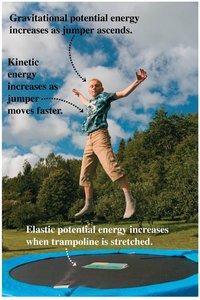
Example: A trampoline jumper experiences increases in gravitational, kinetic, and elastic potential energy as they ascend and the trampoline stretches.
Summary Table: Types of Potential Energy
Type | Formula | Associated Force | Conservative? |
|---|---|---|---|
Gravitational | Gravity | Yes | |
Elastic | Spring (Hooke's Law) | Yes | |
Friction/Air Resistance | N/A | Friction, Air Resistance | No |
Additional info: The notes expand on brief points from the original materials, providing academic context, definitions, and examples for clarity and completeness.
