 Back
BackRelative Motion and Relative Velocity: Concepts and Problem Solving
Study Guide - Smart Notes
 Tailored notes based on your materials, expanded with key definitions, examples, and context.
Relative Motion and Relative Velocity
Introduction to Relative Motion
Relative motion is a fundamental concept in kinematics, describing how the position and velocity of an object are observed from different frames of reference. Understanding relative motion is essential for analyzing real-world scenarios where multiple objects move with respect to each other.
Relative Motion: The motion of an object as observed from another moving or stationary object.
Frame of Reference: The perspective (often a coordinate system) from which motion is measured.
Importance: Relative motion is crucial in transportation, navigation, and understanding physical phenomena in different contexts.
Defining Relative Velocity
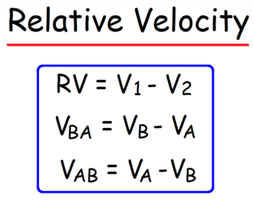
Relative velocity quantifies the velocity of one object as observed from another moving object. It is a vector quantity, meaning both magnitude and direction are important.
Relative Velocity (\( \vec{V}_{AB} \)): The velocity of object A as measured from object B.
Formula:
Where \( \vec{V}_A \) and \( \vec{V}_B \) are the velocities of objects A and B with respect to a common reference (e.g., the ground).
Relative Motion in One Dimension
When objects move along a straight line (one dimension), their relative velocity can be found by simple vector addition or subtraction, depending on their directions.
Same Direction: Subtract the velocities.
Opposite Directions: Add the magnitudes (with appropriate signs for direction).
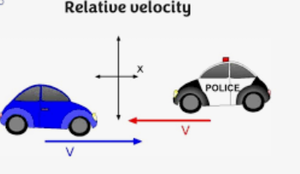
If both objects move in the same direction, the relative velocity is the difference.
If they move in opposite directions, the relative velocity is the sum of their speeds (with direction considered).
Examples of Relative Velocity in One Dimension
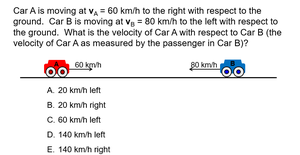
Example 1: Two cars move toward each other, one at 60 km/h and the other at 80 km/h. The relative velocity of one car with respect to the other is:
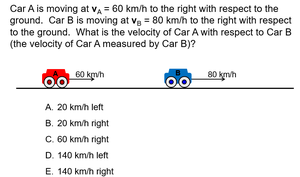
Example 2: If both cars move in the same direction, the relative velocity is the difference of their speeds.
Relative Velocity in Two Dimensions
When objects move in perpendicular directions, their relative velocity is found using vector addition. This is common in problems involving boats crossing rivers or airplanes flying with wind.
Resultant Velocity: Use the Pythagorean theorem to find the magnitude of the resultant velocity.
Where \( V_x \) and \( V_y \) are the velocity components in perpendicular directions.
Frames of Reference
Different observers (frames of reference) may measure different velocities for the same object. The choice of frame affects the observed motion.
Stationary Frame: Observer is at rest relative to the ground.
Moving Frame: Observer is moving relative to the ground.
Key Point: Relative velocity depends on the observer's frame of reference.
Sample Problems and Applications
Problem 1: Two trains move on parallel tracks in opposite directions. Train A travels at 100 km/h, Train B at 80 km/h. The relative velocity of A with respect to B is:
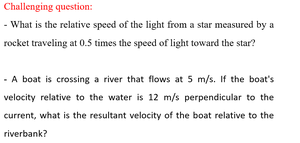
Problem 2: A boat crosses a river flowing at 5 m/s. The boat's velocity relative to the water is 12 m/s perpendicular to the current. The resultant velocity relative to the riverbank is:
Challenging Questions
Light and Special Relativity: The relative speed of light from a star, as measured by a rocket traveling at 0.5c toward the star, remains c (the speed of light), according to Einstein's theory of special relativity.
Real-Life Applications
Cars moving on highways (e.g., Dubai Metro and road traffic)
Boats crossing rivers with currents
Airplanes flying with or against the wind
Understanding relative velocity is essential for navigation, transportation safety, and interpreting motion in different frames of reference.
Summary Table: Relative Velocity Scenarios
Scenario | Relative Velocity Formula | Result |
|---|---|---|
Same direction | Difference of speeds | |
Opposite directions | Sum of speeds | |
Perpendicular directions | Use Pythagorean theorem |
Key Takeaways
Relative velocity depends on the observer's frame of reference.
Direction is crucial in calculating relative velocity.
Applications include transportation, navigation, and understanding physical phenomena.
