 Back
BackRotational Motion: Concepts, Equations, and Applications
Study Guide - Smart Notes
 Tailored notes based on your materials, expanded with key definitions, examples, and context.
Rotational Motion
Angular Position, Displacement, Velocity, and Acceleration
Rotational motion describes the movement of objects around a fixed axis. The key quantities are angular position (θ), angular displacement (Δθ), angular velocity (ω), and angular acceleration (α).
Angular Position (θ): The angle (in radians) that describes the orientation of a line with respect to a reference direction.
Angular Displacement (Δθ): The change in angular position, measured in radians. 1 revolution = 360° = 2π radians.
Angular Velocity (ω): The rate of change of angular position with respect to time. (unit: rad/s)
Angular Acceleration (α): The rate of change of angular velocity with respect to time. (unit: rad/s2)
Sign Convention: Counterclockwise rotation is positive (Δθ > 0, ω > 0), clockwise is negative (Δθ < 0, ω < 0).
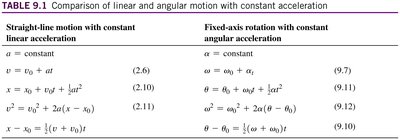
Equations of Rotational Motion with Constant Angular Acceleration
These equations are analogous to those for linear motion, but with angular variables:
Straight-line motion (constant a) | Fixed-axis rotation (constant α) |
|---|---|
Period of Rotational Motion
The period (T) is the time for one complete revolution. For constant angular velocity:
Angular displacement for one revolution: radians
Period:
Angular velocity:
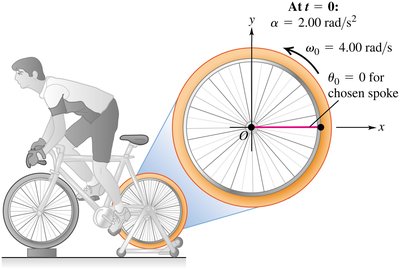
Example: Rotation of a Bicycle Wheel
Given: rad/s, rad/s2, s, . Find the angle and angular velocity at s.
Use:
Use:
Linear and Angular Velocity
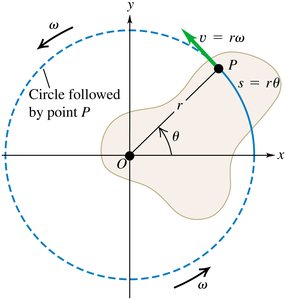
Relationship Between Linear and Angular Velocity
For a point at a distance r from the axis of rotation, the linear (tangential) velocity v is related to the angular velocity ω by:
Direction of v is tangent to the circle at that point.
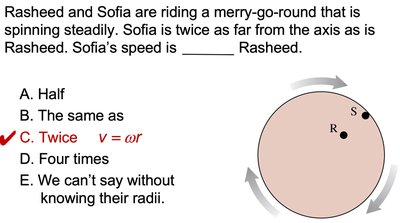
Example: If Sofia is twice as far from the axis as Rasheed on a merry-go-round, her speed is twice Rasheed's ().
Linear and Angular Acceleration
Relation Between Linear and Angular Acceleration
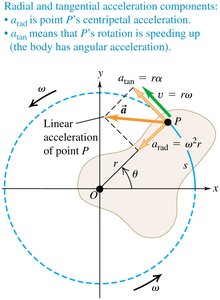
If the angular velocity changes, the linear (tangential) acceleration atan is:
There is also a radial (centripetal) acceleration:
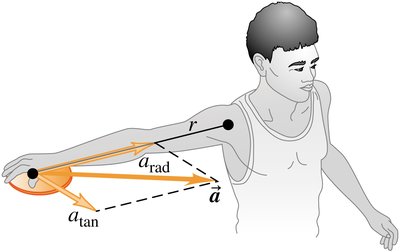
The total acceleration is the vector sum of tangential and radial components.
Example: Throwing a Discus
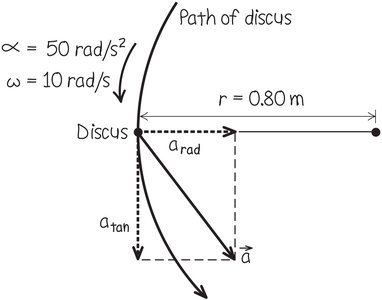
Given: rad/s2, rad/s, m. Find , , and .
m/s2
m/s2
Rotational Motion in Systems
Example: Bicycle Gears
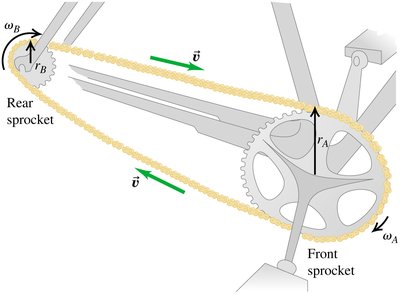
When two sprockets are connected by a chain, their angular speeds are related by the radii (or number of teeth):
Or,
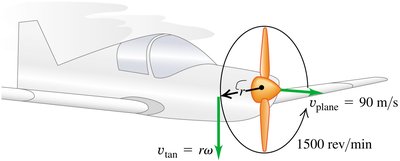
Example: Designing a Propeller
To ensure the tip speed of a propeller does not exceed a certain value, use . Given the maximum allowed tip speed and the rotational speed, solve for the maximum radius:
Kinetic Energy of Rotation
Rotational Kinetic Energy
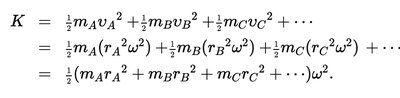
A rotating rigid body has kinetic energy due to the motion of its mass elements. For a system of particles:
For rotation: for each mass element
where is the moment of inertia
Moment of Inertia (I)
The moment of inertia quantifies how mass is distributed relative to the axis of rotation. It depends on both mass and geometry:
for discrete masses
for continuous bodies
Axis must be specified!
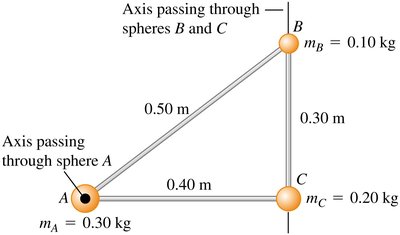
Example: Rotational Kinetic Energy of a Sculpture
Given three masses connected by rods, calculate for different axes and use .
Moments of Inertia for Common Shapes
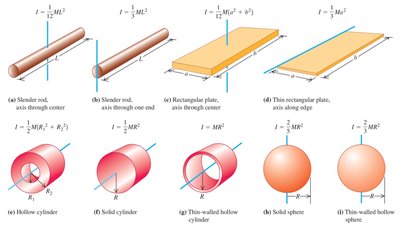
Standard formulas exist for common shapes (about their symmetry axes):
Solid sphere:
Solid cylinder:
Thin rod (center):
Thin rod (end):
Conceptual Question: Sphere vs. Cylinder
Given equal mass and radius, a cylinder has a larger moment of inertia than a sphere about their respective symmetry axes:
Sphere:
Cylinder:
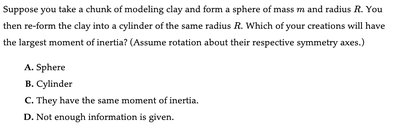
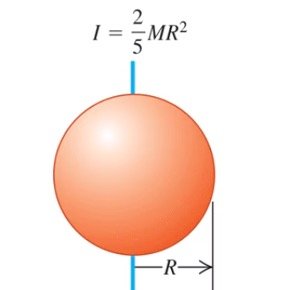
Conclusion: The cylinder has the largest moment of inertia for the same mass and radius.
Summary Table: Linear vs. Rotational Motion
The following table summarizes the analogies between linear and rotational motion with constant acceleration:
Straight-line motion with constant linear acceleration | Fixed-axis rotation with constant angular acceleration |
|---|---|
