 Back
BackSpeed of Sound Waves: Harmonic Oscillator Chains and Sound in Materials
Study Guide - Smart Notes
 Tailored notes based on your materials, expanded with key definitions, examples, and context.
Speed of Sound Waves
Waves in a Harmonic Oscillator Chain
The speed of sound in solids can be modeled using a chain of masses connected by springs, representing atoms in a crystal lattice. This model helps us understand how mechanical waves propagate through discrete systems.
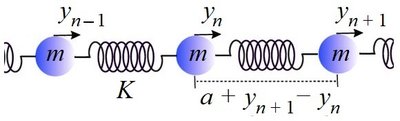
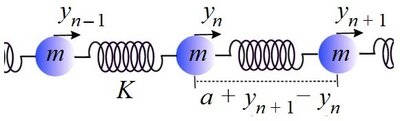
Discrete Model: Consider an infinite chain of masses m connected by springs of stiffness K and rest length a.
Displacement: The displacement of the nth mass from equilibrium is yn.
Force on nth Mass:
Equation of Motion:
Wave Speed (Dimensional Analysis): The only combination of K, m, and a with units of speed is
Polynomial Approximation of Functions
To analyze wave propagation, we often approximate functions using Taylor series expansions near a point x0.
Approximation:
Purpose: This allows us to treat discrete variables as continuous, simplifying the analysis of wave equations.
Continuous Limit of Harmonic Oscillator Chain
When the spacing a is much smaller than the wavelength λ, the system can be treated as a continuous medium.
Position:
Displacement Function:
Taylor Expansion:
Force in Continuous Limit:
Wave Equation:
Wave Speed:
Speed of Sound in Liquids and Gases
Sound Propagation in Liquids
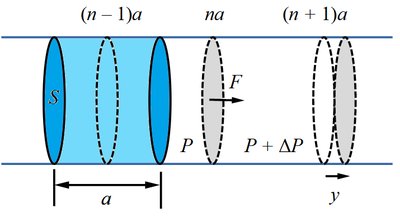
Sound waves in liquids can be modeled by dividing the liquid into small segments, each acting as a mass connected by an elastic spring.
Model: Uniform cylinder of cross-sectional area S, mass density ρ, and equilibrium pressure P.
Segment Mass:
Force from Pressure Change:
Bulk Modulus and Hooke's Law for Liquids
The pressure change in a liquid due to compression is described by Hooke's law, using the bulk modulus B.
Pressure Change: , where ,
Force:
Spring Constant:
Speed of Sound:
Speed of Sound in Gases
In gases, sound waves cause rapid pressure variations, and the bulk modulus is related to the adiabatic process.
Bulk Modulus:
Pressure:
Speed of Sound:
Adiabatic Index (γ):
Monatomic gases:
Diatomic/linear molecular gases:
Non-linear molecular gases:
Exercises
Exercise 1: Speed of a Longitudinal Wave in a Slinky
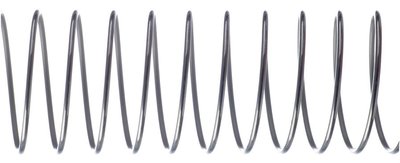
A slinky is a long spring of mass m, equilibrium length L0, spring constant K, and N windings of radius R. Find the speed of a longitudinal wave in a slinky stretched to length L and the time for a pulse to travel from one end to the other.
Wave Speed: (Additional info: Derived using the stretched length and mass distribution.)
Travel Time:
Exercise 2: Speed of Sound in Water
Compressing water in a rigid cylinder increases pressure by MPa, decreasing volume by 2.25%. Use this to predict the speed of sound in water.
Bulk Modulus:
Speed of Sound:
Exercise 3: Speed of Sound in Air at Different Temperatures
Given air density at 300 K is 1.177 kg/m3 and atmospheric pressure is 1 atm = 101.3 kPa, calculate the speed of sound in air at T = 250, 300, and 350 K.
Speed of Sound:
Application: Use γ for diatomic gases (air is mostly N2 and O2), .
Additional info: These exercises reinforce the application of wave speed formulas in real-world scenarios.
