 Back
BackStep-by-Step Guidance for Big10 Physics II for Engineers Exam Questions
Study Guide - Smart Notes
 Tailored notes based on your materials, expanded with key definitions, examples, and context.
Q1. Electrostatics and Capacitance
Background
Topic: Electrostatics, Gauss' Law, Electric Field, Electric Potential, Capacitance
This question tests your understanding of charge transfer, electric fields from charged spheres, dipole fields, and capacitor circuits.
Key Terms and Formulas
Gauss' Law:
Electric field outside a charged sphere:
Dipole field (for ): , where
Capacitance in series and parallel: ,
Charge stored:
Step-by-Step Guidance
For part (a), consider how to transfer charge using a negatively charged object and an insulated metal sphere. Think about the process of grounding and contact.
For part (b), use Gauss' Law to derive the electric field outside a conducting sphere. Set up a Gaussian surface at radius and apply the law.
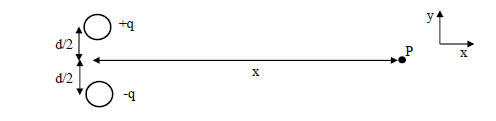
For part (c), analyze the diagram (see below) and use the result from part (b) to find the field at point P due to both spheres. Express the field in terms of , , and for .
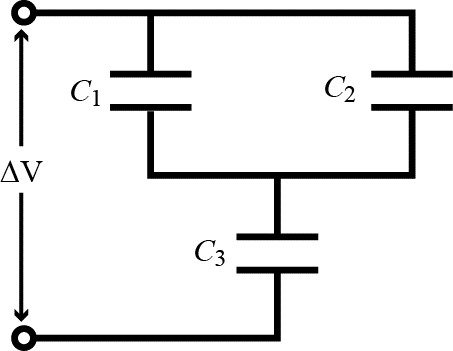
For part (f), examine the capacitor circuit (see below). Identify which capacitors are in series and which are in parallel, then write the formula for equivalent capacitance and total charge.
Try solving on your own before revealing the answer!
Final Answer
See below for concise solutions:
(a) Touch the sphere with the negative object, then ground the sphere to remove negative charge, leaving net positive charge.
(b)
(c) for
(d) Plug in , , to get field strength.
(e) Electric potential at P:
(f) (i) Equivalent capacitance: in parallel, then in series with :
(f) (ii) Total charge:
Q2. Magnetism and Electromagnetism
Background
Topic: Magnetic Force, Gauss's Law for Electricity and Magnetism, Forces Between Wires, Magnetic Field from Current Loops
This question tests your understanding of the direction of magnetic fields, Gauss's Law for magnetism, and calculation of forces and fields in wire configurations.
Key Terms and Formulas
Magnetic force:
Gauss's Law for electricity:
Gauss's Law for magnetism:
Force between parallel wires:
Magnetic field at center of arc:
Step-by-Step Guidance
For part (a), use the right-hand rule to determine the direction of the magnetic field based on the force direction.
For part (b), write both forms of Gauss's Law and explain why magnetic flux through a closed surface is always zero.
For part (c), set up the formula for the force between two parallel wires, define all variables, and sketch the vectors.
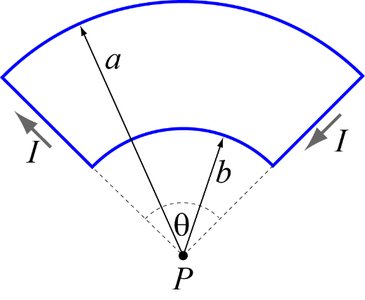
For part (d), use the diagram (see below) and apply the formula for the magnetic field at point P due to two arcs. Consider the direction (into or out of the page).
Try solving on your own before revealing the answer!
Final Answer
(a) The y-component of the magnetic field must be zero; the force is due to another component.
(b) Gauss's Law for electricity: ; for magnetism:
(c) ; direction is attractive for parallel currents.
(d) ; direction depends on current orientation.
Q3. Optics and AC Circuits
Background
Topic: Refraction, Total Internal Reflection, AC Current, LRC Circuits
This question tests your understanding of the index of refraction, critical angle, AC current properties, and damped oscillations in circuits.
Key Terms and Formulas
Index of refraction:
Critical angle:
AC current:
Average current:
Mean square current:
Current amplitude:
Damped angular frequency:
Step-by-Step Guidance
For part (a), use the change in wavelength to calculate the index of refraction. Set up the formula and substitute values.
For part (a)(ii), use the index to find the critical angle for total internal reflection.
For part (b), recall the formulas for average current, mean square current, and amplitude in AC circuits.
For part (c), define all variables in the damped frequency formula and sketch the charge vs. time for underdamped oscillations.
Try solving on your own before revealing the answer!
Final Answer
(a)(i)
(a)(ii)
(b)(i) Average current:
(b)(ii) Mean square:
(b)(iii) Amplitude:
(c)(i) ; = inductance, = capacitance, = resistance
(c)(ii) Sketch: oscillates and decays exponentially for underdamped case.
Q4. Optics: Lenses, Mirrors, and Interference
Background
Topic: Lens Equation, Magnification, Ray Diagrams, Interference Patterns
This question tests your understanding of image formation by lenses and mirrors, ray tracing, and interference minima.
Key Terms and Formulas
Lens equation:
Magnification:
Interference minima:
Step-by-Step Guidance
For part (a), use the lens equation to find the image distance. Substitute cm, cm.
Calculate magnification using the formula and the values found in the previous step.
For part (c), set up the formula for interference minima and substitute m, m.
Try solving on your own before revealing the answer!
Final Answer
(a)(i)
(a)(ii)
(c) for
