 Back
BackStep-by-Step Guidance for PHY 241 Practice Quiz (Chapters 4–6)
Study Guide - Smart Notes
 Tailored notes based on your materials, expanded with key definitions, examples, and context.
Q1. What is the net force acting on the child/sled system in vector notation, given that the system is moving to the right and constantly speeding up?
Background
Topic: Newton's Second Law of Motion
This question tests your understanding of how to represent the net force acting on an object in vector notation, especially when the object is accelerating in a specific direction.
Key Terms and Formulas
Net Force (): The vector sum of all forces acting on an object.
Newton's Second Law:
Unit Vectors: (horizontal/x-direction), (vertical/y-direction)
Step-by-Step Guidance
Identify the direction of motion and acceleration. The sled is moving to the right and speeding up, so the acceleration is in the positive x-direction.
Recall that the net force must be in the same direction as the acceleration (Newton's Second Law).
Express the net force in vector notation using unit vectors. Consider whether there is any vertical acceleration (is the sled moving up or down?).
Write the net force as , and determine which components are nonzero based on the motion described.
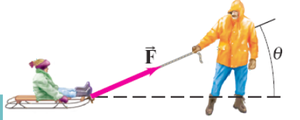
Try solving on your own before revealing the answer!
Q2. In which case will the sled experience more friction force and why? (Magnitude of angle and force are the same in both cases)
Background
Topic: Friction and Normal Force
This question examines your understanding of how the direction of an applied force affects the normal force and, consequently, the frictional force acting on an object.
Key Terms and Formulas
Normal Force (): The perpendicular contact force exerted by a surface on an object.
Kinetic Friction Force ():
Vertical Component of Force: (up or down depending on direction of applied force)
Step-by-Step Guidance
Analyze the direction of the applied force in each case (pulling up at an angle vs. pushing down at an angle).
Determine how the vertical component of the applied force affects the normal force in each scenario.
Recall that increasing the normal force increases the friction force, and decreasing the normal force decreases the friction force.
Compare the two cases to decide which one results in a greater normal force and thus a greater friction force.
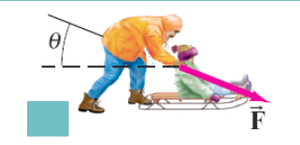
Try solving on your own before revealing the answer!
Q3. What is the average force exerted on a mass during a time interval if its velocity changes from to ?
Background
Topic: Impulse and Momentum
This question tests your ability to relate force, time, and change in momentum using the impulse-momentum theorem.
Key Terms and Formulas
Impulse-Momentum Theorem:
Average Force:
Step-by-Step Guidance
Recall the impulse-momentum theorem, which relates the change in momentum to the average force and time interval.
Express the change in momentum as .
Set up the equation and match it to the answer choices.
Try solving on your own before revealing the answer!
Q4. A 20-N bucket is pulled from the bottom of a 9-m deep well to the top in 3.0 s by a string with constant tension. What can you say about the tension in the string during this interval?
Background
Topic: Dynamics, Tension, and Acceleration
This question tests your understanding of how tension in a rope relates to the weight of an object and its acceleration.
Key Terms and Formulas
Weight ():
Tension (): The force exerted by the string
Newton's Second Law:
Acceleration (): (for constant acceleration from rest over distance in time )
Step-by-Step Guidance
Calculate the acceleration needed to move the bucket from rest over 9 m in 3.0 s using .
Find the mass of the bucket using .
Apply Newton's Second Law: .
Plug in the values for , , and to set up the calculation for .
Try solving on your own before revealing the answer!
Q5. Which of the following is an action/reaction pair according to Newton’s third law?
Background
Topic: Newton's Third Law of Motion
This question tests your understanding of action-reaction pairs, which are always equal in magnitude and opposite in direction, and always act on different objects.
Key Terms and Formulas
Newton's Third Law: For every action, there is an equal and opposite reaction.
Action/Reaction Pair: Forces that are equal in magnitude, opposite in direction, and act on different objects.
Step-by-Step Guidance
Review each answer choice and identify the two objects involved in each force pair.
Check if the forces are acting on different objects (required for a third law pair).
Eliminate choices where both forces act on the same object or are not equal and opposite.
Identify the pair that fits Newton's third law definition.
Try solving on your own before revealing the answer!
