 Back
BackStep-by-Step Guidance for PHYS212H Exam Questions (Electric Fields, Potentials, Gauss's Law, Capacitors)
Study Guide - Smart Notes
 Tailored notes based on your materials, expanded with key definitions, examples, and context.
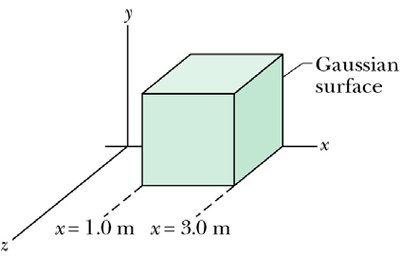
Q9. The outward electric flux through the right face of a cube-shaped Gaussian surface (with a non-uniform electric field) is...
Background
Topic: Gauss's Law and Electric Flux
This question tests your understanding of how to apply Gauss's Law to calculate electric flux through a surface, especially when the electric field is not uniform.
Key Terms and Formulas
Electric flux (): The total electric field passing through a surface.
Gauss's Law:
Non-uniform field: The electric field varies with position, so you may need to integrate over the surface.
Step-by-Step Guidance
Identify the electric field expression given in the question. For example, (where and are unit vectors in the y and z directions).
Determine which face of the cube is the "right face" (typically the face at the largest x value).
For the right face, find the area vector , which points outward and is perpendicular to the face (here, along the direction).
Evaluate the electric field at the location of the right face. If the field does not have an component, consider how this affects the dot product .
Try solving on your own before revealing the answer!
Final Answer: The outward electric flux through the right face is zero.
Since the electric field has no component at the right face, the dot product is zero, so the flux is zero.
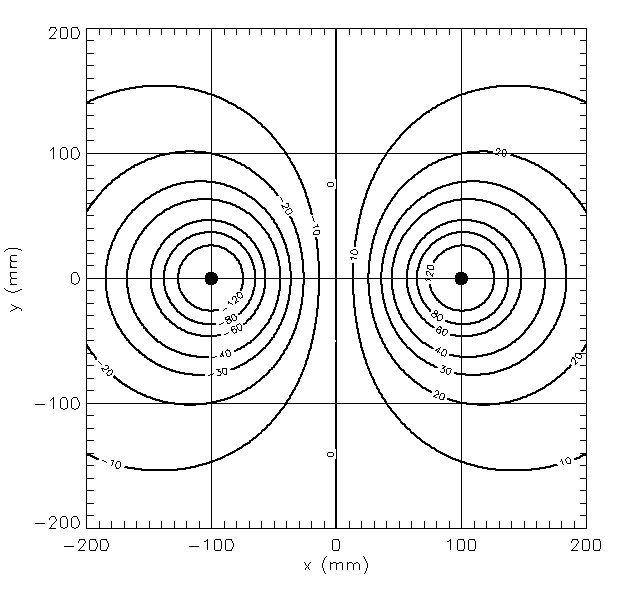
Q12. The work that the electrostatic field does on an electron moved from point X to point Y in the field of a dipole (see equipotential map)...
Background
Topic: Work and Potential Difference in Electrostatic Fields
This question tests your understanding of how the work done by an electric field relates to the change in electric potential, especially for a charged particle moving between two points in the field of a dipole.
Key Terms and Formulas
Work done by electric field:
Equipotential surfaces: Surfaces where the electric potential is constant.
For an electron (), the sign of the work depends on the direction of movement relative to the potential difference.
Step-by-Step Guidance
Identify the potentials at points X and Y using the equipotential map. Note the values labeled on the surfaces.
Determine the direction of movement: Is the electron moving to a higher or lower potential?
Recall that the work done by the field is , and for an electron, .
Consider the sign of the work: If the electron moves to a higher potential, the work done by the field is negative; if to a lower potential, it is positive.
Try solving on your own before revealing the answer!
Final Answer: The work done by the electrostatic field is negative.
The electron moves to a higher potential, so the field does negative work on it.
