Back
BackStudy Guide: Forces and Newton’s Laws of Motion (Chapter 4)
Study Guide - Smart Notes
 Tailored notes based on your materials, expanded with key definitions, examples, and context.
Chapter 4: Forces and Newton's Laws of Motion Quick Check
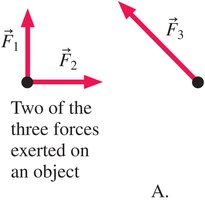
Q1. The net force on an object points to the left. Two of three forces are shown. Which is the missing third force?
Background
Topic: Vector Addition of Forces
This question tests your understanding of how multiple forces combine to produce a net force, specifically using vector addition and Newton's Second Law.
Key Terms and Formulas
Force (): A vector quantity that causes acceleration.
Net Force (): The vector sum of all forces acting on an object.
Newton's Second Law:
Vector Addition:
Step-by-Step Guidance
Identify the direction of the net force (to the left) and the directions of the two given forces ( and ).
Draw or visualize the vector addition of and ; consider their vertical and horizontal components.
Determine what vector must be added to and so that the sum points to the left.
Check if the vertical components cancel, leaving only a horizontal component pointing left.
Try solving on your own before revealing the answer!
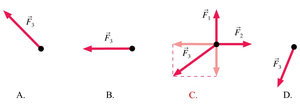
Final Answer: The missing third force is a vector pointing to the left.
By adding the vertical and horizontal components, the third force must cancel the rightward force and leave a net force to the left.
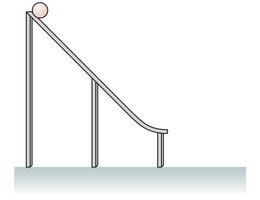
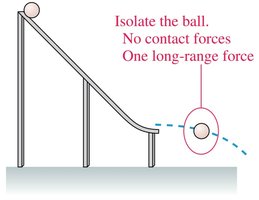
Q2. A ball rolls down an incline and off a horizontal ramp. Ignoring air resistance, what force or forces act on the ball as it moves through the air just after leaving the horizontal ramp?
Background
Topic: Forces on a Projectile
This question tests your understanding of projectile motion and the forces acting on an object in free flight.
Key Terms and Formulas
Projectile: An object moving through the air under the influence of gravity only.
Gravity (): The force acting downward on the ball.
Newton's First Law: An object in motion remains in motion unless acted upon by a net force.
Step-by-Step Guidance
After the ball leaves the ramp, consider what forces are acting on it (no contact with ramp).
Ignore air resistance as stated in the question.
Identify the long-range force acting on the ball (gravity).
Recognize that no horizontal force acts on the ball after it leaves the ramp; its horizontal motion is due to inertia.
Try solving on your own before revealing the answer!
Final Answer: The only force acting is the weight of the ball (gravity) acting vertically downward.
Once airborne, the ball is only affected by gravity, as there are no contact forces.
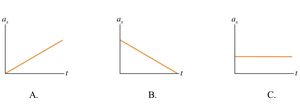
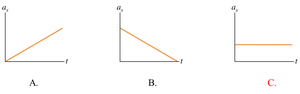
Q3. A cart is pulled to the right with a constant, steady force. How will its acceleration graph look?
Background
Topic: Newton's Second Law and Acceleration Graphs
This question tests your ability to relate a constant force to the resulting acceleration of an object.
Key Terms and Formulas
Acceleration (): The rate of change of velocity.
Newton's Second Law:
Constant Force: Implies constant acceleration if mass is constant.
Step-by-Step Guidance
Recall that a constant force applied to a mass produces a constant acceleration.
Examine the three acceleration graphs and identify which one represents constant acceleration.
Match the graph to the physical scenario described (cart pulled with steady force).
Consider the relationship: , where is constant.
Try solving on your own before revealing the answer!
Final Answer: The acceleration graph is a horizontal line, indicating constant acceleration.
Since the force is constant and mass does not change, acceleration remains constant over time.
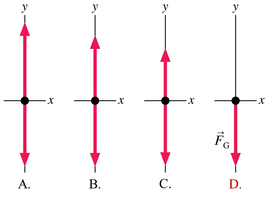
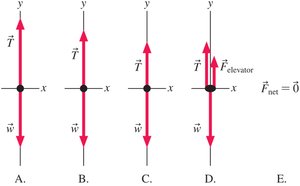
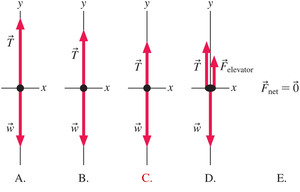
Q4. An elevator, lifted by a cable, is moving upward and slowing. Which is the correct free-body diagram?
Background
Topic: Free-Body Diagrams and Newton's Second Law
This question tests your ability to analyze forces acting on an object in motion, specifically when the object is slowing down.
Key Terms and Formulas
Free-Body Diagram: A visual representation of all forces acting on an object.
Tension (): The force exerted by the cable.
Weight (): The force of gravity acting downward.
Net Force (): Determines the direction of acceleration.
Step-by-Step Guidance
Identify the forces acting on the elevator: tension upward and weight downward.
Since the elevator is moving upward but slowing, its acceleration is downward.
Determine which diagram shows a net force pointing downward (tension less than weight).
Compare the length of the arrows representing tension and weight in each diagram.
Try solving on your own before revealing the answer!
Final Answer: The correct free-body diagram shows the weight arrow longer than the tension arrow, indicating net force downward.
This matches the scenario where the elevator is moving upward but slowing down, so the net force is downward.
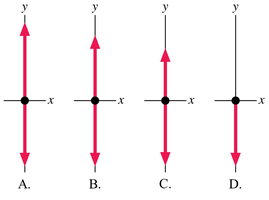
Q5. A ball has been tossed straight up. Which is the correct free-body diagram just after the ball has left the hand? Ignore air resistance.
Background
Topic: Free-Body Diagrams for Projectile Motion
This question tests your understanding of the forces acting on a projectile immediately after it leaves contact with the thrower.
Key Terms and Formulas
Gravity (): The only force acting on the ball after it leaves the hand.
Projectile: An object in free flight under gravity.
Step-by-Step Guidance
After the ball leaves the hand, it is no longer in contact with any other object.
Ignore air resistance as stated in the question.
Draw the free-body diagram showing only the force of gravity acting downward.
Check that no other forces (such as upward push) are present.
Try solving on your own before revealing the answer!
Final Answer: The correct free-body diagram shows only a downward force (gravity).
Once airborne, gravity is the only force acting on the ball.