Back
BackStudy Guide: Vectors and Motion in Physics
Study Guide - Smart Notes
 Tailored notes based on your materials, expanded with key definitions, examples, and context.
Course Topics Overview
This syllabus outlines the foundational topics in college-level physics, focusing on vectors and motion. The sequence covers essential concepts for understanding physical systems and their behavior.
Week of Jan 12: Introduction / Vectors
Vectors are fundamental in physics for representing quantities that have both magnitude and direction. Understanding vectors is crucial for analyzing motion and forces.
Definition: A vector is a quantity described by both magnitude and direction (e.g., displacement, velocity, force).
Representation: Vectors are often represented graphically by arrows, and mathematically by components.
Vector Addition: Vectors can be added using the triangle or parallelogram method.
Example: Displacement from point A to B can be described as a vector.
Week of Jan 19: Vectors / Linear Motion
Linear motion describes the movement of objects along a straight path. Combining vectors with linear motion allows for a comprehensive analysis of position, velocity, and acceleration.
Key Terms: Position, displacement, velocity, acceleration.
Equations:
Example: An object moving at constant velocity along a straight line.
Week of Jan 26: Linear Motion
This week continues the study of linear motion, focusing on the mathematical description and analysis of motion along a straight line.
Uniform Motion: Motion with constant velocity.
Accelerated Motion: Motion with changing velocity, often described by kinematic equations.
Kinematic Equations:
Example: Free fall under gravity.
Week of Feb 2: Motion in Plane
Motion in a plane involves two-dimensional movement, requiring vector analysis to resolve components and describe trajectories.
Projectile Motion: The motion of an object thrown into the air, subject to gravity.
Vector Components: Motion is analyzed in horizontal and vertical directions.
Equations:
Example: A ball thrown at an angle follows a parabolic path.
Week of Feb 9: Motion in Plane, Exam 1 (Feb 12)
This week continues the study of motion in a plane and prepares students for the first exam, covering vectors and both linear and planar motion.
Review: Practice problems on vector addition, kinematics, and projectile motion.
Application: Analyzing real-world scenarios such as sports, vehicle movement, and physics experiments.
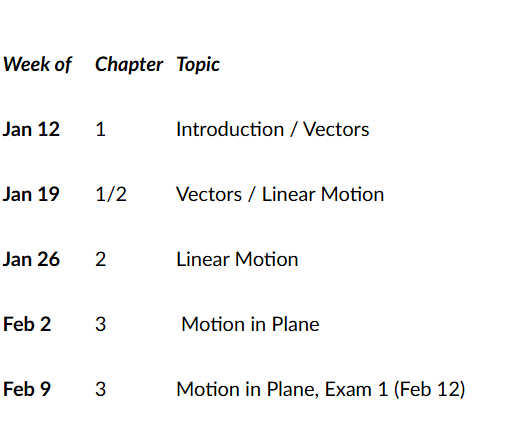
Summary Table: Weekly Topics
Week of | Chapter | Topic |
|---|---|---|
Jan 12 | 1 | Introduction / Vectors |
Jan 19 | 1/2 | Vectors / Linear Motion |
Jan 26 | 2 | Linear Motion |
Feb 2 | 3 | Motion in Plane |
Feb 9 | 3 | Motion in Plane, Exam 1 (Feb 12) |