Back
BackStudy Notes: Hooke's Law and Physical Explanation of Friction
Study Guide - Smart Notes
 Tailored notes based on your materials, expanded with key definitions, examples, and context.
Hooke's Law
Direct Proportionality Between Force and Displacement
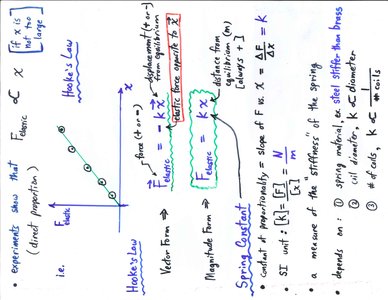
Hooke's Law describes the relationship between the force applied to a spring and the resulting displacement. It is a fundamental principle in mechanics, especially in the study of elastic materials.
Definition: The force required to stretch or compress a spring is directly proportional to the displacement from its equilibrium position.
Mathematical Form:
Vector Form:
Magnitude Form:
Spring Constant (k): A measure of the stiffness of the spring. The SI unit is .
Graphical Representation: The slope of the force vs. displacement graph gives the spring constant .
Factors Affecting k:
Material of the spring (stiffer materials have higher k)
Diameter of the spring
Number of coils
Applications: Used in measuring forces, designing suspension systems, and understanding elastic properties of materials.
Example: If a spring has a spring constant of and is stretched by , the force required is .
Physical Explanation of Friction
Microscopic Origin of Friction Forces
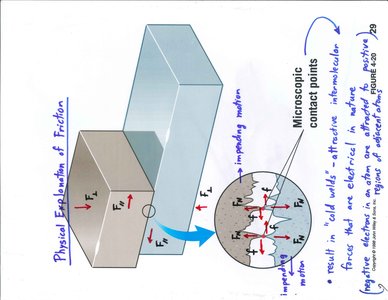
Friction is a resistive force that opposes the relative motion of two surfaces in contact. Its physical origin can be explained by the interactions at microscopic contact points.
Microscopic Contact Points: Surfaces are not perfectly smooth; they have microscopic asperities that interact when pressed together.
Nature of Forces: At these contact points, forces are primarily electrical in nature, resulting from intermolecular interactions.
Result in Cold Welds: Attractive forces at contact points can lead to cold welds, where atoms from each surface bond together.
Impediment to Motion: These microscopic bonds and interactions resist the motion, resulting in friction.
Applications: Understanding friction is crucial in engineering, material science, and everyday phenomena such as walking, driving, and machinery operation.
Example: When a block slides over a surface, frictional forces at microscopic contact points oppose the motion, requiring an applied force to maintain movement.