 Back
BackStudy Notes: Schrödinger Wave Equation and Quantum Operators
Study Guide - Smart Notes
 Tailored notes based on your materials, expanded with key definitions, examples, and context.
Schrödinger Wave Equation for a Free Particle
Basic Wave Equation and Definitions
The motion of a free particle in quantum mechanics is described by a wave function, which encapsulates the probability amplitude of finding the particle at a given position and time. The momentum and energy of the particle are related to the wave properties.
Wave Vector (k): , where is the wavelength.
Propagation Constant: is also known as the propagation constant.
Energy Expression: , where is the frequency.
Plane Monochromatic Wave: The simplest wave is described by .
Example: A free particle moving along the x-axis with velocity has a wave function . 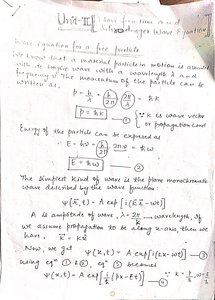
Time-Dependent Schrödinger Equation
Derivation and Application
The time-dependent Schrödinger equation describes the evolution of the wave function for a particle with kinetic and potential energy.
General Form:
Hamiltonian Operator:
Potential Energy Function: can be time-dependent or independent.
Example: For a free particle (), the equation simplifies to . 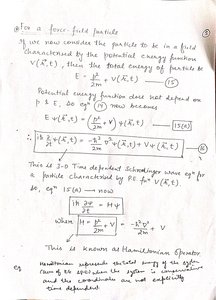
Time-Independent Schrödinger Equation
Separation of Variables and Stationary States
When the potential is independent of time, the Schrödinger equation can be solved by separation of variables.
Product Solution:
Time-Independent Equation:
Stationary State: A solution where is independent of time.
Example: The stationary state is defined as . 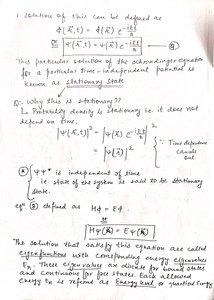
Operators, Eigenfunctions, and Observables
Definitions and Properties
Operators in quantum mechanics act on wave functions to yield physical observables.
Eigenvalue Equation:
Observables: Quantities measured in experiments, such as position and momentum.
Commutator:
Example: The position and momentum operators do not commute: . 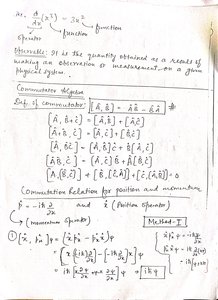
Orthogonality and Normalization of Eigenfunctions
Mathematical Structure
Eigenfunctions corresponding to different eigenvalues are orthogonal and can be normalized.
Orthogonality Condition: for
Normalization Condition:
Example: Normalized eigenfunctions are called orthonormal. 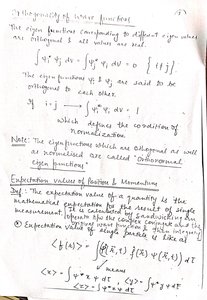
Expectation Values
Calculation and Interpretation
The expectation value of an observable is the average value obtained from many measurements.
General Formula:
Position:
Momentum:
Example: For a normalized wave function, gives the average position. 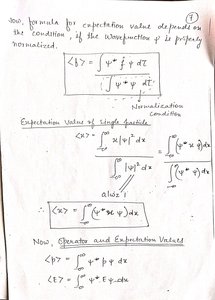
Energy, Momentum, and Other Operators
Operator Forms
Operators are used to represent physical quantities in quantum mechanics.
Energy Operator:
Momentum Operator:
Kinetic Energy Operator:
Potential Energy Operator:
Position Operator:
Example: The velocity operator is . 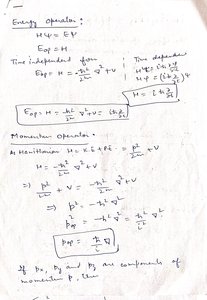
Application: Particle in a 1D Box
Schrödinger Equation and Quantization
The particle in a box is a fundamental quantum system with quantized energy levels.
Potential: for , otherwise.
Wave Function:
Energy Levels:
Normalization:
Example: The probability density is . 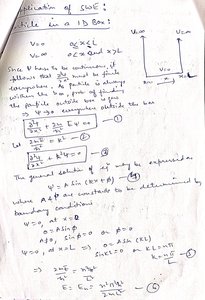
Commutator Relations and Methods
Commutator Calculations
Commutators are used to determine the relationships between operators.
Position and Momentum:
Other Relations: ,
Example: Commutator calculations for more complex operators. 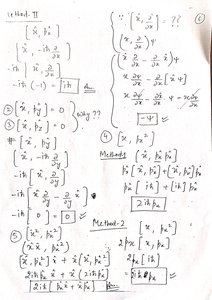
Numerical Examples
Expectation Values for Specific Wave Functions
Calculations of expectation values for given wave functions illustrate the application of operators.
Wave Function:
Expectation Value of Momentum:
Expectation Value of :
Example: Calculation for yields , . 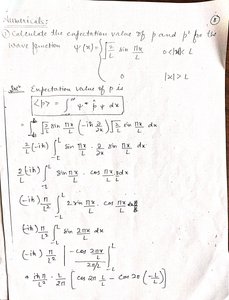
Summary Table: Common Quantum Operators
Operator and Observable Correspondence
Physical Quantity | Operator |
|---|---|
Position | |
Momentum | |
Kinetic Energy | |
Potential Energy | |
Energy (Hamiltonian) |
Additional info: These notes cover the foundational aspects of quantum mechanics relevant to college-level physics, including the Schrödinger equation, operators, eigenfunctions, commutators, and applications such as the particle in a box.
