 Back
BackStudy Notes: Sound Waves and Their Properties
Study Guide - Smart Notes
 Tailored notes based on your materials, expanded with key definitions, examples, and context.
Sound Waves
Production and Nature of Sound Waves
Sound waves are mechanical waves that propagate through a medium by the oscillation of particles. They are produced when a source, such as a piston, compresses and expands the air, creating regions of high and low pressure that travel through the medium. The motion of air particles is parallel to the direction of wave propagation, making sound waves longitudinal waves.
Longitudinal Wave: The oscillation of particles is parallel to the direction of wave travel.
Propagation: Sound waves can travel through gases, liquids, and solids.
Audible Range: Humans can hear frequencies from 20 Hz to 20,000 Hz.
Restoring Force: Pressure fluctuations act as a restoring force, similar to elasticity in a string.
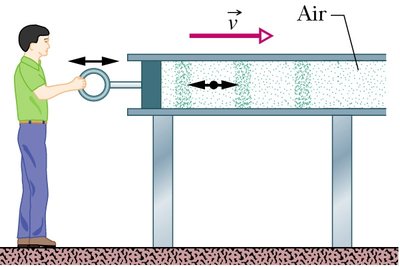
Speed of Sound: The speed of sound depends on the medium's inertial and elastic properties. The bulk modulus (B) measures the medium's resistance to compression, and the speed of sound (v) is given by:
Speed in air at 20°C: 343 m/s
Speed in water: 1402 m/s
Speed in steel: 5941 m/s
Wavefronts and Rays
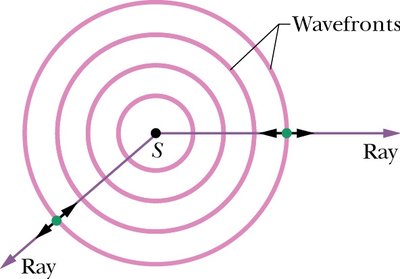
A point source emits sound waves in all directions. Wavefronts are surfaces of constant phase, and rays are lines perpendicular to wavefronts indicating the direction of wave travel.
Mathematical Description of Sound Waves
Displacement and Pressure Variation
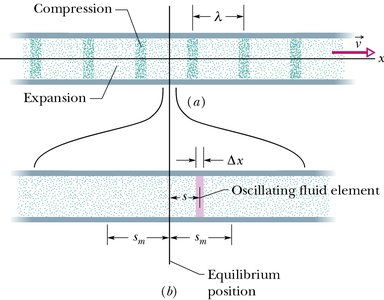
The displacement of an air element at position x and time t in a sinusoidal sound wave is:
Displacement amplitude (sm): Maximum displacement from equilibrium.
Wave number (k):
Angular frequency (\omega):
Wavelength (\lambda): Distance over which the wave pattern repeats.
Period (T):
The pressure variation is given by:
Where is the pressure amplitude, related to displacement amplitude by:
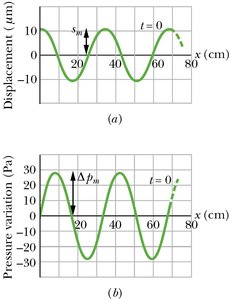
Maximum displacement corresponds to equilibrium pressure.
Maximum pressure variation occurs where displacement is zero.
Interference of Sound Waves
Principle of Superposition and Path Difference
Sound waves can interfere constructively or destructively depending on the path difference between two sources. The phase difference is:
Constructive Interference: (waves in phase)
Destructive Interference: (waves out of phase)
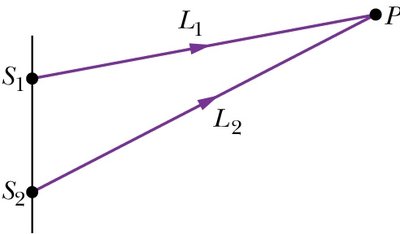
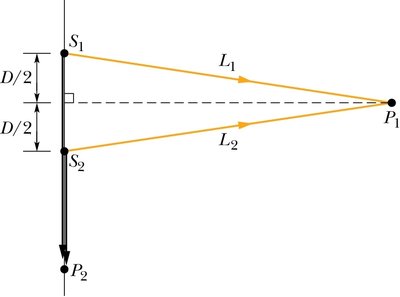
Example: Two sources separated by distance D = 1.5λ emit identical waves. At point P1 (perpendicular bisector), path difference is zero (constructive). At point P2, path difference is D = 1.5λ (destructive).
Intensity and Sound Level
Power, Intensity, and Decibel Scale
Sound waves transmit power as each element of fluid does work on its neighbors. The average power is:
The intensity (I) is the average power per unit area:
For a point source emitting isotropically:
Intensity decreases with the square of the distance from the source.
Human hearing covers a wide range of intensities (1012).
The sound level β in decibels (dB) is:
W/m2 (reference intensity)
Each tenfold increase in intensity increases sound level by 10 dB.
Standing Waves and Musical Sound
Standing Waves in Pipes
Standing waves can be set up in air-filled pipes, producing musical notes. For a pipe open at both ends, the ends are antinodes (A), and the wavelength is:
, for
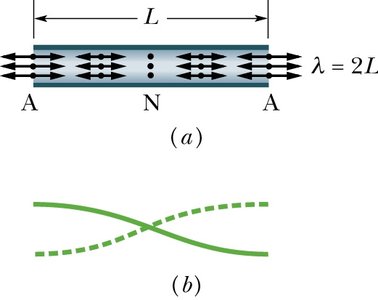
For a pipe with one end closed (node N, antinode A):
, for
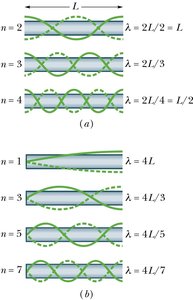
Fundamental mode: n = 1
Harmonics: Higher values of n
Beats
Superposition of Two Close Frequencies
When two sound waves of similar frequencies interfere, the result is a beat pattern. The sum of two waves:
Resultant wave:
Where:
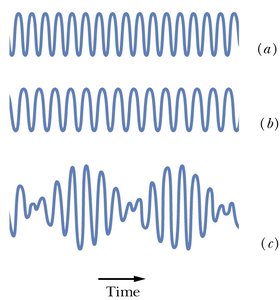
Beat frequency:
Beats are heard as periodic variations in loudness.
Doppler Effect
Frequency Shift Due to Relative Motion
The Doppler effect describes the change in frequency detected when the source or observer is moving. If the source moves toward the observer, the detected frequency increases; if moving away, it decreases.
General expression:
Upper sign: +vD if detector moves toward source; -vD if away.
Lower sign: +vS if source moves away from detector; -vS if toward.
v: Speed of sound in medium
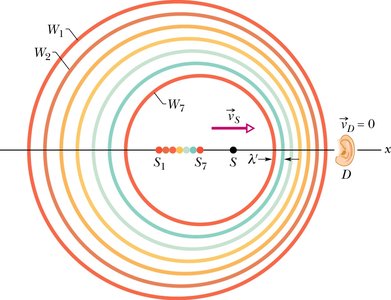
Example: A submarine emits a sonar signal in a moving current. The detected frequency depends on the relative velocities of the source and detector with respect to the medium.
Case (a): Detector stationary relative to water, source moves toward detector.
Case (b): Detector moves toward source, both velocities considered relative to water.
Calculated frequencies show the effect of motion on detected sound.
