 Back
BackQuiz 5: Superposition of Wave Pulses and Predicting Resultant Motion
Study Guide - Smart Notes
 Tailored notes based on your materials, expanded with key definitions, examples, and context.
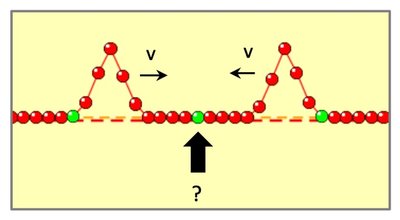
Q1. What happens to the spot on the string (indicated by the arrow) as two wave pulses approach and overlap?
Background
Topic: Superposition Principle for Waves
This question tests your understanding of how two wave pulses interact when they meet on a string. The principle of superposition states that when two or more waves overlap, the resulting displacement at any point is the sum of the displacements due to each individual wave at that point.
Key Terms and Formulas
Superposition Principle: The net displacement at a point where two waves overlap is the algebraic sum of the individual displacements.
Constructive Interference: When two pulses in the same direction overlap, their amplitudes add.
Destructive Interference: When two pulses in opposite directions overlap, their amplitudes subtract.
Step-by-Step Guidance
Identify the direction and shape of each pulse. In the image, both pulses are moving toward each other and are both upward (positive displacement).
Apply the superposition principle: When the pulses overlap at the spot indicated by the arrow, add their displacements at that point.
Consider the possible outcomes: If both pulses have the same amplitude and are both upward, the spot will move upward by the sum of the two amplitudes (constructive interference).
Think about what happens after the pulses pass through each other: Each pulse continues on its way, unaffected in shape or speed, but the spot returns to its original position after the overlap.
Try solving on your own before revealing the answer!
Final Answer:
The spot will go up to a height equal to the sum of the amplitudes of the two pulses (greater than either individual pulse) while they overlap, due to constructive interference.
This is because both pulses are upward and their effects add together at the point of overlap.
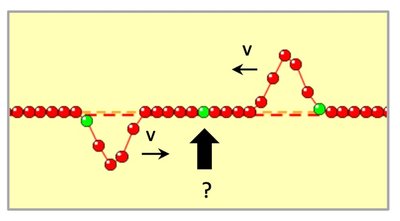
Q2. What happens to the spot on the string (indicated by the arrow) as an upward and a downward pulse overlap?
Background
Topic: Superposition Principle for Opposite Pulses
This question explores what happens when two pulses of equal magnitude but opposite direction (one upward, one downward) meet at the same point on a string.
Key Terms and Formulas
Destructive Interference: When two pulses of equal magnitude but opposite direction overlap, their amplitudes subtract, possibly canceling each other out.
Superposition Principle: The net displacement is the sum (with sign) of the individual displacements.
Step-by-Step Guidance
Identify the direction of each pulse: One is upward (positive displacement), the other is downward (negative displacement).
Apply the superposition principle: At the spot where they overlap, add the upward and downward displacements (with their signs).
If the pulses have equal magnitude, their displacements will cancel each other out, resulting in zero net displacement at the overlap point (complete destructive interference).
After the pulses pass through each other, each continues on its way, unchanged in shape or speed.
Try solving on your own before revealing the answer!
Final Answer:
The spot will remain at its equilibrium position (no displacement) while the pulses overlap, due to complete destructive interference.
This is because the upward and downward displacements exactly cancel each other out at the point of overlap.
