 Back
BackThe Magnetic Field: Properties, Sources, and Applications
Study Guide - Smart Notes
 Tailored notes based on your materials, expanded with key definitions, examples, and context.
The Magnetic Field
Magnetic Poles
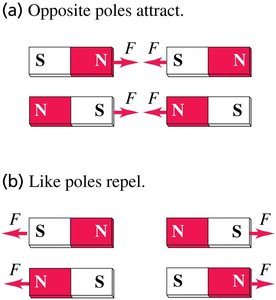
Magnets possess two distinct poles: the north pole (N) and the south pole (S). These poles are fundamental to the behavior of magnets and their interactions.
Opposite poles attract each other, while like poles repel each other.
When a bar magnet is free to rotate, its north pole points toward the Earth's geographic north.
Magnetic Poles Always Come in Pairs
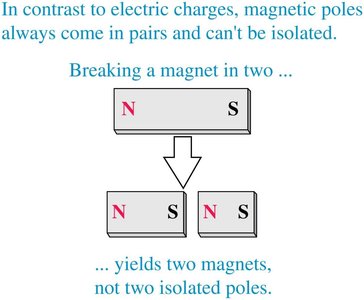
Unlike electric charges, magnetic poles cannot be isolated. If a magnet is broken in half, each piece forms a new north and south pole, resulting in two smaller magnets.
There is no experimental evidence for the existence of magnetic monopoles.
The Magnetic Field (\(\vec{B}\))
A magnetic field is a vector field produced by moving electric charges (currents) and magnetic materials. The field exerts forces on other moving charges and magnetic poles.
The direction of the magnetic field at a point is the direction a north pole would move if placed at that point.
The magnetic field is denoted by \(\vec{B}\).
Magnetic Field and Compass Needles
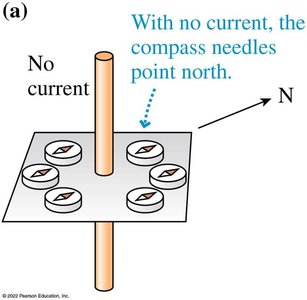
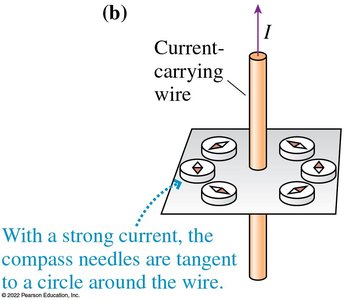
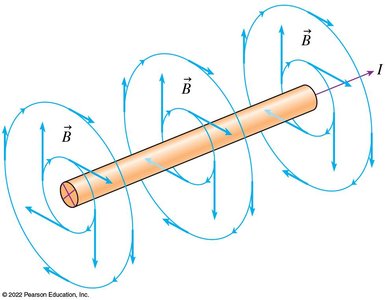
Compass needles align with the Earth's magnetic field. In the absence of current, they point north. When a current flows through a nearby wire, the compass needles align tangentially to circles around the wire, indicating the direction of the magnetic field produced by the current.
Force on Magnetic Poles
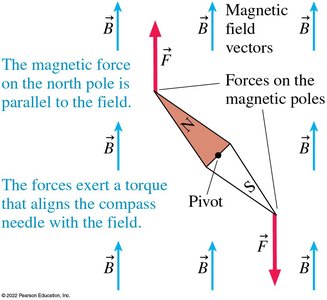
The magnetic field exerts a force on magnetic poles. The force on a north pole is parallel to \(\vec{B}\), while the force on a south pole is opposite to \(\vec{B}\). This force creates a torque that aligns a compass needle with the field.
Magnetic Field Lines
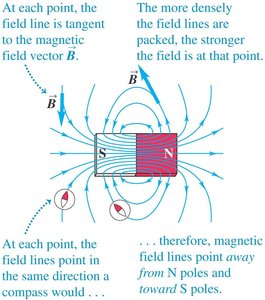
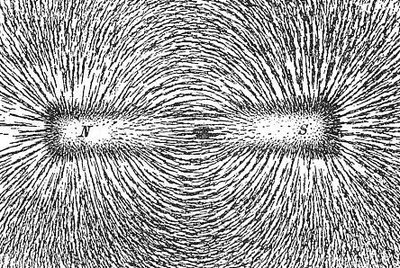
Magnetic field lines are imaginary lines used to represent the direction and strength of the magnetic field. The field is tangent to these lines at every point, and the density of the lines indicates the field's strength.
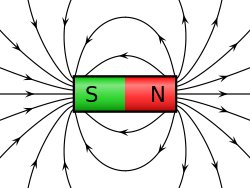
Field lines emerge from the north pole and enter the south pole outside the magnet.
Inside the magnet, field lines run from south to north, forming closed loops.
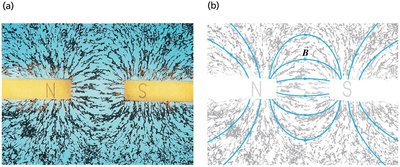
Iron filings align along magnetic field lines, making them visible in experiments.
The Earth's Magnetic Field
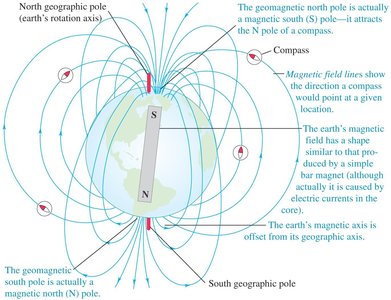
The Earth itself acts as a giant magnet, with a magnetic field similar to that of a bar magnet. The geomagnetic north pole is actually a magnetic south pole, as it attracts the north pole of a compass.
The Earth's magnetic axis is offset from its geographic axis.
The field lines show the direction a compass would point at various locations on Earth.
Units of the Magnetic Field
The SI unit of the magnetic field is the tesla (T):
\(1\ \mathrm{T} = 1\ \mathrm{N}/(\mathrm{A} \cdot \mathrm{m}) = 1\ \mathrm{N} \cdot \mathrm{s}/(\mathrm{C} \cdot \mathrm{m})\)
Another unit: gauss (G), where \(1\ \mathrm{G} = 10^{-4}\ \mathrm{T}\).
Magnetic Field of a Moving Charge
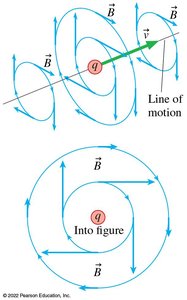
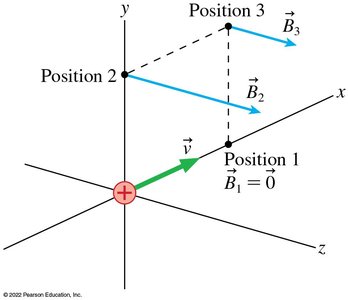
A moving charge generates a magnetic field whose direction depends on the velocity of the charge. The field forms concentric circles around the path of the moving charge.
The direction of the field can be determined by the right-hand rule.
Mathematical Expression for the Magnetic Field of a Moving Charge
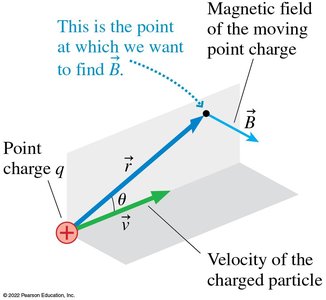
The magnetic field \(\vec{B}\) at a point due to a charge \(q\) moving with velocity \(\vec{v}\) is given by:
\(\mu_0\) is the vacuum permeability:
This formula is valid for speeds much less than the speed of light.
Example: Magnetic Field at Various Positions
Consider a proton moving with velocity \(\vec{v} = 1.0 \times 10^7 \hat{i}\) m/s. The magnetic field at different positions can be calculated using the above formula. The direction and magnitude depend on the position relative to the moving charge.
Magnetic Field of a Current Element: The Biot-Savart Law
The Biot-Savart Law gives the magnetic field produced by a small segment of current-carrying wire:
The total field is the vector sum (integral) of the contributions from all current elements.
This law is valid for steady currents.
Example: Magnetic Field of a Current Segment
For a wire carrying a current, the magnetic field at a point can be calculated using the Biot-Savart law. The direction of the field is given by the right-hand rule for the cross product.
Magnetic Field of a Long Straight Conductor
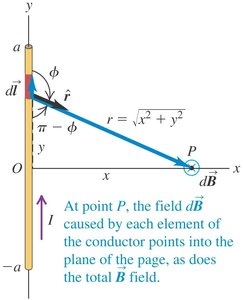
Applying the Biot-Savart law to a long straight wire yields:
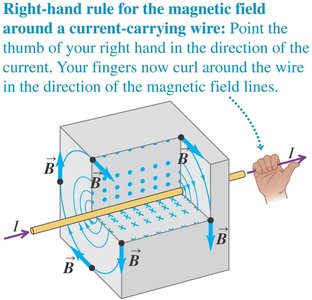
The field forms concentric circles around the wire.
The direction is given by the right-hand rule: thumb in the direction of current, fingers curl in the direction of the field.
Magnetic Field of Parallel Wires
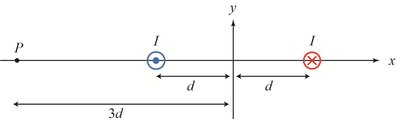
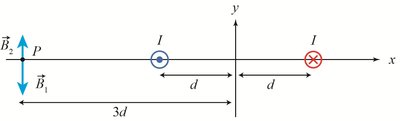
Two parallel wires carrying currents produce magnetic fields that interact. The net field at a point is the vector sum of the fields from each wire.
Magnetic Field of a Circular Current Loop
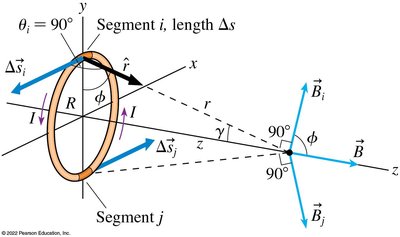
The Biot-Savart law can be used to calculate the field at the center of a circular loop of radius \(R\) carrying current \(I\):
For \(N\) loops, at the center.
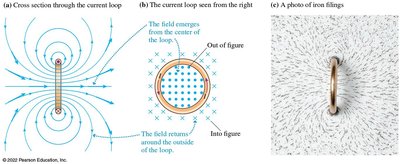
Magnetic Dipoles and Dipole Moment
A small current loop behaves as a magnetic dipole. The magnetic dipole moment \(\vec{\mu}\) is defined as:
\(N\): number of turns, \(I\): current, \(\vec{A}\): area vector (perpendicular to the loop).
The field of a dipole at a distance \(z\) on its axis is:
Summary Table: Key Magnetic Field Formulas
Configuration | Magnetic Field (B) |
|---|---|
Long straight wire | |
Center of circular loop | |
Solenoid (inside) | |
Magnetic dipole (on axis) |
*Additional info: The above table summarizes the most important magnetic field equations for common geometries, which are essential for problem-solving in electromagnetism.*
