Back
BackThe Nucleus of the Atom and Nuclear Physics
Study Guide - Smart Notes
 Tailored notes based on your materials, expanded with key definitions, examples, and context.
The Nucleus of the Atom
Discovery of Radioactivity
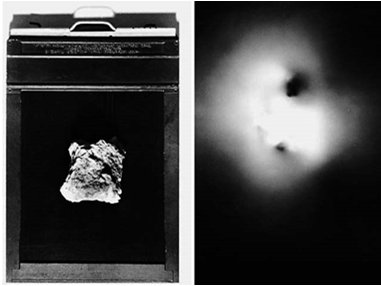
Radioactivity was discovered by Henri Becquerel in 1896 when he observed that uranium salts emitted invisible radiation that could expose photographic film. This phenomenon was named radioactivity, and materials that emitted such radiation were termed radioactive materials.
Radioactivity is the spontaneous emission of particles or energy from an atomic nucleus as it disintegrates.
Radioactive decay is the process by which an unstable nucleus loses energy by emitting radiation.
Types of Radioactivity
Ernest Rutherford identified three main types of radioactive emissions:
Alpha particles (α): Helium nuclei (2 protons, 2 neutrons), positively charged and relatively massive.
Beta particles (β): High-energy electrons (β-) or positrons (β+), less massive and negatively or positively charged.
Gamma rays (γ): Electromagnetic radiation with very short wavelength and high energy, uncharged.
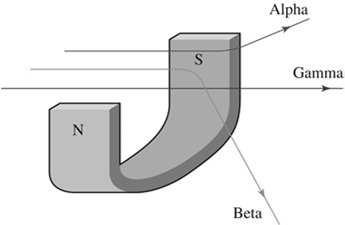
When passed through a magnetic field, these radiations behave differently due to their charge and mass:
Alpha particles are deflected in one direction (positive charge, large mass).
Beta particles are deflected in the opposite direction (negative charge, small mass).
Gamma rays are not deflected (neutral).
Structure of the Nucleus
Nucleons and Isotopes
The nucleus contains two types of subatomic particles: protons and neutrons, collectively called nucleons. The number of protons (Z) determines the element, while the total number of nucleons (A = Z + N) gives the atomic mass.
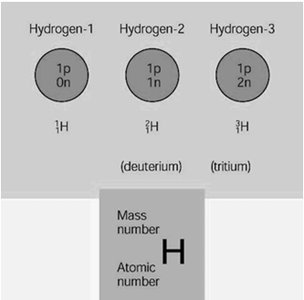
Isotopes are atoms of the same element (same Z) with different numbers of neutrons (N), thus different atomic masses (A).
Examples: Hydrogen-1 (protium), Hydrogen-2 (deuterium), and Hydrogen-3 (tritium).
Band of Stability
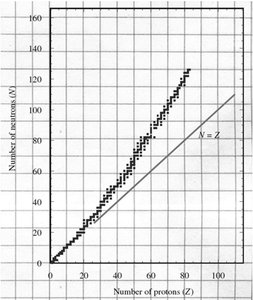
Stable nuclei are found within a specific range of neutron-to-proton ratios, known as the band of stability. Nuclei outside this band are radioactive and tend to decay toward stability.
Radioactive Decay and Nuclear Reactions
Radioactive Decay
All isotopes with atomic number greater than 83 are unstable and radioactive.
Isotopes with certain numbers of protons or neutrons (2, 8, 20, 28, 50, 82, 126) are especially stable.
Radioactive decay transforms an unstable nucleus into a more stable one, often emitting particles or energy.
Balancing Nuclear Reactions
Nuclear reactions must conserve both the number of nucleons and the total charge (atomic number).
Half-Life
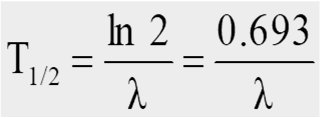
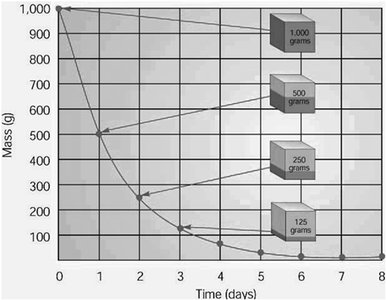
The half-life (T1/2) of a radioactive substance is the time required for half of the nuclei in a sample to decay. The decay constant (λ) is specific to each isotope.
The relationship is given by:
Radioactive decay follows an exponential law, as shown in the graph below:
Types of Radioactive Decay
Alpha Decay
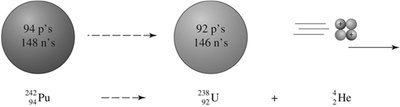
In alpha decay, the nucleus emits an alpha particle (α), reducing its atomic number by 2 and its mass number by 4.
Example:
Beta Decay
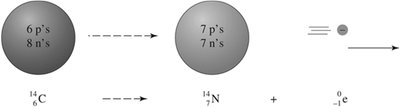
In beta decay, a neutron transforms into a proton, emitting an electron (β-) and an antineutrino, or a proton transforms into a neutron, emitting a positron (β+) and a neutrino. The atomic number changes by one, but the mass number remains the same.
Example:
Gamma Decay
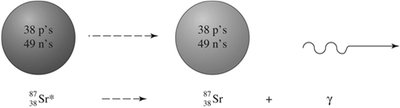
In gamma decay, the nucleus releases excess energy as a gamma photon (γ), without changing its atomic number or mass number.
Example:
Penetrating Power of Radiation
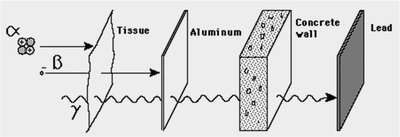
The ability of radiation to penetrate materials varies:
Alpha particles: Stopped by paper or skin.
Beta particles: Penetrate paper, stopped by a few millimeters of aluminum.
Gamma rays: Highly penetrating, require thick lead or concrete for shielding.
Radioactive Decay Series
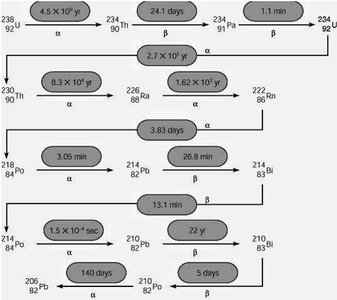
Some heavy nuclei decay through a series of steps, each with its own half-life, until a stable nucleus is formed. The uranium-238 decay series is a classic example.
Units of Radioactivity
Unit | Definition |
|---|---|
Becquerel (Bq) | 1 decay per second |
Curie (Ci) | 3.7 × 10¹⁰ decays per second |
rad | 0.01 J of energy absorbed per kg of tissue |
Gray (Gy) | 1 J of energy absorbed per kg of tissue (1 Gy = 100 rad) |
rem | Roentgen Equivalent Man (biological effect) |
Sievert (Sv) | 1 Sv = 100 rem (biologically equivalent dose) |
Applications of Radioactivity
Carbon Dating
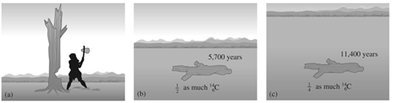
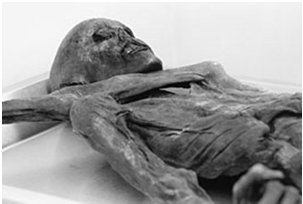
Carbon-14 dating is used to determine the age of formerly living things. Cosmic rays convert nitrogen-14 to carbon-14 in the atmosphere. Living organisms maintain a constant ratio of C-14 to C-12, but after death, C-14 decays with a half-life of 5730 years. Measuring the remaining C-14 allows scientists to estimate the time since death.
Biological Effects of Radiation
Ionizing Radiation
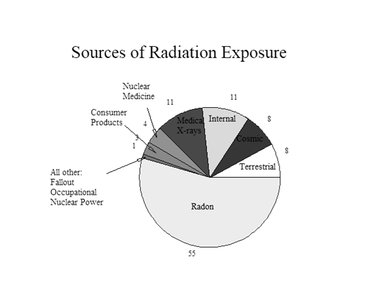
Ionizing radiation has enough energy to remove electrons from atoms, potentially damaging or killing biological cells. The biological effect depends on the type and amount of radiation absorbed.
Sources of exposure include cosmic rays, radon, medical procedures, and consumer products.
There is no minimum safe dose; exposure should be minimized.
Nuclear Binding Energy
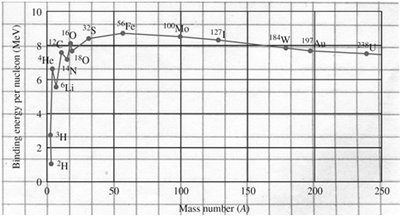
The mass of a nucleus is less than the sum of its constituent nucleons. The difference, called the mass defect (Δm), is converted to binding energy according to Einstein's equation:
The binding energy per nucleon peaks around iron (A ≈ 56), making both fission of heavy nuclei and fusion of light nuclei energetically favorable.
Nuclear Fission
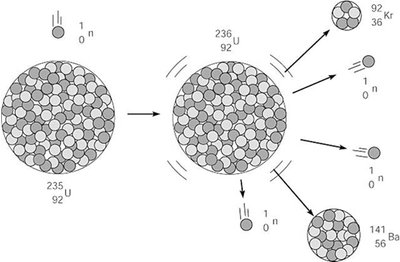
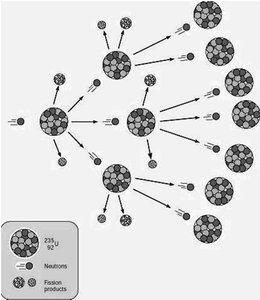
Nuclear fission is the splitting of a heavy nucleus into two lighter nuclei, releasing energy and additional neutrons. These neutrons can induce further fission, leading to a chain reaction.
Example:
Nuclear Power
Nuclear reactors use controlled fission chain reactions to generate energy for electricity production. The fuel is typically enriched uranium (3% U-235, 97% U-238).
Nuclear Fusion
Nuclear fusion is the process of combining two light nuclei to form a heavier nucleus, releasing energy. Fusion powers the Sun and other stars.
Example (solar fusion):
Example (energy research):
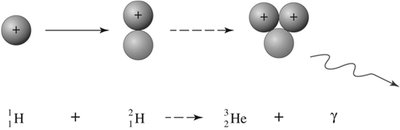
Fusion requires extremely high temperatures and pressures to overcome the electrostatic repulsion between protons.
Formation of Elements in Stars
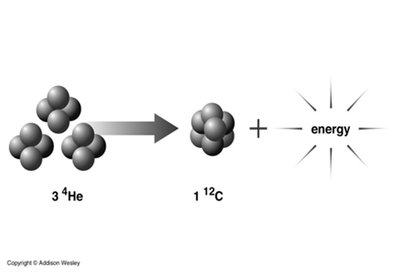
Fusion reactions in stars create heavier elements. For example, three helium nuclei can fuse to form carbon in the cores of stars and during supernovae.