 Back
BackThe Nucleus of the Atom and Nuclear Physics
Study Guide - Smart Notes
 Tailored notes based on your materials, expanded with key definitions, examples, and context.
The Nucleus of the Atom
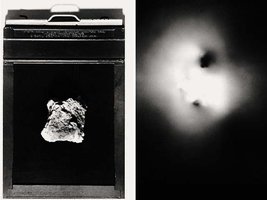
Discovery of Radioactivity
Radioactivity was discovered by Henri Becquerel in 1896 when he observed that uranium salts emitted invisible radiation that could expose photographic film. This phenomenon was named radioactivity, and materials that emitted such radiation were termed radioactive materials.
Radioactivity: The spontaneous emission of particles or energy from an atomic nucleus as it disintegrates.
Radioactive decay: The process by which an unstable atomic nucleus loses energy by emitting radiation.
Types of Radioactivity
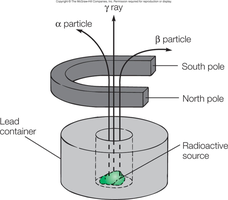
Ernest Rutherford identified three types of radioactivity:
Alpha particles (α): Helium nuclei (2 protons, 2 neutrons), positively charged.
Beta particles (β): High-energy electrons, negatively charged.
Gamma rays (γ): Electromagnetic radiation with very short wavelength and high energy, neutral.
When passed through a magnetic field:
α particles are deflected one way (positive charge).
β particles are deflected the opposite way (negative charge).
γ rays are not deflected (neutral).
Structure of the Nucleus
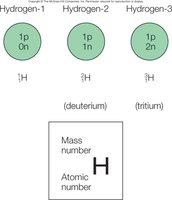
The nucleus contains two types of subatomic particles called nucleons:
Protons: Positively charged particles.
Neutrons: Neutral particles.
The strong nuclear force binds protons and neutrons together, overcoming the repulsive Coulomb force between protons.
Atomic number (Z): Number of protons; determines the element.
Mass number (A): Total number of protons and neutrons; .
Isotopes: Atoms of the same element (same Z) with different numbers of neutrons (different A).
Band of Stability
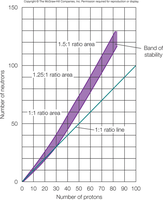
The band of stability refers to the range of neutron-to-proton ratios that result in stable nuclei. As nuclei get larger, a higher neutron-to-proton ratio is required for stability. Nuclei outside this band are radioactive.
Nuclear Equations and Reactions
Writing Nuclear Equations
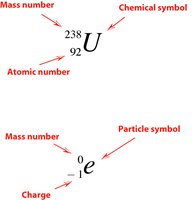
Nuclear reactions are represented by equations that must conserve both charge and mass number. The notation for nuclear particles includes the chemical symbol, atomic number, and mass number.
Balancing Nuclear Equations
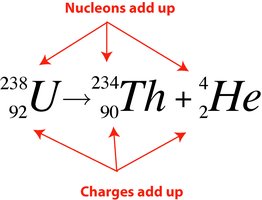
The sum of atomic numbers (charges) and mass numbers (nucleons) must be equal on both sides of the equation.
Types of Nuclear Reactions
Alpha decay: Emission of an alpha particle; atomic number decreases by 2, mass number by 4.
Beta decay: Neutron transforms to a proton, emitting an electron (β-) and an antineutrino, or a proton transforms to a neutron, emitting a positron (β+) and a neutrino.
Gamma decay: Emission of a gamma photon as the nucleus transitions from an excited state to a lower energy state.
Radioactive Decay and Half-Life
Half-Life
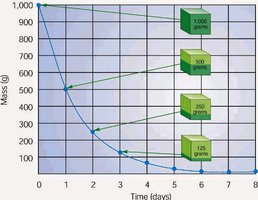
The half-life of a radioactive substance is the time required for half of the nuclei in a sample to decay. The decay constant () is specific to each isotope.
Half-lives can range from fractions of a second to billions of years.
Types of Radioactive Decay
Alpha Decay
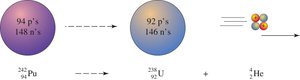
In alpha decay, the parent nucleus emits an alpha particle, resulting in a daughter nucleus with atomic number reduced by 2 and mass number by 4.
Beta Decay
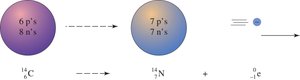
In beta decay, a neutron transforms into a proton, emitting a beta particle (electron) and an antineutrino, or a proton transforms into a neutron, emitting a positron and a neutrino. The atomic number changes by ±1, but the mass number remains the same.
Gamma Decay
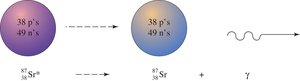
Gamma decay involves the emission of a gamma photon as the nucleus transitions from a higher to a lower energy state. There is no change in atomic or mass number.
Penetrating Power of Radiation
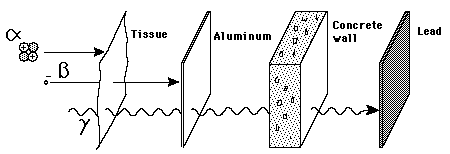
The ability of radiation to penetrate materials varies:
Alpha particles: Least penetrating; stopped by paper or skin.
Beta particles: More penetrating; stopped by a few millimeters of aluminum.
Gamma rays: Most penetrating; require several centimeters of lead or concrete for shielding.
Radioactive Series and Applications
Radioactive Decay Series
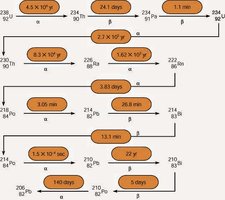
Some heavy nuclei decay through a series of steps, each with its own half-life, until a stable nucleus is formed. For example, uranium-238 decays through multiple steps to lead-206.
Carbon Dating
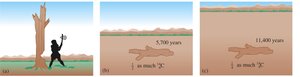
Carbon-14 dating is used to determine the age of formerly living things. Cosmic rays convert nitrogen-14 to carbon-14 in the atmosphere. Living organisms maintain a constant ratio of C-14 to C-12, but after death, C-14 decays with a half-life of 5730 years. Measuring the remaining C-14 allows determination of the time since death.

Biological Effects and Measurement of Radiation
Biological Effects
Ionizing radiation can damage or kill biological cells by ionizing atoms in macromolecules such as DNA. The severity depends on the type and amount of radiation.
Ionizing radiation: Has enough energy to remove tightly bound electrons from atoms, creating ions.
Radiation dose: Measured in rems (roentgen equivalent man), accounting for both the amount and biological effect of radiation.
Nuclear Energy: Mass-Energy Equivalence and Binding Energy
Mass Defect and Binding Energy
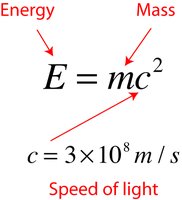
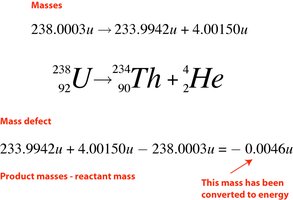
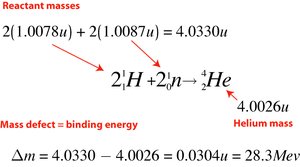
The mass of a nucleus is less than the sum of the masses of its individual nucleons. This difference, called the mass defect (), is converted to binding energy that holds the nucleus together, as described by Einstein's equation:
Fission and Fusion
Nuclear fission: Splitting a heavy nucleus into smaller nuclei, releasing energy.
Nuclear fusion: Combining light nuclei to form a heavier nucleus, also releasing energy.
The maximum binding energy per nucleon occurs near iron (A ≈ 56). Fission of heavy nuclei and fusion of light nuclei both release energy due to increased binding energy per nucleon.
Nuclear Fission
Fission Process and Chain Reactions
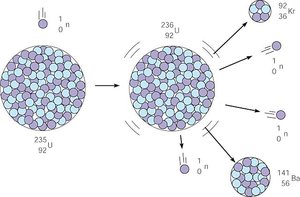
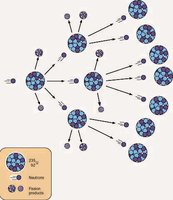
When a heavy nucleus such as uranium-235 absorbs a neutron, it becomes unstable and splits into two smaller nuclei, releasing additional neutrons and energy. These neutrons can induce further fission, resulting in a chain reaction.
Nuclear Reactors
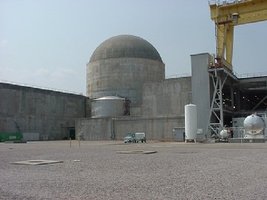
Nuclear reactors control the fission chain reaction to produce energy safely. They use enriched uranium fuel and various safety mechanisms to regulate the reaction.
Applications of Nuclear Physics
Medical Applications
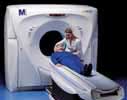
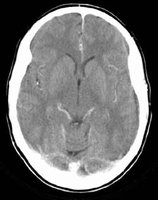
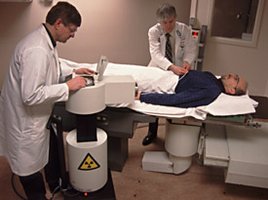
Radiation is used in medicine for both diagnosis (e.g., PET scans, CT scans) and treatment (e.g., cancer radiotherapy).
Industrial Applications
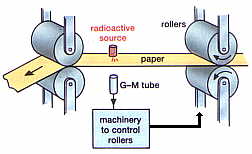
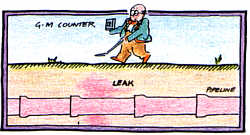
Radiation is used in industry for thickness gauging, leak detection, and imaging to inspect materials for flaws.
Consumer Products
Smoke detectors use radioactive sources to detect smoke.
Radiation is used to treat non-stick pans, computer disks, gemstones, and for sterilization of food and medical supplies.



Nuclear Fusion
Fusion in Stars and Energy Research
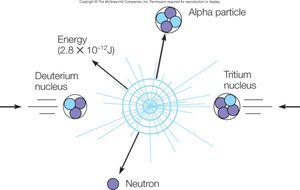
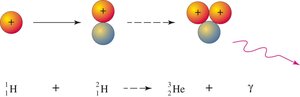
Nuclear fusion is the process by which two light nuclei combine to form a heavier nucleus, releasing energy. Fusion powers the Sun and other stars, and is being researched as a potential energy source on Earth.
Fusion requires extremely high temperatures and pressures to overcome electrostatic repulsion between nuclei.
Stellar Nucleosynthesis
Fusion reactions in stars create heavier elements, such as the formation of carbon from helium nuclei in supernovae.
